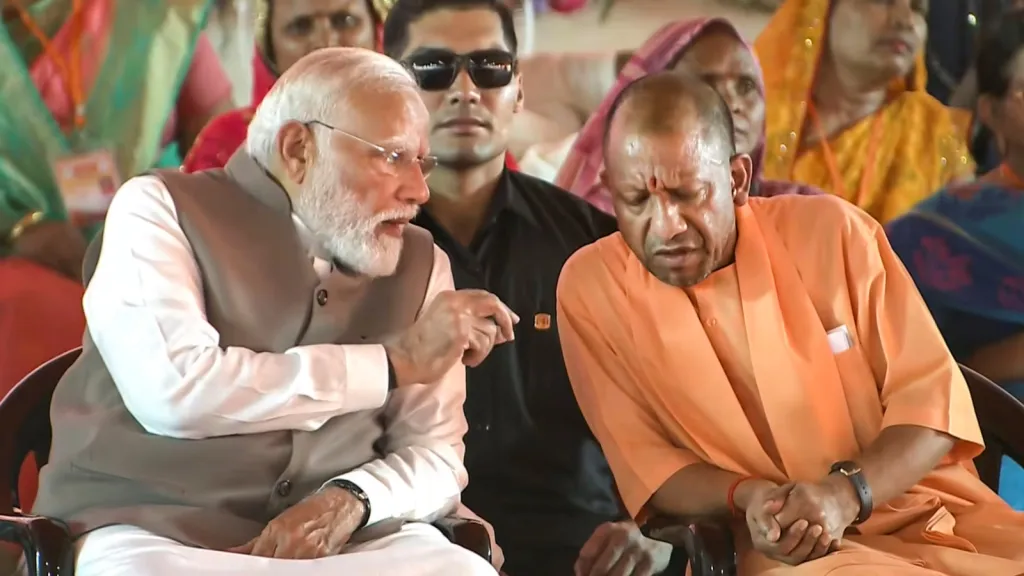
The Bharatiya Janata Party (BJP) has suffered a setback in Varanasi, Prime Minister Narendra Modi’s Lok Sabha constituency, as the Samajwadi Party (SP) has retained the teachers’ seat in the Uttar Pradesh Legislative Council Elections and established a strong lead in the graduates’ constituency.
Of the 11 Legislative Council seats in Uttar Pradesh covered by the elections, the BJP has won six and the Samajwadi Party four, while the result in the Varanasi graduates’ constituency remains awaited in the supplied report. If the SP secures the remaining seat, its tally will rise to five, compared with the two seats it won in the previous election.
The closely watched graduates’ constituency has become the centre of a tense standoff. Nearly 49 hours after counting began, BJP and SP leaders and workers were still present at the counting centre, with both sides raising allegations about irregularities in the process.
The contest has attracted attention beyond the immediate results because the Varanasi division includes eight districts with 47 Assembly constituencies. The outcome also comes amid public concerns about unemployment and paper leaks affecting candidates preparing for competitive examinations.
Although teachers’ and graduates’ constituencies do not represent the entire electorate, their results can offer an indication of political preferences among registered voters from these groups. For the BJP, the contest has also raised questions about campaign strategy, voter mobilisation and the party’s reliance on the popularity of its senior leaders.
Uttar Pradesh MLC Election Results: BJP Wins Six Seats
The Uttar Pradesh results have given the BJP a majority of the 11 seats covered by the election, but the Samajwadi Party has improved its position compared with the previous contest. The BJP has won six seats, while the SP has secured four, with the Varanasi graduates’ result still pending in the supplied account.
The Samajwadi Party’s performance is significant because it has retained the Varanasi teachers’ constituency and is ahead in the graduates’ seat. A victory in the latter would bring the party’s tally to five, more than doubling its previous total of two seats in this group of constituencies.
The prolonged counting in Varanasi has added uncertainty to the result. Both parties have mobilised workers at the counting centre, while their leaders have questioned aspects of the process and called for scrutiny of the final count.
The election has also renewed attention on how political parties engage with teachers, graduates and other registered voters who participate in these specialised constituencies. Organisational activity, voter registration and direct outreach can play an important role in contests where the electorate is narrower than in general Assembly elections.
Lal Bihari Yadav Retains Varanasi Teachers’ Constituency
The Samajwadi Party’s Lal Bihari Yadav retained the Varanasi teachers’ seat, defeating BJP candidate Pramod Kumar Mishra by 5,015 votes, according to the figures cited in the supplied report.
The result repeated the outcome of the 2020 election, when Yadav defeated Mishra, who had contested as an Independent, by a margin of 936 votes. Chet Narayan Singh, a sitting MLC who had received BJP support in 2020, contested as an Independent this time and finished third.
The wider margin compared with the previous election underlined the SP’s continued strength in the constituency. Yadav’s victory also gave the party an early win in Varanasi before the prolonged counting process in the graduates’ seat became the principal focus of the election.
The contest was particularly significant because the BJP had deployed senior leaders to campaign ahead of the polls. The loss of the teachers’ constituency in the Prime Minister’s parliamentary constituency added to the party’s challenges in the region.
Ashutosh Sinha Leads in the Graduates’ Constituency
The Varanasi graduates’ constituency became the centre of attention as counting continued over multiple rounds. Samajwadi Party candidate and sitting MLC Ashutosh Sinha established a comfortable lead over BJP candidate Kedar Nath Singh, whom he had defeated in the 2020 election.
In the earlier contest, Sinha had won by a margin of 3,850 votes. The latest figures cited in the supplied report indicated that his advantage was likely to be substantially larger this time, although the result was still awaited when the report was written.
Subsequent reports published on October 29 said Sinha won the graduates’ seat, completing the SP’s sweep of both Varanasi constituencies. This took the party’s tally in the 11 Uttar Pradesh Legislative Council constituencies to five, while the BJP retained six seats. :chatgpt-content-reference{index=”0″}
The result strengthened the SP’s position ahead of the 2027 Uttar Pradesh Assembly elections. It also meant the BJP was unable to dislodge the opposition party from either of the two Varanasi constituencies despite its campaign efforts.
A 49-Hour Battle of Nerves at the Counting Centre
The extended counting process in the graduates’ constituency produced a tense atmosphere, with BJP and SP leaders and workers maintaining a presence at the counting centre. Both parties raised allegations about irregularities, turning the wait for the final result into a political confrontation.
Samajwadi Party chief Akhilesh Yadav urged party workers not to leave the counting centre until they had received the victory certificate. In a post on X on Thursday morning, he appealed to local workers to arrange food, drinking water, umbrellas and towels for colleagues who had remained at the site.
Yadav also encouraged workers to maintain their morale and remain vigilant throughout the counting process. His message reflected the SP leadership’s concern that the result should be formally completed and the party’s candidate should receive the necessary certificate.
Earlier, Yadav had questioned the integrity of the process after reports emerged of a possible recount. In a post on X, he referred to people arriving at the counting centre with Gangajal, suggesting that officials should be asked to hold it as a test of their integrity.
The BJP candidate, Kedar Nath Singh, also raised objections. Late on Wednesday night, he demanded a recount, alleging anomalies in the counting process and attempts to manipulate the result.
These allegations were made by the political parties and candidates involved in the contest. They should not be treated as established findings of electoral misconduct without supporting evidence or an official determination.
The standoff demonstrated how a prolonged counting process can intensify tensions, particularly when the result has wider political significance. With both sides mobilising workers and questioning the procedure, the dispute became about not only the lead in the contest but also confidence in the final declaration.
Why the Varanasi Result Matters Beyond the City
The Varanasi division’s teachers’ and graduates’ constituencies cover eight districts: Ballia, Ghazipur, Jaunpur, Varanasi, Chandauli, Bhadohi, Mirzapur and Sonbhadra. Together, these districts contain 47 Assembly constituencies, making the region important to the political calculations of both the BJP and the SP.
In the 2022 Uttar Pradesh Assembly elections, the BJP-led National Democratic Alliance won 28 of these 47 seats. The BJP secured 22, while Apna Dal (S) and the Nishad Party won three each.
The Samajwadi Party won 14 Assembly seats in the region, while its then ally, the Suheldev Bharatiya Samaj Party led by Om Prakash Rajbhar, won four. The Bahujan Samaj Party secured the remaining seat.
Rajbhar’s party has since joined the NDA, and he is a cabinet minister in the Uttar Pradesh government. The changing alliance structure adds another dimension to the political landscape in the region.
The BJP has also given substantial representation to the eight districts in the state government, with nine cabinet ministers reportedly coming from the area. This political presence makes the party’s performance in Varanasi and the surrounding districts particularly relevant as it prepares for the next Assembly election.
However, the MLC results cannot be directly translated into a prediction about the Assembly election. Teachers’ and graduates’ constituencies have a different electorate and electoral structure from general Assembly seats. Their results provide a narrower indication of political support rather than a comprehensive measure of public opinion across the region.
Unemployment and Paper Leaks Form Part of the Political Context
The MLC results have drawn attention against the backdrop of concerns about unemployment and paper leaks affecting candidates preparing for competitive examinations.
These issues have remained politically sensitive in Uttar Pradesh, particularly among young people seeking government jobs and candidates investing time and money in recruitment examinations. Allegations of examination irregularities and delays can create frustration among aspirants who depend on fair and transparent selection processes.
Graduates’ and teachers’ constituencies offer a limited but relevant window into how some sections of the educated electorate respond to contemporary political and administrative concerns. Their voting patterns may reflect a combination of local candidate relationships, professional interests, party organisation and broader political issues.
Still, the results do not establish that unemployment or paper leaks alone determined the outcome in Varanasi. The supplied information does not provide voter surveys or constituency-level evidence that would identify the decisive issues behind the result.
The election therefore offers political signals that parties may examine, but the reasons for individual voting decisions cannot be determined from the result alone.
BJP Campaign Relied on Senior Leaders
The BJP deployed prominent leaders ahead of the Legislative Council elections, seeking to strengthen its position in the teachers’ and graduates’ constituencies.
Uttar Pradesh Chief Minister Yogi Adityanath addressed a gathering of teachers and graduates on October 14 as part of the party’s campaign. During the event, he described the Samajwadi Party as “anti-education” and accused its previous governments of corruption in government job recruitment.
Adityanath appealed to voters not to trust the party led by Akhilesh Yadav. The remarks placed education, recruitment and governance at the centre of the BJP’s campaign messaging.
Uttar Pradesh cabinet minister Suresh Khanna had also referred to the BJP’s losses in the 2020 election, attributing them to overconfidence. His comments indicated that the party was aware of the need to examine its performance in these specialised constituencies.
Despite the campaign by senior leaders, the BJP lost the Varanasi teachers’ seat and, according to subsequent reports, the graduates’ constituency as well. The results have prompted questions about whether the party’s campaign strategy adequately addressed the priorities of registered voters.
BJP Leaders Point to Overconfidence and Weak Voter Outreach
Following the setbacks, a senior BJP leader said overconfidence and negligence had again played a role in the party’s performance. The leader said a district-wise analysis of the votes would be undertaken.
Another party leader suggested that the Samajwadi Party’s organisational activity may have given it an advantage. According to the leader, SP workers were more active in ensuring that their supporters registered as voters.
The leader also argued that BJP candidates and the party organisation had relied too heavily on the popularity of Prime Minister Narendra Modi and Chief Minister Yogi Adityanath instead of engaging directly with voters.
These comments reflect the explanations offered by BJP leaders after the results. A detailed assessment of the party’s performance would require further examination of voter registration, turnout, local campaign activity and the candidates’ support bases.
The contest highlights the importance of constituency-level organisation even for parties with prominent national and state leaders. In elections involving specific groups of registered voters, direct outreach and mobilisation may be particularly important because the electorate is narrower than in general elections.
The Samajwadi Party’s gains suggest that it was able to maintain its position in Varanasi and improve its overall tally in the MLC contest. Whether the same factors influence the Assembly elections will depend on a different electorate, campaign environment and set of local contests.
What the Results Mean Ahead of the 2027 Assembly Elections
The Uttar Pradesh MLC results give both parties material to examine ahead of the 2027 Assembly elections. The BJP retained six of the 11 seats, while the SP increased its tally to five after winning the Varanasi graduates’ constituency.
For the BJP, the results underline the need to assess its performance in constituencies where the party had expected support from its wider political presence. Its overall tally remained unchanged from the six seats it held in 2020, but the distribution of seats and losses in key constituencies provide grounds for reviewing its strategy.
For the Samajwadi Party, the results offer a boost as it seeks to challenge the BJP in the state. Retaining the Varanasi teachers’ seat and winning the graduates’ constituency strengthened its position in a region represented in the Lok Sabha by Modi.
However, MLC elections and Assembly elections operate under different conditions. The graduates’ and teachers’ seats are determined by specialised electorates, whereas Assembly contests involve a much broader range of voters. The results should therefore be treated as an indication of party performance in these constituencies rather than a forecast of the next state election.
Conclusion
The Uttar Pradesh Legislative Council elections have delivered a setback for the BJP in Varanasi, where the Samajwadi Party retained the teachers’ constituency and went on to win the graduates’ seat after a prolonged counting process.
The nearly 49-hour wait for the graduates’ result was marked by allegations of irregularities, demands for a recount and calls from Akhilesh Yadav for party workers to remain at the counting centre until the victory certificate was issued. The allegations added to the tension but do not, by themselves, establish that the counting process was manipulated.
The SP’s final tally of five seats, against the BJP’s six, gives the opposition party a boost ahead of the 2027 Uttar Pradesh Assembly elections. For the BJP, the results have prompted questions about overconfidence, voter registration and the effectiveness of relying on the popularity of senior leaders instead of sustained local outreach.
Although these MLC results cannot determine the outcome of the next Assembly election, the contest in Varanasi offers both parties an opportunity to reassess their organisation and engagement with voters before the next major electoral test.
For breaking news and live news updates, like us on Facebook or follow us on Twitter and Instagram. Read more on Latest India on thefoxdaily.com.




COMMENTS 0