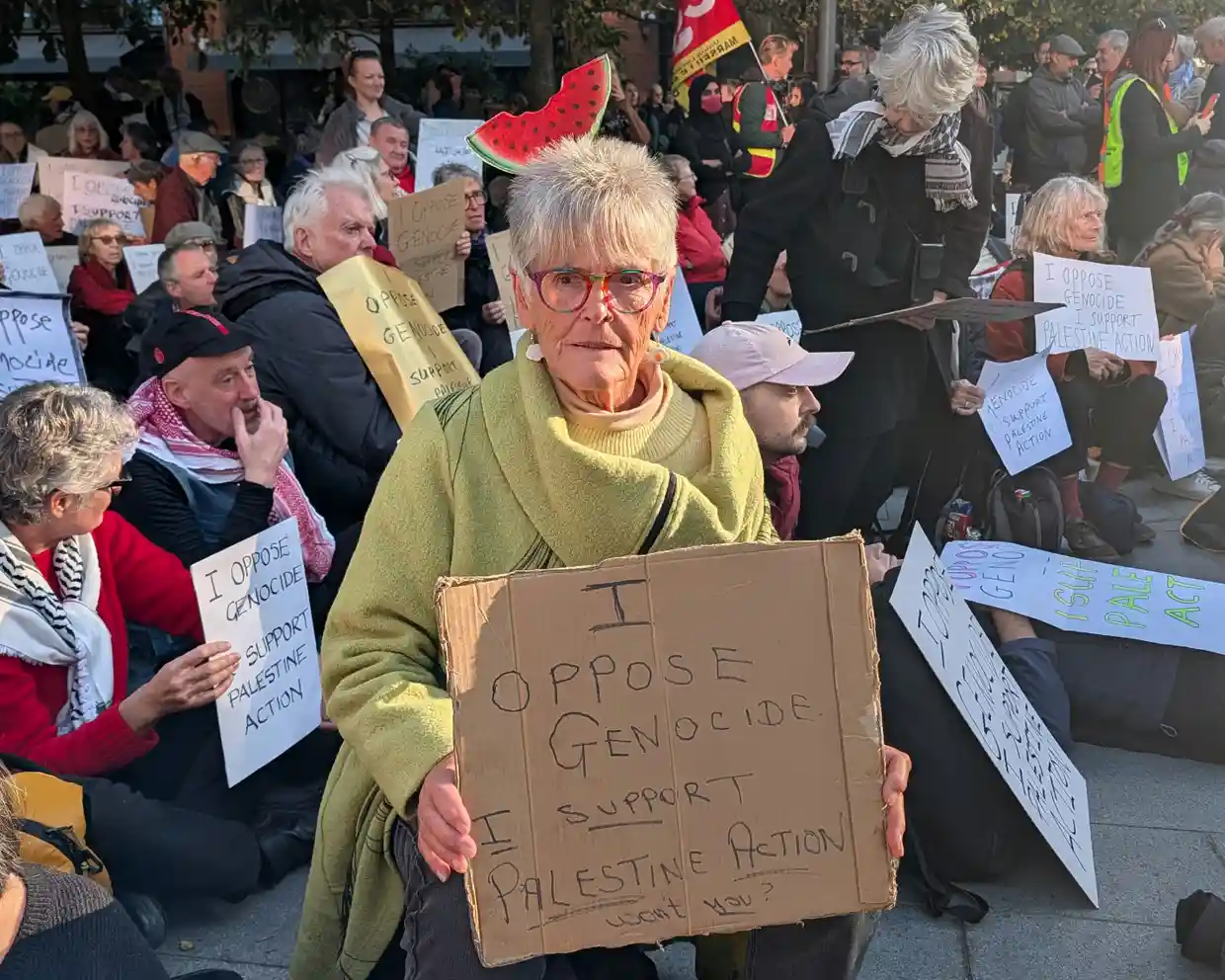
Police arrested 48 people during a demonstration outside the US embassy in Battersea, south London, on October 31, as protesters gathered to oppose the UK government’s ban on Palestine Action. The demonstration, organised by campaign group Defend Our Juries, took place days before a Supreme Court hearing challenging the group’s designation as a terrorist organisation.
Hundreds of people gathered outside the embassy holding placards reading, “I oppose genocide, I support Palestine Action.” The Metropolitan Police had warned in advance that participants could face arrest for expressing support for the proscribed organisation, as well as for organising or providing logistical assistance to the event.
The police operation became the focus of a wider dispute over the government’s use of terrorism legislation, the right to peaceful protest and the legal restrictions imposed following Palestine Action’s proscription in July 2025. Organisers accused the authorities of responding excessively, while police said they were enforcing the law.
Metropolitan Police Confirm 48 Arrests
The Metropolitan Police confirmed on social media that 48 people had been arrested during the London demonstration. The force said the majority of arrests were for expressing support for a proscribed organisation.
Commander Adam Slonecki, who was leading the policing operation, defended the force’s approach before the protest. He said people attending the gathering were aware that supporting Palestine Action was unlawful under the current legislation.
“All those intending on coming to this event know that supporting a proscribed organisation is unlawful – they are essentially meeting to purposefully commit a crime.”
Before the demonstration, the Met warned that its enforcement action would not be limited to people displaying placards. It said individuals considered to be playing a key role in organising the event, giving instructions to others or providing logistical support could also face arrest.
The force described its approach as a robust policing operation. Officers were deployed around the embassy area as demonstrators gathered, and arrests began during the afternoon.
Protesters Gather Outside US Embassy in Battersea
The demonstration took place outside the US embassy in Battersea, south London. Participants sat outside the building holding signs that directly connected their opposition to the war in Gaza with their support for Palestine Action.
Defend Our Juries estimated that around 400 people had gathered to take part. The group criticised the police response, accusing the Metropolitan Police of being more concerned about avoiding embarrassment for the United States than facilitating the right to protest.
The campaign group said the demonstration was intended to challenge the government’s decision to proscribe Palestine Action and draw attention to the consequences of the ban for freedom of expression and assembly.
A separate vigil was also held outside the US consulate in Edinburgh. The gathering showed that opposition to the proscription was not confined to London, although the scale and police response differed between the two locations.
Demonstrators Say They Are Opposing Genocide and Supporting Palestine
Among those taking part in the London protest was 79-year-old retiree Sue Morhall, who held a placard expressing support for Palestine Action. She said she wanted political leaders, including US President Donald Trump, to understand the strength of public opposition to the situation in Gaza.
Morhall criticised the role of the United States in international conflicts and said she believed there was a possibility that the new government under Prime Minister Andy Burnham could reconsider the proscription. She acknowledged that such a change might be unlikely but said she remained hopeful.
She also said she had previously been arrested five or six times at demonstrations and was prepared to face arrest again. For her, participation was a matter of principle and a way to express opposition to what she described as the criminalisation of people attempting to stop genocide.
The Rev Bill White, 72, was another demonstrator holding a sign supporting Palestine Action. He said he was appalled by Britain’s role in the conflict and accused the UK of supplying weapons used against Palestinians.
White said he had expected a different approach from Burnham and had resigned from the Labour Party after Palestine Action was proscribed. He described taking part in the demonstration as a moral responsibility, arguing that people seeking to prevent genocide should not be criminalised.
Defend Our Juries Accuses Police of Overreach
Defend Our Juries criticised the Metropolitan Police’s handling of the demonstration, describing the operation as excessive. A spokesperson for the group said the arrests exposed how far UK authorities were prepared to go to accommodate American interests.
The organisers also linked their protest to the role of the United States in Israel’s military operations in Gaza. They argued that American political and military support was central to the continuation of the conflict.
The police and organisers therefore presented sharply different accounts of the purpose and legality of the gathering. Defend Our Juries described it as an act of protest against a controversial ban, while the Met maintained that expressing support for a proscribed organisation could amount to a criminal offence.
The distinction is central to the legal dispute. The right to demonstrate and criticise government policy remains protected, but the proscription of Palestine Action creates specific restrictions on expressing support for the organisation under the Terrorism Act 2000.
Why Palestine Action Was Banned
Palestine Action was proscribed under the Terrorism Act 2000 in July 2025. The decision followed a series of direct-action activities by the group, including an incident at RAF Brize Norton in which activists entered the military airbase and damaged two aircraft.
The government argued that the group’s activities justified its designation under terrorism legislation. Once the proscription order came into force on July 5, 2025, membership of or support for the organisation became subject to criminal restrictions.
Under the legislation, inviting support for a proscribed organisation can constitute an offence. The law also covers certain forms of arranging or addressing meetings in support of such an organisation. The maximum penalty for some offences under the relevant provisions can reach 14 years in prison.
Supporters of Palestine Action and civil liberties campaigners have challenged the breadth and proportionality of the ban. They argue that it risks criminalising peaceful political expression and activities that would ordinarily fall within the scope of protest.
Supreme Court Appeal Scheduled for November 4
The October 31 demonstration took place ahead of a major legal hearing at the UK Supreme Court on November 4 and 5. The case, brought by Palestine Action co-founder Huda Ammori, challenges the legality of the government’s decision to proscribe the organisation.
The Supreme Court case is listed as R (on the application of Ammori) v Secretary of State for the Home Department. The central question is whether the Home Secretary’s decision to proscribe Palestine Action under Section 3 of the Terrorism Act 2000 was lawful. :chatgpt-content-reference{index=”0″}
The legal challenge has already passed through several stages. In February 2026, the High Court ruled that the government’s decision was unlawful, finding problems with the way the Home Secretary had applied the proscription policy and concluding that the ban was disproportionate in relation to freedom of expression and assembly.
The government appealed. In June 2026, the Court of Appeal overturned the High Court’s decision and ruled that the proscription was lawful. It considered the balance between individual rights, including freedom of speech and assembly, and the government’s responsibilities concerning national security and public protection.
The Supreme Court appeal will examine the legal questions raised by the case. The outcome could have implications for the continuing restrictions on Palestine Action and for people facing proceedings connected with alleged expressions of support for the organisation. :chatgpt-content-reference{index=”1″}
More Than 160 Arrested at Earlier Liverpool Demonstration
The London protest was not the first large-scale demonstration against the ban in recent weeks. Last month, more than 160 people were arrested or reported for summons during a similar action outside the Labour Party conference in Liverpool.
Those demonstrations were also organised by Defend Our Juries and involved participants displaying messages in support of Palestine Action. The repeated arrests have intensified debate about how the proscription is being enforced and whether the law is being applied too broadly to peaceful demonstrators.
Police have maintained that their actions are based on the legal status of Palestine Action and the restrictions that apply to proscribed organisations. Campaigners, meanwhile, argue that the arrests demonstrate the chilling effect the ban may have on public discussion and political protest.
New Government Faces Pressure Over the Proscription
The new government has faced calls to reverse the ban, with campaigners and some political figures arguing that the decision should be reconsidered. However, Home Secretary Shabana Mahmood has continued to support the proscription and remained in her position under the new administration.
The controversy has also extended into cultural and public life. Journalist and author Sarah Helm, the wife of the prime minister’s national security adviser Jonathan Powell, attracted criticism after posting on X that authors who support Palestine and Palestine Action should be protected.
Her comments followed reports that Irish author Sally Rooney could no longer sell her books in the UK because of her support for the group. The issue prompted questions about how the legal restrictions might affect writers, publishers and others expressing political views.
Helm’s post was later examined in the context of the law, but the Metropolitan Police assessed that it did not meet the criminal threshold. A woman carrying a placard that adapted Helm’s message by replacing the word “authors” with “retirees” was among those arrested at the London demonstration.
Ed Miliband Also Challenged Over Palestine Action Arrests
The issue had previously surfaced during the Labour Party conference in Liverpool, where two activists confronted Foreign Secretary Ed Miliband while he was having a meal at a Pizza Express restaurant in the city centre.
Video of the encounter showed one protester urging Miliband to describe the situation in Gaza as genocide and asking him to support the removal of Palestine Action’s proscription. Miliband said he was willing to discuss the matter but suggested doing so at another time. The protesters were subsequently ushered out of the restaurant.
The confrontation illustrated the pressure facing Labour figures over the government’s position on the ban and Britain’s response to the conflict in Gaza.
Edinburgh Vigil Adds to Nationwide Opposition
Alongside the London demonstration, activists held a vigil outside the US consulate in Edinburgh. The gathering formed part of the same campaign against Palestine Action’s proscription and was intended to draw attention to the restrictions on public expressions of support for the group.
According to the Associated Press, no arrests were immediately reported at the Edinburgh event, although police were reviewing evidence and could consider further action. The London operation, by contrast, resulted in 48 arrests, most of them linked to expressing support for the proscribed organisation. :chatgpt-content-reference{index=”2″}
What Happens After the London Arrests?
The 48 arrests have added another chapter to the dispute over the UK’s treatment of Palestine Action and the enforcement of terrorism legislation. Those arrested may face further investigation, with the specific allegations and decisions on possible charges depending on the evidence gathered by police.
The Metropolitan Police’s position is that officers are required to enforce the law while the proscription remains in force. Defend Our Juries and other opponents of the ban argue that the law places disproportionate restrictions on peaceful protest and political expression.
The Supreme Court hearing on November 4 and 5 is now a key moment in the dispute. It will examine the legal basis of the proscription, while the arrests outside the US embassy have brought the practical consequences of the ban back into public focus.
Palestine Action Ban Remains at the Centre of a Free Speech Debate
The demonstration in Battersea brought together people from different backgrounds who said they were prepared to risk arrest to oppose the government’s decision. Their messages focused on Gaza, Britain’s foreign policy and the right to express support for a group that has been proscribed under terrorism legislation.
For the police, the issue is enforcement of a law that remains in effect following the Court of Appeal’s ruling. For campaigners, the arrests represent a serious restriction on freedom of expression and peaceful assembly.
With the Supreme Court appeal approaching, the legal status of Palestine Action and the limits of protest under the Terrorism Act are set to receive renewed scrutiny. The outcome could shape the next stage of the dispute, but until the courts or government change the position, the existing proscription and its associated restrictions remain in force.
For breaking news and live news updates, like us on Facebook or follow us on Twitter and Instagram. Read more on Latest World on thefoxdaily.com.





COMMENTS 0