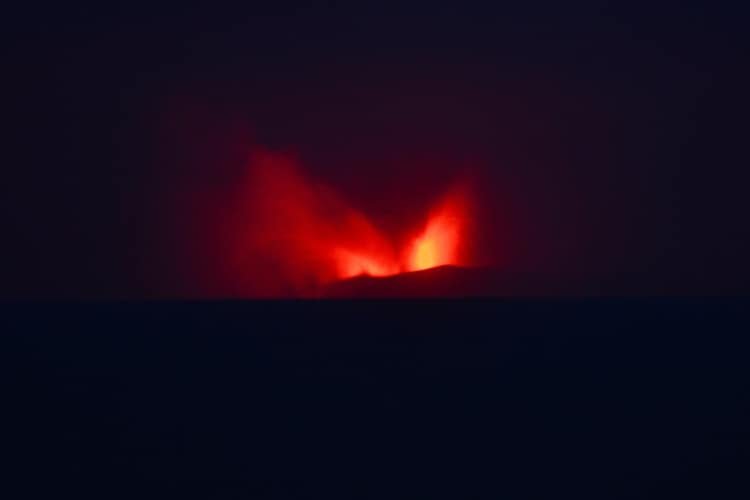
Indonesia’s Anak Krakatau volcano erupted on Sunday, sending volcanic ash across parts of western Indonesia and disrupting air Travel at Soekarno-Hatta International Airport in Jakarta. The eruption temporarily halted airport operations and affected 209 flight movements, leaving thousands of passengers facing cancellations, delays and rescheduling.
The volcanic activity began after Anak Krakatau showed increased signs of activity in the preceding days. Indonesia’s geological authorities have continued to monitor the volcano closely because of the island’s history of powerful eruptions and tsunami-generating activity.
The eruption itself lasted roughly 30 seconds during an early-morning event, with monitoring cameras recording bright lava activity at the volcano. Ash clouds subsequently spread over areas of Jakarta, Banten, West Java and several parts of Sumatra.
There were no immediate reports of deaths or injuries and authorities did not order a mass evacuation. However, residents, tourists and visitors were warned to remain at least 3 kilometres from the active crater as volcanic activity continued.
What happened when Anak Krakatau erupted?
Anak Krakatau is located in the Sunda Strait, between Indonesia’s major islands of Java and Sumatra. The volcano has remained active for years and is monitored continuously by Indonesia’s Centre for Volcanology and Geological Hazard Mitigation.
Indonesia’s geological authorities said the volcano had shown heightened activity since Friday before the latest eruption. Monitoring equipment captured lava flares and other signs of continuing volcanic activity.
The early-morning eruption produced ash that was carried by winds into areas well beyond the immediate volcanic island. Because volcanic ash can remain suspended in the atmosphere and move considerable distances, aviation authorities quickly began assessing conditions around Jakarta.
The eruption did not trigger an immediate evacuation of nearby communities because the nearest settlement is more than 16 kilometres away. The main public-safety instruction was to keep people away from the active crater and monitor official warnings.
Why Jakarta airport was forced to suspend flights
The biggest immediate impact was on aviation.
Volcanic ash was detected around Soekarno-Hatta International Airport, Jakarta’s primary international aviation hub. Airport operations were temporarily suspended as authorities assessed the ash cloud and its implications for aircraft safety.
The suspension was initially implemented during the morning and affected hundreds of scheduled flight movements. Even after the airport reopened, airlines faced the challenge of reorganising aircraft, crews, gates and passenger connections.
Volcanic ash presents a particular danger to aircraft because it can enter jet engines, damage turbine components and reduce engine performance. It can also affect visibility and potentially damage aircraft windshields and other systems.
That is why aviation authorities generally treat ash in controlled airspace as a major operational hazard rather than simply a weather inconvenience.
209 flights and nearly 22,800 passengers affected
Indonesian aviation authorities said the eruption and resulting ash contamination affected 209 flight movements and approximately 22,800 passengers.
The disruption involved both domestic and international operations.
International services affected included routes connecting Jakarta with Singapore, Kuala Lumpur, Hong Kong, Sydney, Seoul, Doha and Amsterdam. Several domestic routes were also cancelled, delayed or diverted.
Among domestic destinations affected were Lampung, Bali, Surabaya and Makassar.
International flights to Singapore recorded particularly significant disruption, reflecting the importance of the Jakarta-Singapore route and the potential impact of ash on aircraft operating between the two countries.
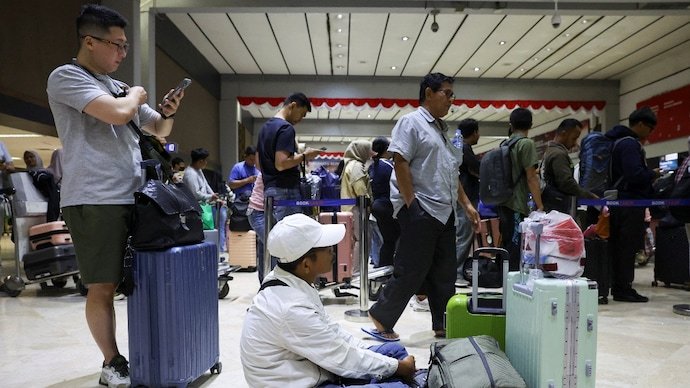
For passengers, the consequences included cancelled departures, delayed flights, rescheduled services and long waits at the airport while airlines reassessed their schedules.
Passengers rushed to collect baggage and seek refunds
As the airport suspension took effect, passengers were seen waiting inside terminals while departure boards showed a growing number of disrupted flights.
Some travellers sought refunds or began collecting checked baggage after learning that their flights would not operate as scheduled.
Airlines faced a complicated recovery process because the impact of a volcanic ash event can continue even after the airport itself reopens. Aircraft that were unable to depart may be in the wrong locations, while crews and passengers can also become displaced.
This creates a cascading disruption in which one cancelled flight affects several later flights operated by the same aircraft or crew.
Airlines therefore often need several hours to restore their normal schedules after an ash-related closure, depending on weather conditions and the movement of the ash cloud.
Why volcanic ash is dangerous for aircraft
Volcanic ash is not simply ordinary dust. It consists of tiny fragments of pulverised volcanic rock and minerals that can remain airborne at high altitudes.
When an aircraft flies through a dense ash cloud, those particles can enter the engines and melt inside their high-temperature sections. As the material cools, it can accumulate on engine components and affect airflow.
Ash can also cause abrasion to cockpit windows, sensors and other exposed parts of the aircraft.
These risks mean that airlines and aviation authorities rely heavily on satellite observations, meteorological forecasts and volcanic ash advisories when deciding whether flights can safely operate.
The decision to suspend flights therefore does not necessarily mean the airport itself has been physically damaged. It is primarily a safety response designed to prevent aircraft from entering hazardous airspace.
Two ash clouds reached different regions
Indonesia’s volcanology agency and Australia’s Darwin Volcanic Ash Advisory Centre identified two separate ash clouds associated with the eruption.
One plume rose to roughly 20,000 feet, or 6,100 metres, and moved toward the northeast. It affected parts of Jakarta, Banten and West Java as well as surrounding waters.
A second and much higher ash cloud reached approximately 50,000 feet, or 15,200 metres.
That plume moved westward and northwestward, extending over parts of Banten, Lampung and Bengkulu, the southern Sunda Strait and portions of the Indian Ocean west of Sumatra.
The difference in altitude and direction is important for aviation because aircraft can operate at different cruising levels. A high-altitude ash cloud can therefore affect routes far from the volcano itself.
Jakarta was affected even though the volcano is offshore
The eruption demonstrates why volcanic hazards can have effects hundreds of kilometres from the eruption site.
Anak Krakatau sits in the Sunda Strait, but wind patterns carried ash toward populated areas and major transport corridors.
Jakarta is particularly vulnerable to such disruptions because Soekarno-Hatta is one of the busiest airports in Southeast Asia and serves as a major gateway for Indonesia’s domestic and international air traffic.
Even a temporary reduction in capacity can therefore affect tens of thousands of travellers.
Other airports and routes may also face disruption if airlines need to reroute aircraft or if ash enters adjacent airspace.
Indonesia’s aviation authorities monitor the situation
The Directorate General of Civil Aviation said it was closely monitoring the eruption and coordinating with airlines, airport operators, air-navigation service providers and meteorological authorities.
Officials stressed that safety remained the priority when making decisions about airport operations.
Such coordination is essential because volcanic eruptions can change rapidly. An ash plume may rise higher than initially expected, change direction as wind conditions shift or be followed by additional eruptions.
Airlines therefore need updated information continuously rather than relying on a single assessment made immediately after the first eruption.
Travellers were advised to check directly with their airlines before heading to the airport because schedules could change as conditions developed.
Why flight disruptions can continue after reopening
One of the least visible effects of a volcanic eruption is the operational chain reaction created by cancelled flights.
Suppose an aircraft scheduled to fly from Jakarta to Singapore cannot depart because of volcanic ash. That same aircraft may have been scheduled later to operate another route. The second flight can then be affected even if the ash cloud has moved away from its destination.
The same applies to crew members. Pilots and cabin crews operate under strict scheduling and rest requirements, meaning delays can create further limitations on how quickly an airline can restore its timetable.
Passengers stranded in Jakarta can also miss connecting flights elsewhere.
That is why a few hours of airport closure can result in disruption lasting much longer than the original safety restriction.
Anak Krakatau has a deadly history
The latest eruption is particularly significant because of Anak Krakatau’s connection to one of the world’s most famous volcanic disasters.
The name Anak Krakatau means “Child of Krakatau”. The volcanic island developed from the remnants of the original Krakatau volcano following its enormous eruption in 1883.
The 1883 disaster was among the most powerful volcanic eruptions in recorded history. It destroyed much of the original volcanic island and generated enormous waves across the surrounding region.
The event also had global atmospheric effects, contributing to unusual weather and a temporary period of global cooling.
Anak Krakatau subsequently emerged from the sea and continued to grow through repeated eruptions.
The 2018 Anak Krakatau tsunami changed how the volcano is viewed
Anak Krakatau’s most important recent event occurred in December 2018, when an eruption caused the partial collapse of the volcano’s southwestern flank.
The collapse displaced a massive volume of seawater and generated a tsunami that struck coastal areas of Java and Sumatra.
At least 430 people were killed in the disaster, with thousands more injured or displaced.
Unlike many tsunamis, the 2018 event was not triggered by a large undersea earthquake. It was associated with volcanic activity and a landslide into the sea.
The tragedy transformed scientific understanding and public awareness of the risks posed by volcanic islands in the Sunda Strait.
Why authorities maintain a safety zone around the crater
Anak Krakatau has remained under a high level of volcanic alert since the 2018 disaster. Authorities have repeatedly established exclusion zones around the crater to reduce the risk to visitors, fishermen and other people who might approach the island.
The current safety distance of 3 kilometres reflects the possibility of sudden eruptions, lava movement, falling volcanic material and other hazards close to the crater.
Even when an eruption appears relatively small, volcanic systems can change rapidly. A quiet period can be followed by explosive activity, which is why Indonesian authorities use continuous seismic and visual monitoring.
For visitors, following the exclusion zone is therefore essential even when there is no immediate evacuation order.
Anak Krakatau is much smaller than before 2018
The volcanic island today is substantially smaller than it was before the 2018 collapse.
The partial destruction of the southwestern slope removed a significant portion of the volcano’s mass and changed its shape.
Scientists have closely monitored its subsequent rebuilding because fresh eruptions can gradually add new lava and volcanic material to the island.
The continuing growth of the volcano is part of a natural cycle of destruction and construction that has characterised Anak Krakatau since it emerged from the sea.
Its changing shape is also one reason scientists study the volcano carefully, because the stability of volcanic slopes can influence the potential for future landslides and tsunami generation.
No immediate evacuation was ordered
Despite the eruption and widespread ash, authorities did not issue an immediate evacuation order for nearby communities.
The closest settlement is located more than 16 kilometres from the volcano, providing a substantial buffer from the crater’s immediate danger zone.
However, authorities continued to advise people to remain outside the restricted area and follow official instructions.
The absence of an evacuation order does not mean the eruption is considered harmless. It indicates that authorities judged the current level of risk to nearby populated areas to be manageable while monitoring continued activity.
Schools and fishing activities also affected
The volcanic ash has had consequences beyond aviation.
Authorities suspended or restricted some school activities and fishing operations as a precaution in areas affected by ashfall and the changing volcanic conditions.
Fine ash can irritate the eyes and respiratory system, particularly when wind carries particles into populated areas.
Residents in affected locations have been advised to limit outdoor exposure, follow local safety instructions and use protective equipment where necessary.
These measures are intended to reduce Health risks while authorities determine how long ashfall is likely to continue.
Indonesia sits on the Pacific Ring of Fire
Indonesia experiences frequent volcanic and earthquake activity because it lies along the Pacific Ring of Fire, an enormous zone of tectonic activity surrounding much of the Pacific Ocean.
The country is home to numerous active volcanoes, many of which are located close to densely populated communities.
This creates a permanent challenge for Indonesian disaster-management agencies. Volcanic eruptions can vary from small emissions of ash to explosive events capable of generating pyroclastic flows, landslides and tsunamis.
Continuous monitoring and clearly defined exclusion zones are therefore among the country’s most important tools for reducing casualties.
The biggest immediate risk is continued ash disruption
For Jakarta, the immediate concern is not a repeat of the 2018 tsunami but the continuing movement of volcanic ash through regional airspace.
Ash concentrations can change quickly depending on eruption intensity and wind direction. If another significant eruption occurs, airports could face additional restrictions.
That makes the recovery of normal air travel dependent not only on what happened during Sunday’s eruption but also on whether Anak Krakatau continues producing ash at levels dangerous to aircraft.
Airlines will therefore continue monitoring official aviation and volcanic-ash warnings before restoring all services.
What travellers should expect
Passengers travelling through Jakarta should expect possible delays or schedule changes while airlines assess the situation.
Even flights that do not directly cross the ash cloud can be affected because aircraft, crews and airport Infrastructure are shared across multiple routes.
Travellers should therefore rely on airline updates rather than assuming that the reopening of the airport means every flight has returned to normal.
The safest approach is to check departure information shortly before travelling and allow additional time for possible congestion inside the terminal.
Why the eruption matters beyond Indonesia
The Anak Krakatau eruption is a local volcanic event with potentially regional economic consequences.
Jakarta is a major aviation hub, while Indonesia’s position between the Indian and Pacific oceans makes its airspace important for international travel across Southeast Asia.
A prolonged closure or repeated ash events could therefore affect flights connecting Australia, South Asia, East Asia and the Middle East.
The disruption also highlights how natural hazards increasingly intersect with highly interconnected transportation systems. A volcano on a relatively small island can temporarily affect an international airport serving tens of thousands of travellers.
What happens next at Anak Krakatau?
The next stage will depend on whether the volcano’s activity declines or continues.
Indonesia’s geological authorities will monitor seismic activity, lava emissions, ash production and changes in the volcano’s appearance. Aviation agencies will simultaneously track the movement and altitude of ash clouds.
If ash levels fall and no new major eruption occurs, flight operations can progressively return to normal. If activity intensifies, additional flight restrictions may be required.
For people living near the Sunda Strait, the most important instruction remains to stay outside the restricted area and follow official announcements.
Because of Anak Krakatau’s history, authorities are likely to maintain a cautious approach even if the latest eruption appears limited.
Jakarta flights disrupted, but the larger lesson is volcanic preparedness
The eruption of Anak Krakatau on September 6 has once again demonstrated how quickly volcanic activity can affect modern life far beyond the immediate eruption site.
The event temporarily disrupted operations at Soekarno-Hatta International Airport, affecting 209 flights and nearly 22,800 passengers. Volcanic ash spread across portions of Java and Sumatra, with one plume reaching about 50,000 feet and extending over the Sunda Strait and Indian Ocean.
No immediate casualties or mass evacuation were reported, but authorities warned people to stay away from the crater while monitoring continued volcanic activity.
The eruption also revived memories of Anak Krakatau’s dangerous history. The volcano emerged from the remains of the 1883 Krakatau disaster and later caused the deadly 2018 tsunami after part of its flank collapsed into the sea.
That history explains why even a relatively brief eruption receives close scientific and public attention.
For now, the primary concern is maintaining aviation safety while monitoring the volcano’s next movements. The disruption at Jakarta’s airport shows the economic cost of volcanic ash, but the wider priority remains protecting communities and preventing a natural hazard from becoming a human disaster.
For breaking news and live news updates, like us on Facebook or follow us on Twitter and Instagram. Read more on Latest World on thefoxdaily.com.

COMMENTS 0