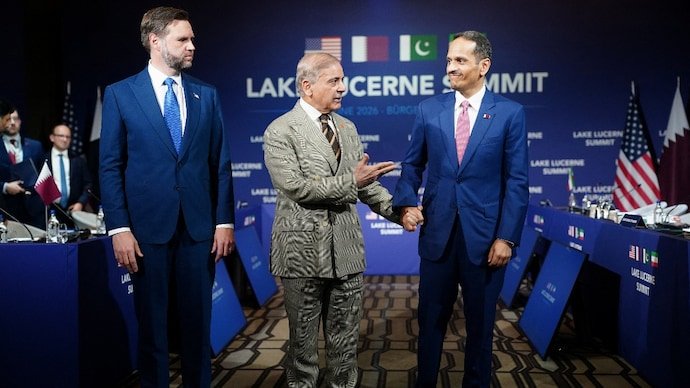
The first round of US-Iran peace talks under the newly signed Islamabad Memorandum of Understanding (MoU) opened amid diplomatic tension and visible signs of unease among participating delegations. While the negotiations were intended to focus on regional de-escalation, Sanctions relief, and Iran’s nuclear programme, much of the early attention shifted to a brief but highly scrutinized moment involving Qatar’s Prime Minister Sheikh Mohammed bin Abdulrahman Al Thani and US Vice President JD Vance.
Video footage from the Swiss resort of Burgenstock appeared to show the Qatari Prime Minister walking past Vance during a reception sequence while warmly greeting Pakistan Prime Minister Shehbaz Sharif and Pakistan Army Chief Asim Munir. The clip quickly spread across social media platforms, prompting speculation about whether the interaction represented a diplomatic snub or simply an awkward moment taken out of context.
What Happened at Burgenstock?
The talks brought together representatives from the United States, Iran, Qatar, and Pakistan as part of a broader diplomatic effort to reduce tensions in West Asia. Qatar and Pakistan have been acting as mediators between Washington and Tehran following the signing of a framework agreement designed to facilitate negotiations.
During the arrival ceremony, Sheikh Mohammed approached the reception area where various officials were gathered. Video clips circulating online appeared to show him greeting Pakistani leaders while not immediately engaging with Vance.
The footage generated intense online discussion, with some commentators claiming it demonstrated dissatisfaction within Doha regarding recent American positions in the region. Others argued that the short clip lacked sufficient context and that diplomatic events often involve complex sequencing that may appear unusual when viewed in isolation.
Neither Qatar nor the United States issued any statement suggesting a diplomatic dispute, and no official complaint or clarification emerged following the incident.
Why Qatar’s Role Matters
The attention surrounding the moment stems largely from Qatar’s unique position in regional Diplomacy.
Qatar remains one of Washington’s most important partners in the Middle East. The Gulf nation hosts major US military facilities, including Al Udeid Air Base, one of America’s largest military installations outside the United States.
At the same time, Doha has maintained communication channels with a variety of regional actors, including Iran, making it a valuable intermediary during periods of heightened tension.
Over the past decade, Qatar has frequently served as a mediator in negotiations involving the United States, Iran, Afghanistan, and several regional conflicts. Because of this role, any perceived sign of friction between Qatari and American officials naturally attracts significant attention.
However, diplomatic experts caution against reading too much into brief public interactions without broader evidence of policy disagreements.
Iran’s Tough Opening Stance
The awkward optics involving Qatar were not the only unusual development during the opening session.
Iranian officials reportedly declined to participate in a planned joint photo opportunity with members of the American delegation. Iranian Foreign Minister Abbas Araghchi and chief negotiator Mohammad Bagher Ghalibaf were said to have rejected participation in what Iranian media described as a public relations exercise.
According to reports, Iranian representatives preferred to focus directly on negotiations rather than symbolic gestures designed for international media coverage.
The refusal highlighted the cautious and sometimes confrontational atmosphere surrounding the talks despite both sides agreeing to engage diplomatically.
Washington and Tehran remain divided on several critical issues, including sanctions, nuclear enrichment levels, regional security arrangements, and the future role of Iranian-backed groups operating across the Middle East.
Why Body Language Gets So Much Attention
Modern diplomacy increasingly unfolds under constant media scrutiny. Every handshake, smile, seating arrangement, and public interaction can become the subject of intense analysis.
Political observers often attempt to interpret body language as a signal of deeper diplomatic relationships. While such observations can occasionally reveal genuine tensions, they can also be misleading.
Diplomatic events involve carefully managed schedules, security protocols, protocol officers, and multiple simultaneous interactions. A brief moment captured on camera may not accurately reflect broader relationships between governments.
History offers many examples where apparently awkward exchanges generated headlines despite having little impact on actual policy decisions.
As a result, analysts generally focus more on official statements, negotiation outcomes, and policy changes than isolated visual moments.
The Larger Context of the Negotiations
The Burgenstock meeting carries significance far beyond any viral video.
The negotiations represent one of the most substantial diplomatic engagements between the United States and Iran in recent years. The discussions are taking place under a framework designed to create a pathway toward regional stability after months of heightened tensions.
Key topics reportedly include:
- Iran’s nuclear programme and enrichment activities.
- Sanctions relief and access to frozen financial assets.
- Regional security concerns involving Lebanon and Hezbollah.
- Freedom of navigation and trade through the Strait of Hormuz.
- Long-term mechanisms for reducing military escalation.
These issues carry significant implications not only for the Middle East but also for global energy markets, international security, and geopolitical stability.
Early Signs of Difficulty
Despite hopes for progress, reports suggested that negotiations encountered challenges almost immediately.
Iranian media indicated that Tehran’s delegation temporarily left discussions after roughly 80 minutes amid disagreements linked to recent comments from US President Donald Trump.
Trump had issued warnings regarding Iranian-backed groups operating in Lebanon and suggested that further escalation could trigger a strong American response.
Iranian officials criticized the remarks, arguing that such statements undermine confidence-building efforts and complicate ongoing negotiations.
The incident highlighted the fragile nature of the diplomatic process, where progress can be influenced by political rhetoric as much as by formal negotiations.
Social Media Amplifies Every Gesture
The rapid spread of the Qatar-Vance footage illustrates how social media increasingly shapes public perceptions of international diplomacy.
Within hours, millions of users had viewed, shared, and commented on the video. Some interpreted it as evidence of changing alliances, while others dismissed it as an overreaction to a routine diplomatic interaction.
Platforms such as X, TikTok, and YouTube have transformed diplomatic events into real-time spectacles where every movement can be analyzed by audiences worldwide.
This environment creates both opportunities and risks. While greater transparency allows citizens to observe international affairs more closely, it also encourages speculation based on incomplete information.
As a result, viral moments often generate more discussion than the substantive policy issues being negotiated behind closed doors.
US-Qatar Relations Remain Strong
Despite online speculation, there is little evidence that the brief interaction reflects any significant deterioration in relations between Washington and Doha.
The United States and Qatar maintain extensive military, economic, and diplomatic cooperation. Qatar continues to play a vital role in regional mediation efforts and remains a key American security partner.
Both countries have worked closely on issues ranging from counterterrorism and Energy Security to conflict resolution and humanitarian initiatives.
Given the depth of the relationship, experts suggest that any meaningful diplomatic disagreement would likely be reflected in policy decisions rather than isolated public interactions.
What Happens Next?
The real measure of success for the Burgenstock talks will not be determined by arrival ceremonies or photo opportunities but by whether negotiators can narrow differences on the major issues dividing Washington and Tehran.
Officials hope the current framework can eventually produce agreements covering nuclear restrictions, sanctions relief, regional security arrangements, and broader diplomatic normalization.
However, substantial obstacles remain.
Trust between the two sides remains limited, domestic political pressures influence negotiators, and developments in Lebanon, the Gulf, and other parts of the Middle East continue to affect the diplomatic environment.
For now, the viral moment involving Qatar’s Prime Minister and JD Vance has added another layer of intrigue to already complex negotiations. Whether it was a genuine snub, a misunderstanding, or simply a routine diplomatic interaction caught at an awkward angle may never be fully known.
What is clear is that the success or failure of the talks will ultimately depend on the difficult negotiations taking place behind closed doors rather than the body language displayed in front of cameras.
For breaking news and live news updates, like us on Facebook or follow us on Twitter and Instagram. Read more on Latest World on thefoxdaily.com.




COMMENTS 0