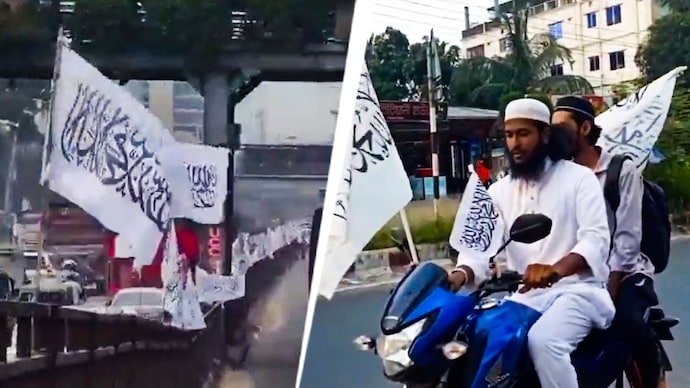
Bangladesh‘s streets are once again filled with football fever. Every FIFA World Cup season, supporters decorate homes, rooftops, markets and highways with the national flags of Brazil, Argentina and other competing nations. This year, however, another flag has appeared alongside them—one carrying the Kalema, the Islamic declaration of faith.
The widespread appearance of black-and-white Kalema flags across several Bangladeshi cities has generated intense debate among policymakers, security agencies and counterterrorism experts. While the inscription itself is a central declaration of Islamic belief and is revered by Muslims worldwide, certain flag designs featuring the Kalema have also been adopted by extremist organisations including Al-Qaida, the Islamic State (ISIS), and other jihadist groups.
The distinction between a religious expression and the use of symbols historically associated with violent extremist organisations has become the focus of growing concern within Bangladesh’s security establishment.
What Are the Kalema Flags?
The Arabic phrase “La ilaha illallah” translates to “There is no deity worthy of worship except Allah.” It forms the first part of the Islamic declaration of faith and is among the most sacred expressions in Islam.
Authorities have observed two primary flag variants appearing across Bangladesh:
- Black Arabic script displayed on a white background.
- White Arabic script displayed on a black background.
While the religious phrase itself is universally accepted within Islam, similar black-and-white flag designs have historically been used by several militant organisations. Over the years, extremist groups have employed these designs as ideological banners, creating sensitivity whenever identical or nearly identical flags appear in public demonstrations.
Security experts therefore emphasise that concern is directed not at the Kalema itself but at the symbolism attached to particular flag designs and the organisations that have popularised them internationally.
Where Have the Flags Been Seen?
The first reported sightings emerged in Dhaka on June 17, where several flags appeared on a major flyover.
Within days, similar displays were reported across multiple districts, including:
- Dhaka
- Mirpur
- Chattogram
- Cox’s Bazar
- Faridpur
- Dinajpur
Images circulating across Social Media also showed motorcycle rallies and public processions featuring the same flags, prompting law enforcement agencies to begin monitoring the developments more closely.
Why Security Agencies Are Concerned
Counterterrorism officials reportedly believe the campaign may represent an effort to familiarise the broader public with symbols long associated with transnational extremist movements.
Rather than openly promoting violence, analysts suggest such campaigns often seek to establish ideological legitimacy by presenting controversial symbols within broader religious or cultural contexts.
One Bangladeshi security official reportedly described the phenomenon as an apparent attempt to bring “foreign extremist behaviour and culture into the mainstream” while seeking moral acceptance among ordinary religious communities.
This gradual normalisation strategy has been observed in multiple countries where extremist movements attempt to blend political messaging with religious symbolism.
Connection to Hizb ut-Tahrir and Other Islamist Groups
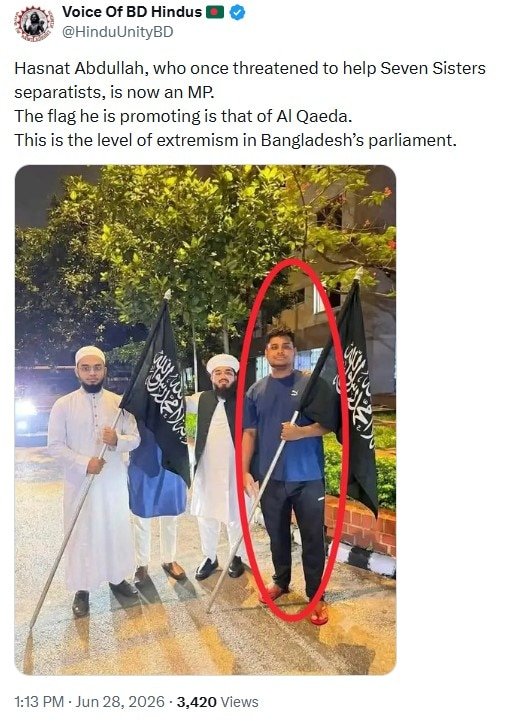
Although investigators have not officially linked the current campaign to any specific organisation, attention has focused on several Islamist groups that have expanded their public activities in Bangladesh over the past two years.
Among them is Hizb ut-Tahrir, an organisation banned in Bangladesh since 2009.
The group advocates establishing a global Islamic caliphate through ideological mobilisation rather than electoral Politics. Despite remaining prohibited, it has reportedly increased public visibility following Bangladesh’s political changes during 2024.
Large public gatherings advocating a caliphate have drawn renewed attention to the organisation’s activities.
Authorities have not confirmed whether Hizb ut-Tahrir organised the recent flag displays.
‘Tawhidi Janata’ and Grassroots Mobilisation
Several recent marches have reportedly been organised under the banner of “Tawhidi Janata,” a loosely connected Islamist movement promoting Islamic monotheism.
Organisers have stated that their objective is to encourage religious awareness while discouraging excessive enthusiasm surrounding international football tournaments.
In some rallies, Palestinian flags accompanied the Kalema banners, reflecting broader expressions of solidarity with Palestinians.
However, security analysts caution that ideological movements sometimes combine legitimate political causes with broader mobilisation campaigns whose long-term objectives may differ significantly from their public messaging.
Role of Social Media
The spread of Kalema flags has not been limited to physical demonstrations.
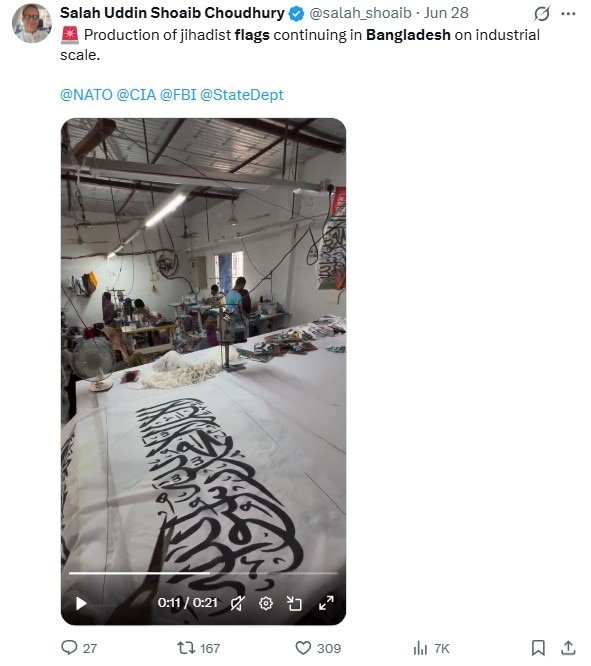
Social media platforms have witnessed increasing promotion of similar flags through religious pages, online marketplaces and community groups.
The rapid online circulation has amplified visibility while making it more difficult for authorities to determine whether the campaign represents coordinated activity or spontaneous religious expression.
Digital platforms continue to play an increasingly important role in shaping ideological narratives and expanding grassroots mobilisation.
Historical Context of Islamist Extremism in Bangladesh
Bangladesh has experienced several waves of Islamist militancy during the past two decades.
Groups inspired by international jihadist ideologies have carried out attacks targeting secular writers, religious minorities, police personnel and foreign nationals.
Government crackdowns significantly weakened many organisations during previous administrations.
However, security observers have periodically warned that extremist networks often rebuild through ideological recruitment, educational institutions and online propaganda rather than overt military activity.
The current debate surrounding Kalema flags reflects broader concerns regarding ideological influence rather than immediate evidence of organised terrorism.
Implications for India
Developments inside Bangladesh are being monitored carefully by Indian security agencies because the two countries share a border extending over 4,000 kilometres.
Any increase in extremist recruitment or radical ideological movements could potentially influence:
- Border security operations.
- Counterterrorism cooperation.
- Cross-border infiltration risks.
- Communal harmony in border states.
- Regional diplomatic relations.
States such as West Bengal, Assam, Meghalaya, Tripura and Mizoram maintain extensive people-to-people connectivity with Bangladesh, making regional stability particularly important.
Balancing Religious Freedom and Security
The controversy also illustrates the difficult challenge facing democratic governments.
The Kalema itself is among Islam’s holiest declarations and is used daily by Muslims across the world in prayer and religious practice.
At the same time, identical visual symbols have been appropriated by internationally designated terrorist organisations.
This overlap complicates law enforcement responses because authorities must distinguish between legitimate religious expression and deliberate adoption of imagery historically associated with violent extremist movements.
Experts stress that investigations should focus on the intent, organisation, financing and messaging behind such public displays rather than the religious text alone.
Political and Security Outlook
Bangladesh’s security agencies have launched investigations into the sudden appearance of the flags, while political observers continue monitoring whether organised networks are coordinating the campaign.
Analysts argue that if extremist organisations are attempting to normalise their symbols through public visibility, early intervention could help prevent wider ideological expansion.
Conversely, if the displays primarily represent religious activism without links to violent organisations, authorities will face the challenge of addressing public concerns without infringing upon legitimate religious freedoms.
Conclusion
The appearance of Kalema flags across Bangladesh during the FIFA World Cup has sparked a complex debate that extends beyond football celebrations. While the Arabic inscription represents one of Islam’s most sacred declarations of faith, similar flag designs have also been widely used by internationally recognised extremist organisations, creating understandable security concerns.
Whether the recent displays represent coordinated ideological mobilisation, independent religious activism or a combination of both remains under investigation. For Bangladesh, the developments highlight the continuing challenge of safeguarding religious freedom while preventing extremist narratives from gaining wider public acceptance. For neighbouring countries, particularly India, the situation underscores the importance of continued regional cooperation on counterterrorism, border security and intelligence sharing in an increasingly interconnected security environment.
For breaking news and live news updates, like us on Facebook or follow us on Twitter and Instagram. Read more on Latest World on thefoxdaily.com.






COMMENTS 0