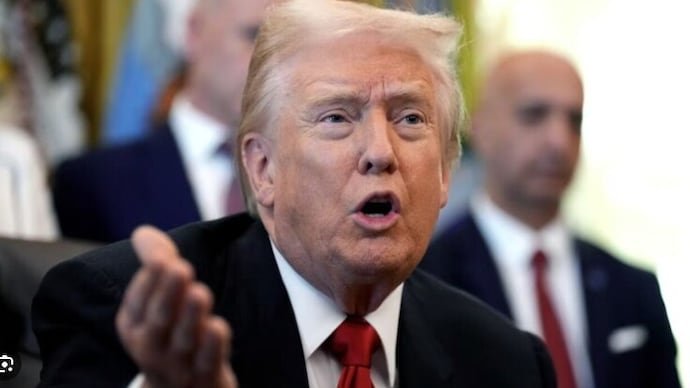
US President Donald Trump has sharply escalated his rhetoric toward Iran, claiming that the United States now has “almost total control” of the Strait of Hormuz and urging the Iranian public to challenge the government in Tehran.
The comments came as the six-month-old US-Iran conflict moved back toward direct military confrontation after a period dominated by sanctions, blockades and diplomatic pressure. Washington launched another round of strikes against Iranian targets on Tuesday, while Iran retaliated against US military positions across the region.
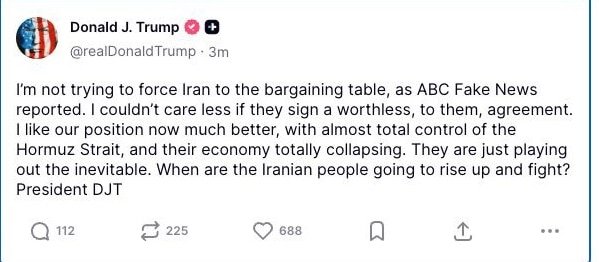
Trump’s latest message also appeared to close the door, at least rhetorically, on an immediate return to negotiations. In a Truth Social post, he rejected a report that the administration was trying to force Iran back to the negotiating table and said he preferred the current US position.
The central issue remains the Strait of Hormuz, a narrow but strategically vital waterway through which a substantial share of Global Oil supplies normally passes. With commercial traffic already severely disrupted, the confrontation is no longer only a military dispute between Washington and Tehran. It is also a growing energy and trade problem for the wider global economy.
Trump says US has ‘almost total control’ of Hormuz
Trump’s claim about the Strait of Hormuz is the latest in a series of statements in which he has asserted that American forces have established effective control over the waterway.
The White House had already claimed in August that US forces controlled the strait and were protecting commercial shipping. The administration said American forces had escorted large numbers of vessels and that Iranian mines had been cleared from international shipping lanes.
Trump went further in his latest statement, describing the US position as “almost total control” while portraying Iran’s economy as “totally collapsing.” He argued that the situation was already moving in Washington’s favour and suggested that Tehran was facing an inevitable outcome.
That assessment is contested by Iran, which has continued to assert its ability to disrupt shipping and use the waterway as leverage.
The practical situation is also more complicated than a simple declaration of control. Preliminary shipping data showed that only four commodity vessels transited the Strait of Hormuz on Tuesday, compared with a 10-day average of about 13. The figures can change as vessels alter course or switch off tracking systems, but the decline illustrates how severely the conflict has affected normal maritime traffic.
Why the Strait of Hormuz matters so much
The importance of the Strait of Hormuz goes far beyond Iran and the United States.
The waterway connects the Persian Gulf with the Gulf of Oman and the wider Arabian Sea. It is a crucial route for energy exports from major oil-producing countries in the Gulf.
Before the current conflict escalated, roughly one-fifth of global oil consumption passed through the strait. Any sustained disruption therefore has the potential to affect crude prices, shipping costs, Inflation and fuel prices far beyond the Middle East.
The latest fighting has already produced a visible reaction in energy markets. Brent crude rose sharply on Tuesday, with prices settling more than $4 a barrel higher amid renewed US-Iran hostilities. On Wednesday, Brent remained elevated at around $95 a barrel as markets continued to assess the risk of further supply disruption.
For importing countries, the danger is not limited to the physical loss of oil supplies. Insurance premiums, freight costs and longer shipping routes can all increase when vessels face military or geopolitical risks.
US and Iran are back in direct confrontation
The latest statements from Trump followed a rapid sequence of military exchanges.
US forces recently struck Iranian launchers on Larak Island near the Strait of Hormuz. Washington said the targets were linked to preparations by Islamic Revolutionary Guard Corps forces to launch rockets carrying sea mines into the waterway.
Iran responded with missile attacks against US military positions in the region. The exchanges marked the most significant direct fighting between the two sides in weeks and ended a period in which the conflict had increasingly shifted toward economic pressure.
The United States then launched another wave of strikes against Iranian targets on Tuesday. US Central Command said the operation targeted Islamic Revolutionary Guard Corps positions following attempted attacks involving commercial shipping and American personnel.
Iran responded with further attacks against US assets and bases in countries including Jordan and Bahrain.
The exact scale of the latest escalation remains uncertain, but the pattern is significant: military action that had temporarily become less frequent is once again driving the confrontation.
Trump rejects reports of renewed negotiations
Trump’s latest comments also matter because they challenge the idea that Washington is currently trying to bring Tehran back into formal negotiations.
Reports had suggested that the United States was seeking ways to pressure Iran back toward the negotiating table. Trump rejected that characterization, saying he was not trying to force Iran into an agreement.
His position reflects the broader strategy adopted by Washington during the conflict: combine military pressure with sanctions and restrictions on Iran’s ability to generate revenue through international trade.
The Trump administration has increasingly used economic measures to target Iran and entities that continue doing business with Tehran. Secondary sanctions are particularly important because they can affect companies and countries outside Iran that purchase Iranian oil or engage with sanctioned entities.
For Tehran, however, the pressure has not produced a public surrender to Washington’s demands.
Trump calls on Iranian people to challenge Tehran
The most politically provocative part of Trump’s message was his direct appeal to the Iranian population.
After describing Iran’s economy as collapsing, Trump asked when the Iranian people would “rise up and fight” against their government.
The appeal places domestic political change inside Iran alongside Washington’s military and economic objectives. Rather than limiting his message to the Iranian government or military, Trump directly addressed the country’s population.
Such rhetoric also carries significant risks. An attempt by an outside power to encourage a population to confront its government can be interpreted by Tehran as an effort at regime change, potentially making diplomatic engagement more difficult.
Iranian authorities have repeatedly portrayed the US campaign as an attempt to weaken the Islamic Republic. Any further American statements explicitly encouraging political action inside Iran could reinforce that interpretation.
Hormuz has become the central pressure point
The Strait of Hormuz has gradually moved from being one element of the wider conflict to becoming one of its central pressure points.
Iran has threatened that if it cannot export its own oil through the Persian Gulf, other countries should not expect unrestricted access either. Iranian officials have warned that preventing Iranian exports could have consequences for the entire region’s energy trade.
That strategy gives Tehran an asymmetric source of leverage. Iran does not need to stop every vessel permanently to create economic uncertainty. Even attacks on individual ships, threats involving naval mines or uncertainty over safe passage can make shipping companies more reluctant to operate in the area.
That is one reason the United States has placed so much emphasis on protecting commercial shipping and maintaining access through the waterway.
Washington’s position is that it can use military power to keep the strait open. Iran’s strategy, meanwhile, has focused on demonstrating that the security of the waterway cannot be separated from Tehran’s own ability to export oil and operate freely in the region.
Oil markets are already pricing in greater risk
The immediate economic consequence of the renewed fighting is visible in crude markets.
oil prices respond not only to actual supply losses but also to expectations about future disruptions. When traders believe that a major shipping route could remain restricted, they can bid prices higher even before a large physical shortage appears.
The latest rise therefore reflects uncertainty as much as confirmed lost production.
If commercial traffic through Hormuz remains depressed, the consequences could extend beyond crude oil. Refined petroleum products, petrochemicals and other energy-intensive industries could also face higher transportation and input costs.
For major energy-importing economies, sustained high oil prices can feed into inflation and put pressure on households and businesses. Central banks may also face a more difficult policy environment if higher energy costs begin to influence broader prices.
The conflict is becoming harder to contain
The latest escalation demonstrates how quickly the conflict can move between economic pressure and direct military action.
For several weeks, Washington had relied heavily on sanctions, maritime pressure and restrictions on Iranian trade. That appeared to create a lower-intensity phase compared with the earlier bombing campaign.
But the recent attacks on shipping and military positions changed that calculation.
Once American and Iranian forces began exchanging direct attacks again, the possibility of further retaliation increased. Each side now has an incentive to demonstrate that attacks against its forces or interests will carry consequences.
That creates a difficult cycle. A US strike intended to deter Iran can trigger an Iranian response. That response can then become the justification for another American attack.
The longer that cycle continues, the more difficult it becomes to return to negotiations without both governments appearing to concede ground.
What happens next could depend on Hormuz
The next stage of the conflict may depend heavily on whether shipping through the Strait of Hormuz can return toward normal levels.
If commercial traffic increases and the two sides avoid further attacks, energy markets could begin to price out some of the immediate geopolitical risk. A sustained reduction in military activity could also create room for indirect Diplomacy.
If attacks continue, however, the economic consequences could become more serious. A prolonged disruption would place greater pressure on oil-importing countries and could increase the cost of transporting goods around the region.
The US claim of near-total control will also be tested by events on the water. Military dominance does not automatically mean that commercial shipping can operate normally. For global markets, the practical question is whether tankers and cargo vessels can safely and consistently pass through the strait.
A dangerous new phase for the US-Iran conflict
Trump’s latest remarks mark a particularly confrontational moment in the six-month US-Iran conflict.
By rejecting the immediate prospect of negotiations, claiming near-total control of Hormuz and openly urging Iranians to challenge their government, the US president has signalled that Washington believes economic and military pressure are producing results.
Iran, however, continues to resist those demands and has demonstrated that it can still threaten American positions and commercial activity in the region.
The result is an increasingly fragile confrontation in which the Strait of Hormuz has become both a military flashpoint and an economic pressure valve.
For now, the most important indicator may not be Trump’s statements or Tehran’s warnings, but the movement of ships through the waterway. If traffic remains severely restricted, the conflict will continue to carry consequences far beyond the battlefield, with oil prices, global trade and inflation all exposed to the next decision made in Washington or Tehran.
For breaking news and live news updates, like us on Facebook or follow us on Twitter and Instagram. Read more on Latest World on thefoxdaily.com.




COMMENTS 0