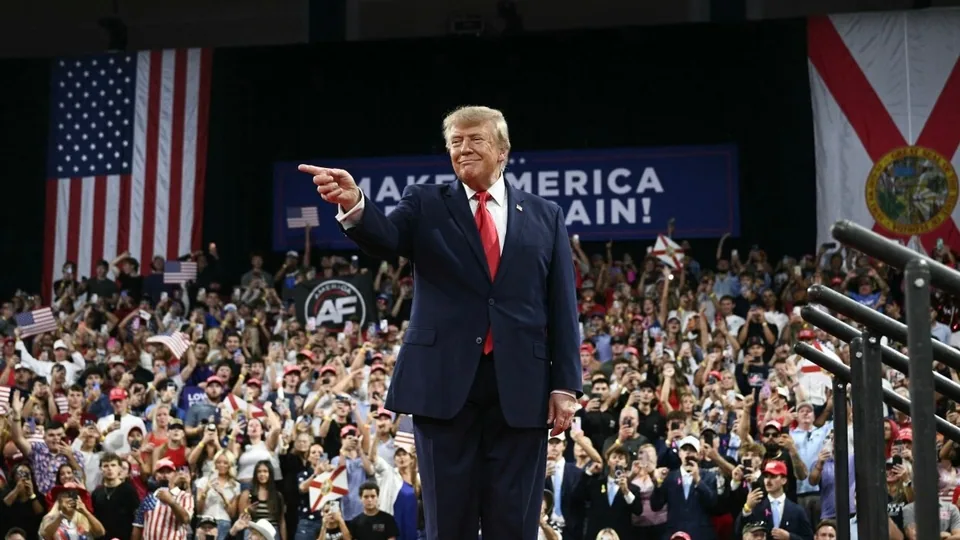
President Donald Trump returned to the campaign trail with an intensive schedule of seven rallies across seven states in seven days, delivering more than 11 hours of speeches as Republicans prepare for the November Midterm Elections. The events showcased the enduring enthusiasm of his supporters, his reliance on familiar political themes and the risks of making the president the central figure in congressional campaigns.
From Kansas on Monday to Michigan on Sunday, Trump addressed crowds in arenas, gyms and airport hangars, promoting his agenda, attacking critics and frequently departing from prepared political messaging. The crowds were generally smaller than those at rallies during his presidential campaigns, but the events retained the atmosphere that has defined his political movement for nearly a decade.
The rallies also exposed the competing pressures facing Republicans. Party advisers see Trump as a powerful tool for energising supporters, particularly voters who do not consistently participate in elections. However, some Republicans worry that his divisive rhetoric, controversial remarks and personal attacks could motivate Democratic voters and complicate the campaigns of vulnerable Republican candidates.
Reporters from The Wall Street Journal attended all seven events, documenting a campaign built around Trump’s personality, his relationship with supporters, spontaneous performances and efforts to influence the midterm election debate.
Trump remains the centre of his political rallies
For many attendees, the attraction of a Trump rally is not necessarily the promise of hearing new political arguments. It is the opportunity to experience the president in person.
Joe Douglas, a 70-year-old retired pipeline worker, drove approximately 90 minutes to attend the Wichita, Kansas, rally on Monday. Wearing a red MAGA hat he had purchased in 2016, Douglas said he already knew what Trump was likely to discuss. He had voted for Trump in the previous three presidential elections but had never seen him in person.
For Douglas, the difference was that the event was happening live. His explanation captures an important feature of Trump’s political appeal: the rallies are performances as much as they are campaign speeches, allowing supporters to participate in an event built around a familiar political figure.
Trump’s advisers have described the rallies as a setting where he can step away from the pressures of governing, critical news coverage and political challenges. On stage, he receives sustained applause from supporters, while occasional expressions of opposition are often drowned out by crowd reactions.
The events also provide Trump with opportunities to reinforce his standing among Republicans at a time when polling cited by The Wall Street Journal showed his approval rating at a low point relative to presidents approaching midterm elections in the publication’s polling history dating to the 1990s.
Trump repeatedly addressed criticism of his abilities and performance. In South Carolina, he defended his mental acuity, referring to a cognitive test he said he had passed and telling the crowd, “I know everything that I’m doing.”
In Wichita, he returned repeatedly to the idea that his accomplishments were not receiving sufficient appreciation. He said “nobody appreciates me” at least 10 times, according to the report, before recounting an anecdote about making a similar complaint to businesspeople at the White House.
The story ended with Trump recognising that he was speaking from the Oval Office, prompting him to acknowledge that he was president. The anecdote reflected the blend of grievance, humour and self-reference that characterised many of his appearances during the week.
Why Republicans are putting Trump at the centre of the midterms
The rally schedule reflects a deliberate Republican campaign strategy. Advisers view Trump as a major force for motivating the party’s core supporters, particularly voters who are less likely to participate in elections without a strong reason to turn out.
The approach resembles the political playbook that helped return Trump to the White House in 2024. Rather than relying exclusively on conventional campaign events, the president is concentrating on energising his MAGA base and encouraging participation in Republican-leaning states.
A senior White House official cited Kansas as an example, saying internal campaign indicators showed increased enthusiasm surrounding Republican Senator Roger Marshall. The official argued that Trump’s ability to mobilise supporters could benefit Republican candidates despite the president’s polarising public image.
However, the strategy carries risks. The midterm elections often become a test of the party controlling the White House, and Republicans could face consequences if voters use their ballots to express dissatisfaction with the administration.
Trump’s prominent role also means that comments made at rallies can become part of congressional candidates’ campaigns, whether or not those candidates agree with the president’s messaging. Remarks that energise loyal supporters could simultaneously provide political opponents with material for criticism.
That tension was visible during the week as Trump mixed discussions of policy and economic performance with personal grievances, provocative claims and attacks on critics.
The strategy therefore depends on more than attracting enthusiastic crowds. It also requires translating the energy generated at rallies into votes while limiting the potential damage caused by controversial statements.
Economic remarks expose a political challenge
Trump’s comments about oil revenues during a Saturday rally in Georgia illustrated the risks of his unscripted approach. He celebrated rising US oil revenues associated with the conflict in the Middle East, even while acknowledging that higher gasoline prices were a concern.
Trump said advisers had warned him against making the remark because consumers were paying more for fuel. He nevertheless told the crowd that the United States was making substantial money and predicted that pump prices would eventually decline.
The comments placed two competing economic messages side by side: the administration’s emphasis on national revenue and energy-related gains, and the immediate cost of gasoline for consumers.
For voters, higher fuel prices can be a direct and visible household expense. A president’s celebration of increased oil revenues may therefore be received differently by supporters focused on national economic performance and consumers concerned about what they pay at the pump.
The episode also illustrates why Trump’s rally remarks can create challenges for Republicans in competitive races. Candidates may want to emphasise economic achievements, but comments that appear disconnected from voters’ everyday financial pressures can give opponents an opportunity to question the administration’s priorities.
Trump said gasoline prices would come down, but the supplied report does not establish when that might happen or provide evidence confirming the prediction. The remark was a statement of expectation rather than a demonstrated outcome.
Seven rallies raise questions about Trump’s demanding schedule
The week-long campaign required Trump to travel across seven states and speak for more than 11 hours in total. By Saturday, his voice was noticeably hoarse, according to the reporters who attended the events.
The pace prompted questions among some of his longtime associates about the demands of repeated rallies. Businessman Mike Lindell, a longtime Trump supporter, said during a recent videoconference with allies that the president looked more tired than he had ever seen him. Lindell also highlighted the relentless sequence of appearances.
A White House official acknowledged that the travel schedule had pushed the administration’s operations to their limits but maintained that Trump remained energised. According to people involved in conversations after the rallies, Trump asked aides which parts of his speeches they liked best.
Republican Senator Tim Scott of South Carolina, who has frequently travelled with Trump, rejected the suggestion that the president was slowing down. In an interview, Scott jokingly described him as possibly being “a little cyborg.”
The accounts offer different perspectives on the physical demands of Trump’s campaign schedule, but they do not establish a medical explanation for his condition. The observable details in the report were the intensity of the travel, the length of the speeches and the noticeable hoarseness of his voice by Saturday.
For the campaign, maintaining that pace serves a political purpose by keeping Trump visible and giving supporters repeated opportunities to see him. It also places substantial demands on the president and the staff responsible for organising his appearances.
Unscripted moments keep supporters engaged
Trump’s speeches included a steady stream of spontaneous remarks that ranged from jokes to unusual personal compliments. These moments were a recurring feature of the rallies and part of what attracted some attendees to the events.
In North Carolina, Trump spoke at length about the physique of Ohio Republican Senator Jon Husted, describing him as “a pile of muscle.” He also praised Health Secretary Robert F. Kennedy Jr., saying in Florida that Kennedy had the body of a 30-year-old, and called attention to the build of Representative Greg Steube.
At the Michigan rally on Sunday, Trump commented on rapper Nicki Minaj’s appearance, continuing the pattern of personal observations that punctuated his speeches.
Some supporters regard these unscripted moments as evidence that Trump is willing to speak freely rather than follow conventional political expectations. Braxton Best, a 17-year-old student who attended the Sioux City, Iowa, rally for the first time, said he was drawn in part by Trump’s improvisational style.
Best described the president as fearless and said he did not appear concerned about what other people thought of him. The student and a friend wore Trump-branded visors with orange, fluffy hair attached to the tops.
The appeal of these moments is not limited to first-time attendees. Over the past decade, a distinctive subculture has developed around Trump’s rallies, with regular participants travelling long distances and using costumes, clothing and other displays to express their support.
Dedicated rallygoers turn Trump’s campaign into a travelling community
Some supporters have made attending Trump rallies a regular activity. Trump often recognises a group of women from North Carolina who have attended his events for years, joking that they are stalking him.
Another recurring attendee is Blake Marnell, a San Diego retiree known as “Mr. Wall” because he wears a suit designed to resemble bricks in support of Trump’s proposed border wall. Marnell said he was sourcing fabric to make a similar suit for Trump at the president’s invitation.
Marnell estimated that he had already driven more than 8,000 miles while travelling to rallies ahead of the midterms. He expected to add another 6,000 miles in the final days before the election.
These supporters help give Trump’s rallies a recognisable identity. Their repeated appearances, distinctive clothing and personal enthusiasm create a sense of continuity across events held in different states.
For attendees, the rallies can offer more than a chance to hear political arguments. They also provide opportunities to meet like-minded people and participate in a shared public spectacle. For the campaign, such dedication demonstrates the intensity of support among a segment of Trump’s political base.
However, the enthusiasm of regular attendees does not by itself establish how broadly those views are shared among the wider electorate. Rally crowds represent people who choose to attend, and their reactions cannot be treated as a direct measure of statewide or national voter opinion.
Protests reveal a more confrontational side of the rallies
Although Trump’s rallies are dominated by supportive crowds, protesters have increasingly appeared at events, sometimes waiting until the president is speaking before interrupting him.
A senior White House official said Trump responds to crowd reactions and that supporters frequently drown out protesters with boos and chants of “USA!” The reaction can turn an interruption into another moment of engagement between Trump and his audience.
One incident in Clemson, South Carolina, went beyond verbal confrontation. During the rally, a supporter struck a protester halfway through Trump’s remarks. Trump responded by praising the moment, saying, “That was incredible! Wow, that was unbelievable.”
The incident highlighted the potential for political disagreement at rallies to become physical. It also raised questions about how the president’s reactions to confrontations may influence the atmosphere at such events.
Supporters may view their response to protesters as a demonstration of loyalty, while critics may see the incident as evidence of hostility toward dissent. The reported physical assault is distinct from the verbal exchanges that typically occur when protesters interrupt political speeches.
As the rallies continue to serve as a central part of Trump’s campaign, the handling of interruptions and confrontations remains relevant to the wider debate about political expression and public safety at campaign events.
Trump merchandise becomes a major business
The commercial activity surrounding Trump’s rallies is another part of the political phenomenon. Vendors outside the events sell a wide range of products, from traditional red MAGA hats to gold-coloured Trump sneakers and other campaign-themed merchandise.
Jonas Williams, a 53-year-old entrepreneur from North Carolina who previously served time in prison, said his merchandise business generates a six-figure income and helped turn his life around.
Williams drives a 2010 Dodge Ram with a trailer to rallies, arriving early to secure a favourable selling location. He said he had sold merchandise associated with former President Barack Obama in the past but that sales generated by Trump’s most enthusiastic supporters were unmatched.
His business illustrates how a political movement can create commercial opportunities beyond official campaign fundraising. Rallies bring together crowds willing to purchase items that communicate their political identity, creating demand for clothing, accessories and novelty products.
Williams predicted that demand for Trump merchandise would rise further after the president’s death, describing him as a legend. That was Williams’s personal prediction, not a measured forecast of future sales.
The market also reflects the enduring cultural identity associated with Trump. Merchandise can function as a visible sign of political allegiance, allowing supporters to express their views at rallies and in their daily lives.
What the seven-rally tour reveals about the midterm campaign
Trump’s seven-event tour demonstrated how central his personality remains to Republican campaigning. Supporters travelled long distances to see him, regular attendees turned the rallies into recurring social events, and vendors built businesses around the crowds.
The speeches also showed the limits of a strategy built around one political figure. Trump’s ability to generate enthusiasm among loyal supporters is a key reason advisers continue to deploy him on the campaign trail. Yet the same approach can create difficulties when unscripted remarks shift attention away from policy or provoke criticism that Republican candidates must then address.
The rallies included repeated assertions about Trump’s accomplishments, responses to criticism of his abilities, economic claims and personal observations about other public figures. These themes kept the president at the centre of each event, even when the broader purpose was to support Republican candidates in congressional races.
The political test is whether the enthusiasm visible inside rally venues translates into broader voter participation and helps Republican candidates at the ballot box. The crowds offer a view of the president’s committed supporters, but they do not independently establish the likely outcome of the midterm elections.
For Republicans, the strategy offers both an organising advantage and a potential liability. Trump’s presence can draw attention and motivate his base, but his comments can also become a distraction for candidates trying to focus on local issues and the administration’s record.
Across more than 11 hours of speeches in seven states, one feature remained consistent: Trump was the main attraction. The events revived the familiar spectacle of his political rallies while revealing the tensions facing a party that has placed the president at the centre of its midterm campaign.
As election day approaches, the effectiveness of that strategy will be measured not by the noise inside arenas or the loyalty of frequent attendees, but by voter participation and the results of congressional races. The seven-rally tour offered a close look at the campaign’s energy, its risks and the enduring role of Trump’s personal appeal in Republican politics.
For breaking news and live news updates, like us on Facebook or follow us on Twitter and Instagram. Read more on Latest World on thefoxdaily.com.




COMMENTS 0