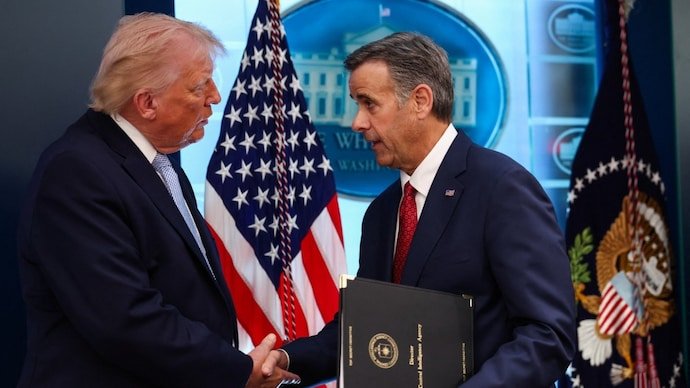
CIA Director John Ratcliffe made an unannounced trip to Moscow on Tuesday for meetings with Russian officials, opening a rare high-level channel between Washington and Moscow at a particularly sensitive point in the war in Ukraine.
The visit was not publicly announced by the White House, Pentagon, CIA or US Air Force. Details about Ratcliffe’s meetings, including the identities of the Russian officials he met and the subjects discussed, remained undisclosed. The Kremlin initially said it had no information about the reported visit or any planned meetings with American officials.
The secrecy surrounding the trip was matched by another unusual development. Before Ratcliffe travelled to Moscow, the United States asked Ukraine to temporarily stop drone and missile attacks on Moscow and other cities in northern Russia, according to reports.
Taken together, the two developments point to an effort by Washington to create space for sensitive communication with Moscow while the Trump administration weighs how to approach the war, Ukraine’s increasingly long-range strikes and Russia’s wider strategic relationships, including its ties with Iran.
Why Ratcliffe’s Moscow trip is significant
Ratcliffe’s journey was his first known visit to Russia since becoming CIA director under President Donald Trump. It was also the first publicly known trip to Moscow by a sitting CIA director since November 2021.
That earlier visit, made by then-CIA Director William Burns, occurred only months before Russia launched its full-scale invasion of Ukraine. Burns travelled to Moscow at a time when US intelligence agencies were assessing Russia’s military buildup and warning that an invasion was possible.
Burns met Russian President Vladimir putin and senior officials and communicated US concerns about the consequences of an attack. Russia nevertheless launched its full-scale invasion of Ukraine in February 2022.
Ratcliffe’s visit comes under very different circumstances, but the historical comparison is difficult to ignore. The United States and Russia remain adversaries, yet Washington is also attempting to find a path toward ending the war.
A meeting involving the CIA director can provide a channel for highly sensitive discussions that may not be suited to conventional diplomatic negotiations. Intelligence officials can communicate about security assessments, military intentions and potential risks in ways that differ from public diplomatic exchanges.
However, the available information does not establish precisely what Ratcliffe discussed in Moscow. Any claim about a specific agreement or secret negotiation would therefore go beyond the confirmed facts.
How the secret trip was discovered
The secrecy surrounding Ratcliffe’s visit did not last completely because the movement of a US military aircraft and diplomatic vehicles provided clues about the operation.
A US Air Force Boeing C-17 Globemaster III military transport aircraft landed at Moscow’s Vnukovo International Airport early Tuesday. Flight-tracking information showed the aircraft had departed from Joint Base Andrews near Washington and stopped in Riga, Latvia, before continuing to Moscow.
The aircraft later left Russia, with reports indicating that Ratcliffe’s stay in the capital lasted only several hours.
Publicly available footage also showed vehicles with diplomatic licence plates moving through central Moscow. Those movements helped reveal that a senior US official was in the Russian capital despite the absence of any formal announcement from Washington.
Officials familiar with the trip spoke anonymously because they were not authorised to discuss the operation publicly. Latvian officials said only that the flight had been properly coordinated and did not provide further information.
The limited official disclosure underlines how sensitive the mission was. Neither the White House nor the CIA publicly explained Ratcliffe’s itinerary or confirmed the details of his meetings.
US reportedly asked Ukraine to pause strikes on Russian cities
The timing of the CIA director’s visit is particularly notable because the United States reportedly asked Ukraine to temporarily halt drone and missile attacks on Moscow and other cities in northern Russia before Ratcliffe’s trip.
Ukraine has increasingly demonstrated the ability to conduct long-range strikes against targets deep inside Russian territory. Such attacks are part of Kyiv‘s broader effort to disrupt Russian military infrastructure and demonstrate that the war is not confined to Ukrainian territory.
Russia, meanwhile, has continued to use drones and missiles against Ukrainian targets.
The reported American request therefore involves a difficult strategic calculation. Washington has been seeking an end to the war, while Ukraine has continued to use military pressure against Russia as part of its effort to defend itself and improve its position.
A temporary reduction in strikes could potentially reduce immediate escalation risks around sensitive diplomatic contacts. But it could also raise questions in Kyiv about whether US efforts to create negotiating conditions might constrain Ukraine’s military strategy.
The available information does not establish how long any requested pause was intended to last or whether Ukraine fully accepted the request. It is therefore important not to treat the reported US appeal as evidence of a formal ceasefire.
Ukraine peace efforts remain difficult
Ratcliffe’s visit comes as efforts to negotiate an end to Russia’s war in Ukraine have struggled to produce a decisive breakthrough.
The conflict has entered its fifth year since Russia’s full-scale invasion, and military operations continue despite diplomatic efforts involving the United States, Russia and Ukraine.
One of the central difficulties is that the three countries have different objectives. Washington is seeking an end to the conflict, Moscow wants outcomes that reflect its strategic and territorial demands, and Kyiv continues to seek security and protection against further Russian attacks while resisting terms it considers unacceptable.
The battlefield therefore remains an important part of the diplomatic equation.
Ukraine’s long-range strikes provide Kyiv with a way to place pressure on Russian military and logistical targets far from the front line. At the same time, Russian attacks on Ukrainian cities and infrastructure continue to demonstrate Moscow’s ability to sustain long-range operations.
For Washington, encouraging restraint while trying to maintain negotiations can be difficult. Any step that reduces military escalation may help Diplomacy, but pressure on Ukraine to limit attacks can also affect the balance between the two sides.
What could the CIA director discuss with Russia?
The exact agenda of Ratcliffe’s Moscow meetings has not been made public.
One possible area of discussion is Russia’s military intentions. Reports have suggested that US intelligence assessments of Moscow’s future military plans could have been relevant, including concerns about possible mobilisation or attempts to test NATO’s resolve.
Those possibilities have not been officially confirmed as the reason for Ratcliffe’s trip.
Still, intelligence-to-intelligence communication can be particularly useful when governments need to clarify intentions without making public commitments.
Such discussions could potentially cover battlefield developments, escalation risks, the broader security environment and the intentions of Russian leadership. But without official confirmation, it would be inappropriate to attribute a specific subject or agreement to Ratcliffe’s meetings.
The importance of the channel lies partly in what it can prevent. During an active war involving nuclear-armed powers, maintaining communication can reduce the risk that military actions or political decisions are misunderstood and lead to an unintended escalation.
Russia’s relationship with Iran adds another complication
The Moscow trip also occurred as Washington was increasing pressure on Iran.
US Treasury Secretary Scott Bessent announced a strategy called Operation Economic Outcast, aimed at increasing economic pressure on Tehran and penalising countries and entities that continue conducting Business with Iran.
Russia’s close relationship with Iran makes the issue relevant to the wider US-Russia relationship.
Moscow and Tehran have developed extensive strategic ties, including cooperation in defence and other areas. Russia has also faced accusations from Ukrainian and Western officials of assisting Iran through intelligence or other forms of support, allegations that Moscow has denied in some instances.
That means Washington is dealing with Russia on more than one strategic front. The Ukraine war remains the central issue, but Russia’s relationship with Iran could influence American calculations about sanctions, regional security and Moscow’s broader foreign-policy priorities.
Ratcliffe’s position as CIA director makes him particularly relevant to discussions involving intelligence cooperation, strategic assessments and the security implications of those relationships.
The Iran connection matters to the Ukraine war too
Russia’s relationship with Iran is not entirely separate from the Ukraine conflict.
Western governments have previously raised concerns about Iranian support for Russia, particularly in relation to military cooperation. At the same time, Russia has maintained its own strategic relationship with Tehran.
For the Trump administration, this creates a complicated diplomatic landscape. Washington may want Russia to participate constructively in efforts to end the Ukraine war while simultaneously trying to constrain Iran through sanctions and other economic measures.
Those objectives can sometimes reinforce one another, but they can also create competing incentives.
If Washington needs Moscow’s cooperation on one issue while imposing pressure on a country closely aligned with Russia on another, negotiations become more complicated. That is one reason Ratcliffe’s secret mission is being viewed in the context of both Ukraine and the broader US-Russia strategic relationship.
How this compares with the 2021 CIA visit
The last publicly known Moscow visit by a sitting CIA director was made by William Burns in November 2021.
| Aspect | 2021 CIA Visit | Current Ratcliffe Visit |
|---|---|---|
| US intelligence chief | William Burns | John Ratcliffe |
| Timing | November 2021 | Tuesday, during the current Trump administration |
| Ukraine context | US intelligence was warning about a possible Russian invasion | US and Russia are dealing with an ongoing war and stalled efforts to reach an end |
| Publicly confirmed purpose | Warnings and discussions with Russian officials over Ukraine | Purpose and detailed agenda have not been publicly disclosed |
The comparison shows why the current trip has attracted attention, but the circumstances are not identical. In 2021, Washington was trying to communicate warnings about an anticipated Russian invasion. Now, the United States is dealing with an established war and attempting to navigate a possible route toward ending it.
Why secrecy matters
Secret diplomatic and intelligence contacts are not unusual during periods of serious international tension. Governments often use private channels when public negotiations are too politically sensitive or when information needs to be exchanged before formal positions are announced.
In this case, however, the secrecy is particularly striking because the United States and Russia remain deeply divided over Ukraine.
The fact that the visit was not announced beforehand does not by itself demonstrate that a major agreement was reached. Nor does the reported request for Ukraine to pause strikes necessarily mean Washington has adopted a permanent policy of restricting Ukrainian operations.
What it does demonstrate is that Washington is willing to maintain high-level communication with Moscow even while the war continues.
What the Moscow trip could mean for Ukraine
For Kyiv, the most important question is whether US diplomacy with Moscow will complement Ukraine’s objectives or place additional restrictions on them.
Ukraine has strong reasons to maintain military pressure on Russia while negotiations remain uncertain. Long-range attacks can target military assets and demonstrate that Russian territory is vulnerable to retaliation.
At the same time, Washington may view reductions in attacks as useful for preventing escalation and creating conditions for diplomatic contacts.
That creates an inherent tension. A strategy designed to open negotiations may require temporary restraint, while Ukraine may believe continued military pressure is necessary to strengthen its position at the negotiating table.
The ultimate significance of the US request will therefore depend not only on whether Ukrainian strikes are paused, but on what diplomatic progress follows.
What happens next?
The clearest immediate fact is that Washington has reopened a high-level channel with Moscow at a sensitive moment in the war.
The next important developments will be whether further US-Russia contacts take place, whether Washington’s efforts produce movement in negotiations involving Ukraine and Russia, and whether any temporary reduction in Ukrainian strikes leads to a broader diplomatic initiative.
The situation will also be influenced by Russia’s relationship with Iran and Washington’s expanding sanctions pressure on Tehran.
For now, Ratcliffe’s Moscow mission remains deliberately opaque. The US government has not publicly disclosed the details of his meetings, the Kremlin has provided little information, and there is no confirmed indication that the trip produced a breakthrough.
What makes the visit important is the timing. The Trump administration is simultaneously trying to pressure Russia, engage with it, influence the direction of the Ukraine war and manage a wider confrontation involving Iran. Asking Ukraine to temporarily halt strikes while sending the CIA director to Moscow suggests Washington is testing whether quiet diplomacy can create room for a larger strategic conversation.
Whether that effort develops into meaningful negotiations will depend on what Moscow is prepared to offer, what Kyiv is willing to accept and whether Washington can reconcile its push for diplomacy with Ukraine’s need to maintain military leverage.
For breaking news and live news updates, like us on Facebook or follow us on Twitter and Instagram. Read more on Latest World on thefoxdaily.com.






COMMENTS 0