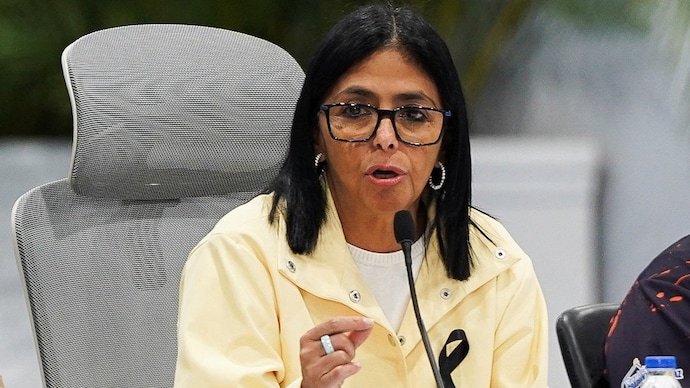
Venezuelan interim President Delcy Rodriguez has described the country’s new energy agreement with the United States as a “historic” partnership, saying Caracas will retain ownership and sovereignty over its natural resources despite expanded US involvement in the oil sector.
Rodriguez said the agreement will remain in force for 25 years and initially focus on developing 17 strategic oilfields with a production target of more than 1.5 million barrels per day. She also said the broader plan includes eight additional greenfield oil blocks as Venezuela attempts to rebuild an industry damaged by years of underinvestment, operational problems and sanctions.
The announcement came one day after US President Donald Trump said Washington had secured majority control of more than 65 billion barrels of Venezuela’s proven oil reserves through a partnership involving private businesses. Trump called it the “biggest oil deal in world history” and argued that the arrangement could help revive Venezuela’s energy industry while increasing crude supplies available to the United States.
The two descriptions of the agreement highlight its central tension. Washington is presenting the arrangement as a major expansion of American control and investment, while Caracas is stressing that Venezuela continues to own its natural resources. The precise legal and commercial structure of the deal has not been fully disclosed.
What Venezuela says the 25-year oil agreement will do
Rodriguez said the bilateral project will run for 25 years and is designed to raise production from the country’s current level toward more than 1.5 million barrels per day.
“This 25-year bilateral project envisages the development of 17 strategic oilfields with a production target of more than 1.5 million barrels per day,” Rodriguez said in an address broadcast on Venezuelan state television.
She emphasized that the 1.5 million-barrel target applies specifically to the bilateral arrangement with the United States and should not be interpreted as the ceiling for Venezuela’s broader oil ambitions.
According to Rodriguez, the country also plans to develop eight greenfield oil blocks as part of a wider expansion of its energy sector. The distinction matters because Venezuela is attempting not simply to restart existing production but to attract capital and Technology for new development as well.
Venezuela has the world’s largest proven crude oil reserves, but its production has remained far below the country’s potential. The gap between reserves and actual output reflects the deterioration of infrastructure and years of inadequate investment, management problems and the impact of US sanctions.
Why the 65 billion barrels figure is significant
Trump’s announcement focused on more than 65 billion barrels of proven Venezuelan reserves. He said the United States had secured majority control of those reserves through a partnership with private business.
That does not mean the United States has acquired ownership of all Venezuelan oil reserves. It refers to control over a substantial portion of the reserves covered by the new arrangement, while the Venezuelan government says its underlying sovereignty over natural resources remains intact.
The distinction between ownership of natural resources and operational or commercial control is central to understanding the deal.
Venezuela’s government says it will retain ownership and sovereignty while using foreign capital, technology and operational expertise to restore production. The United States, meanwhile, is seeking a much larger role for American companies in developing and producing Venezuelan crude.
Until the contractual framework and participating companies are fully disclosed, the exact division of ownership, investment responsibility, production rights and revenues remains an important unanswered question.
Venezuela expects more than $200 billion in revenue
Rodriguez said the agreement could generate approximately $209 billion in revenue for the Venezuelan state, using a benchmark oil price of $65 per barrel.
She acknowledged that crude prices can rise or fall, meaning the eventual amount generated would depend on market conditions, production levels and the actual terms governing the projects.
Rodriguez also said approximately $19 from each barrel produced and sold under the arrangement would flow directly to Venezuela. For a government seeking to rebuild public finances and restore economic activity, the potential revenue stream is one of the most important reasons Caracas is promoting the agreement.
The numbers should nevertheless be viewed as projections rather than guaranteed income. Reaching higher production requires wells to be developed, infrastructure to be repaired, equipment to be deployed and crude to be transported and processed.
The financial outcome will therefore depend not only on the size of Venezuela’s reserves but on how quickly those reserves can be converted into commercially viable production.
Why Venezuela needs foreign capital and technology
Venezuela’s enormous reserves have not translated into equivalent production capacity. Oil fields and related infrastructure require continuous investment, technical expertise and reliable operations.
Rodriguez said the agreement would allow Venezuela to leverage foreign capital, technology and operational knowledge while retaining sovereignty over its resources.
This model reflects a practical problem facing the Venezuelan Oil Industry: possessing large reserves is not enough to guarantee high production. Developing mature fields and new blocks requires substantial spending and specialized equipment, while transportation and processing infrastructure must also be capable of handling the crude being produced.
US companies have extensive experience in oil production and Venezuela has historically had significant commercial links with American energy firms. The new framework therefore aims to use foreign participation as a mechanism for restoring an industry that has struggled to maintain production at its potential.
The deal could reshape Venezuela’s energy industry
If implemented successfully, the agreement could significantly change the structure of Venezuela’s oil sector.
For years, the country’s oil industry has been constrained by a combination of economic difficulties, sanctions, inadequate investment and deteriorating infrastructure. A large inflow of private capital could accelerate repairs and new development.
The proposed expansion also has implications beyond oil production itself. Higher output would require supporting infrastructure, including pipelines, storage, transportation systems and other facilities associated with the petroleum industry.
That could create opportunities for companies involved in engineering, construction, logistics, energy services and equipment supply.
For Caracas, the potential benefit is equally broad. Greater oil production could increase government revenue, provide resources for economic reconstruction and strengthen the country’s ability to finance public services and infrastructure.
US goals go beyond Venezuelan investment
Washington has its own strategic reasons for pursuing a larger role in Venezuela’s oil industry.
Trump has argued that increased Venezuelan production could provide the United States with an additional source of crude and potentially contribute to lower fuel prices. Secretary of State Marco Rubio has also said the arrangement could attract nearly $100 billion in private investment and support economic reconstruction in Venezuela.
The attraction of Venezuelan crude is partly linked to the country’s enormous reserves and the possibility of increasing production closer to the US market than many alternative sources.
However, the impact on American gasoline prices is unlikely to be immediate simply because a major agreement has been announced. Oil production projects take time, particularly when fields and infrastructure require significant rehabilitation.
The eventual effect on US fuel prices would depend on how much additional crude reaches the market, how quickly production increases and what global oil prices are doing at the time.
Why production targets will be difficult to achieve
The proposed increase to more than 1.5 million barrels per day is ambitious when measured against Venezuela’s current production and the condition of its energy infrastructure.
Increasing output requires much more than signing contracts. Operators must determine which fields can be restored economically, secure equipment and investment, repair damaged infrastructure and establish dependable transportation and processing capacity.
Venezuela’s heavy crude also creates technical and logistical challenges. Moving and processing heavier oil can require specialized infrastructure, making the condition and availability of refineries, pipelines and other facilities particularly important.
That means the 1.5 million-barrel target should be understood as an objective under the agreement rather than a production level that will automatically be reached.
Chevron and other companies could play a larger role
Venezuelan officials are preparing to sign additional agreements granting oil exploration and production rights to several companies, including US firms.
Chevron is among the companies expected to be involved in the transition to the new energy framework. Other major international energy companies have also been mentioned in connection with the broader expansion plans.
The participation of established oil producers could be important because rebuilding production requires both capital and technical capabilities. Their involvement would also provide a test of whether the new framework can attract the scale of private investment that Caracas and Washington are anticipating.
The exact commercial terms will matter. Companies will assess the Security of their investments, contractual rights, potential returns, operating conditions and the stability of the legal framework before committing large sums of capital.
Venezuela’s sovereignty claim is central to the agreement
Rodriguez has repeatedly emphasized that Venezuela retains sovereignty over its natural resources.
That message is politically important because control over petroleum has long been closely linked to Venezuelan national sovereignty. The country’s oil reserves are not simply an economic asset; they are also a major part of its national identity and political system.
By framing the agreement as a partnership rather than a transfer of ownership, the interim government is seeking to present US participation as a tool for economic recovery rather than the surrender of Venezuela’s resource base.
The distinction will likely remain a major point of debate as more details emerge.
Domestic opposition raises questions about the US role
Not everyone in Venezuela has welcomed the expanded American role in the country’s oil sector.
Dozens of pro-government groups gathered in downtown Caracas on Saturday to protest against US involvement. Their presence showed that the agreement carries political as well as economic consequences.
Supporters argue that Venezuela needs investment and expertise to restore its oil industry. Critics of greater US involvement can view the arrangement through the lens of national sovereignty and foreign influence.
That debate is unlikely to disappear simply because the government has described the agreement as beneficial. The practical results of the deal, including how much revenue reaches the state and how much control foreign companies receive, will shape public perceptions.
The biggest unanswered questions
Despite the scale of the announcement, important details remain unclear.
- Which specific oilfields are covered by the agreement?
- How will majority US control be structured legally and commercially?
- Which private companies will participate?
- How much capital will be committed and on what timetable?
- How will production revenues be divided between Venezuela, US companies and other participants?
- What legal protections will investors receive?
- How quickly can production rise toward the 1.5 million-barrel target?
These questions are especially important because the success of the agreement will ultimately depend on implementation rather than the headline numbers.
What happens next
The immediate next step is expected to be the signing of additional agreements granting exploration and production rights to companies operating within Venezuela’s new energy framework.
Those contracts should provide greater clarity about how the announced partnership will work in practice.
The development of the 17 strategic fields and eight proposed greenfield blocks will then become a longer-term test of Venezuela’s ability to attract investment and increase production.
The outcome could depend on several factors, including crude prices, the condition of existing infrastructure, the availability of financing, the pace of field development and the legal framework governing foreign participation.
A major opportunity, but not an instant oil revival
Venezuela’s new agreement with the United States represents a potentially major shift in the country’s oil industry. Caracas says it will retain sovereignty over its resources while using foreign capital and expertise to restore production. Washington, meanwhile, sees the arrangement as a way to expand American influence over a huge reserve base and potentially increase crude supplies.
The numbers involved are enormous: more than 65 billion barrels of reserves, 17 strategic oilfields, a production target above 1.5 million barrels per day and a Venezuelan revenue projection of about $209 billion at a $65 oil price.
But those figures are not the same as immediate production or guaranteed income. Venezuela’s oil industry still faces the practical challenge of turning reserves into barrels that can be produced, transported and sold.
The agreement’s real significance will therefore become clearer as contracts are signed, companies commit capital and field development begins. For Venezuela, the central question is whether US-backed investment can restore its damaged energy industry without undermining the sovereignty Caracas says the agreement is designed to protect.
For breaking news and live news updates, like us on Facebook or follow us on Twitter and Instagram. Read more on Latest World on thefoxdaily.com.






COMMENTS 0