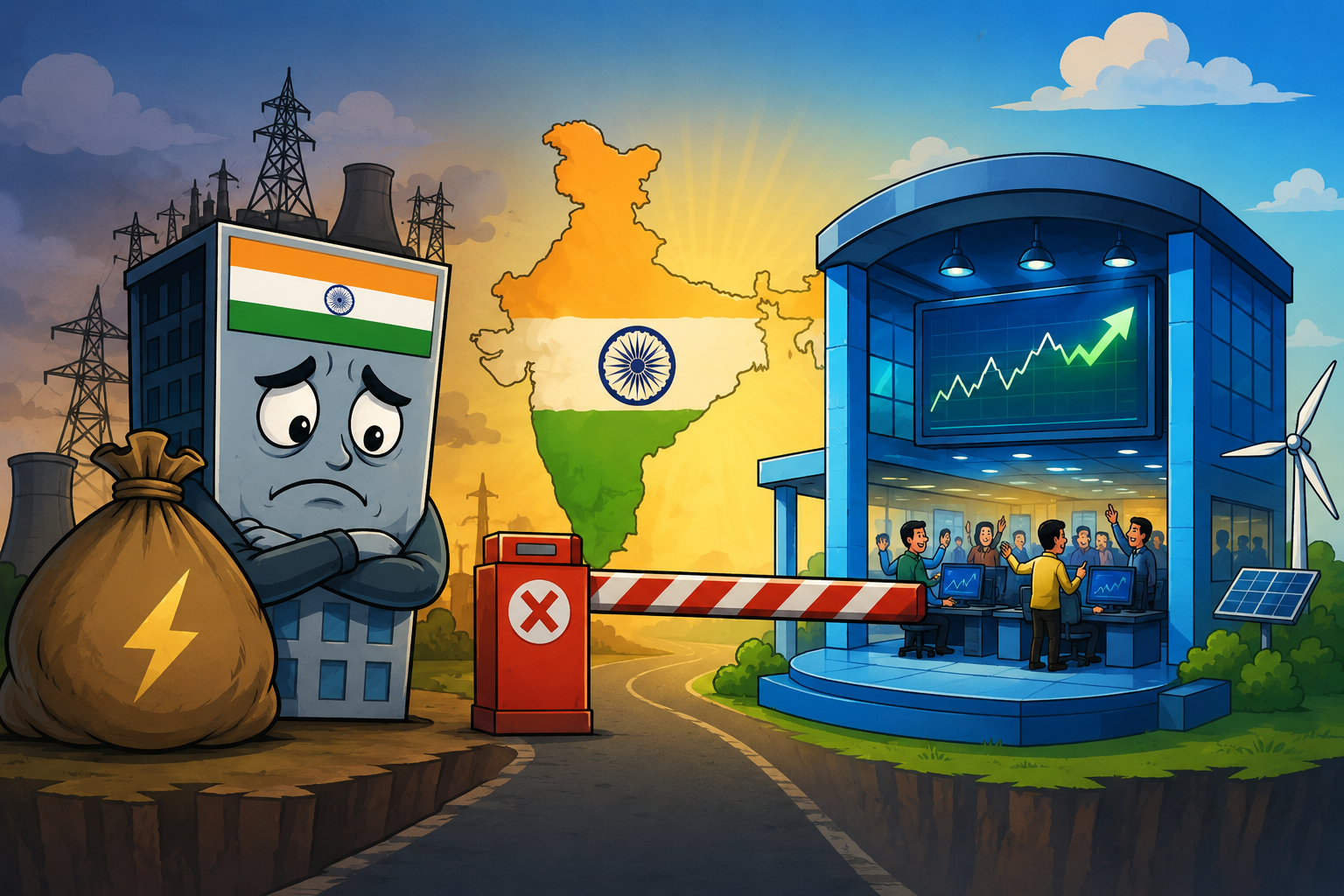
India‘s electricity market is undergoing one of its most significant transformations since power trading was introduced more than two decades ago. At the center of a major regulatory debate is PTC India, the country’s largest power trading company, which finds itself unable to participate in trading activities on Hindustan Power Exchange (HPX) a platform it played a key role in creating.
The issue highlights a broader challenge facing India’s evolving power markets: how to balance competition, market integrity, investor interests, and efficient price discovery while encouraging new entrants in a market still dominated by a single exchange.
The Central Electricity Regulatory Commission (CERC) recently rejected HPX’s request to grant PTC India a temporary exemption that would have allowed the company to trade on the exchange while gradually reducing its shareholding. The decision has intensified discussions about market structure, exchange competition, and upcoming reforms such as market coupling.
Beyond the immediate dispute, the case offers important insights into the future of India’s electricity markets and the challenges of creating genuine competition in a rapidly expanding Energy Sector.
What Is PTC India and Why Is It Important?
Established in 1999, PTC India is widely regarded as the pioneer of organized power trading in India.
Before electricity markets became sophisticated and exchange-driven, power transactions were largely conducted through long-term agreements and bilateral arrangements. PTC played a crucial role in facilitating power purchases between generating companies, distribution utilities, and large consumers.
Today, it remains the largest licensed power trader in India.
In FY25, PTC India accounted for nearly one-third of all bilateral electricity volumes traded through licensed power traders. Its influence extends across multiple segments of the electricity market, making any regulatory restrictions on its operations significant for the broader power sector.
Understanding Power Exchanges in India
To understand the current dispute, it is important to understand how power exchanges work.
Power exchanges are electronic platforms where electricity buyers and sellers transact electricity through transparent market mechanisms.
Participants include:
- Power generation companies.
- State electricity distribution companies.
- Open-access consumers.
- Power traders.
- Industrial users.
- Renewable energy producers.
These exchanges help determine market-based electricity prices based on supply and demand.
India currently has three major power exchanges:
- Indian Energy Exchange (IEX).
- Power Exchange India Limited (PXIL).
- Hindustan Power Exchange (HPX).
Among these, IEX remains the dominant player with a market share exceeding 80%, making it one of the most influential entities in India’s power trading ecosystem.
The Regulatory Rule Creating the Problem
The dispute stems from provisions contained in the CERC (Power Market) Regulations, 2021.
Under these regulations, a trader-member cannot hold more than 5% equity in a power exchange where it actively trades.
The purpose of the rule is straightforward: prevent conflicts of interest.
If a large trader owns a significant stake in an exchange where it trades, concerns may arise regarding:
- Market manipulation.
- Preferential access.
- Governance influence.
- Unfair competitive advantages.
- Price discovery integrity.
PTC India currently owns approximately 22.62% of HPX, significantly above the permitted threshold.
As a result, the company cannot legally trade on the exchange unless it first reduces its ownership stake.
The Catch-22 Facing PTC India
The situation has become a classic Business paradox.
PTC India cannot trade on HPX because its stake is too large. However, reducing that stake may be difficult because HPX itself has struggled to gain sufficient market share and trading volume.
This creates a circular challenge:
- HPX needs more liquidity and trading activity.
- PTC India could potentially provide substantial volumes.
- PTC cannot trade without reducing ownership.
- Reducing ownership is difficult because investor interest remains limited.
- Limited activity affects HPX’s attractiveness to new investors.
The result is a regulatory deadlock that affects both the exchange and one of its key shareholders.
Why HPX Wanted an Exemption
HPX approached the regulator seeking a three-year transitional exemption.
The proposal would have allowed PTC India to trade on the exchange while gradually reducing its shareholding over time.
HPX argued that this approach would generate several benefits:
- Higher liquidity.
- Increased trading volumes.
- Improved market participation.
- Enhanced competition among exchanges.
- Greater value for stakeholders.
The exchange maintained that immediate divestment was impractical given current market realities and investor sentiment.
However, the regulator ultimately rejected these arguments.
Why CERC Rejected the Request
The regulator’s decision centered on compliance and governance principles.
CERC noted that PTC India had not demonstrated substantial efforts to reduce its shareholding since HPX commenced operations in 2022.
According to the regulator, commercial difficulties alone cannot justify exemptions from established market regulations.
The commission observed that investors entered HPX with the expectation that PTC’s participation would contribute to future business growth. Yet despite these expectations, ownership dilution had not occurred.
The regulator concluded that granting an exemption could undermine the integrity of the regulatory framework.
HPX’s Market Share Problem
One of the central issues in the debate is market concentration.
HPX has repeatedly argued that the Indian power exchange market remains heavily dominated by a single platform.
New exchanges face substantial challenges when attempting to attract participants because electricity trading naturally benefits from network effects.
In simple terms:
- More buyers attract more sellers.
- More sellers attract more buyers.
- Higher volumes improve price discovery.
- Better liquidity attracts additional participants.
This creates a self-reinforcing cycle that favors established exchanges.
For newer platforms such as HPX, breaking this cycle requires significant liquidity, strong participant confidence, and sustained growth.
Market Concentration in India’s Power Trading Sector
| Power Exchange | Approximate Market Position | Key Challenge |
|---|---|---|
| IEX | Dominant Market Leader | Maintaining leadership |
| PXIL | Smaller Competitor | Increasing participation |
| HPX | New Entrant | Building liquidity and volumes |
The concentration issue has become increasingly important as regulators seek to encourage greater competition and market efficiency.
The Emerging Debate Over Market Coupling
The timing of this dispute is particularly significant because India is considering one of the biggest changes in power market design: market coupling.
Under the current system, each power exchange independently discovers electricity prices based on its own buy and sell orders.
This means prices can differ across exchanges.
Market coupling would fundamentally change this structure.
Instead of each exchange determining prices separately, a centralized mechanism would aggregate bids from all exchanges and determine a uniform market-clearing price.
The process would be managed by a designated Market Coupling Operator.
How Market Coupling Could Change Everything
Supporters of market coupling argue that it can improve efficiency by ensuring all market participants receive the same price signal.
Potential benefits include:
- Uniform electricity pricing.
- Improved market efficiency.
- Reduced fragmentation.
- Better utilization of generation resources.
- Enhanced transparency.
Critics, however, worry about operational complexity and the potential reduction of competition among exchanges.
The debate remains one of the most important regulatory discussions currently shaping India’s electricity sector.
PTC India’s Argument for Regulatory Change
PTC India believes that market coupling fundamentally alters the rationale behind ownership restrictions.
Its argument is based on a simple premise.
If prices are no longer determined independently by individual exchanges, the risk of influencing price discovery through ownership becomes significantly lower.
In a coupled market:
- Bids are aggregated centrally.
- Price discovery becomes exchange-neutral.
- Individual exchange influence decreases.
- Market-clearing prices emerge from a common mechanism.
PTC argues that under such a framework, the current ownership restrictions should be reconsidered.
The regulator has not yet accepted this position, but the issue is likely to remain part of future Policy discussions.
Why Selling the Stake Is Easier Said Than Done
Although regulations technically provide a clear solution sell the excess stake the practical realities are more complicated.
HPX remains an unlisted company.
This limits the pool of potential buyers and makes valuation more difficult.
Several factors affect investor interest:
- HPX’s relatively small market share.
- Strong competition from established exchanges.
- Uncertainty surrounding market coupling.
- Liquidity challenges.
- Evolving regulatory frameworks.
Potential investors may hesitate to commit capital until greater clarity emerges regarding the future structure of India’s power markets.
Why This Matters for India’s Energy Future
At first glance, the dispute may appear to involve only one company and one exchange.
In reality, it reflects broader questions about how India’s electricity markets should evolve.
India’s power demand continues to grow rapidly due to:
- Industrial expansion.
- Urbanization.
- Rising electricity consumption.
- Electric vehicle adoption.
- Renewable energy integration.
Efficient electricity markets will play a crucial role in balancing supply and demand while supporting affordability and reliability.
The success of exchanges like HPX, PXIL, and IEX will influence how effectively electricity can be traded across regions and market segments.
A Unique Insight: This Is Really a Competition Policy Debate
Although framed as a regulatory compliance issue, the dispute is ultimately about competition.
HPX argues that allowing PTC participation would help build a viable competitor to the dominant market leader.
CERC argues that governance principles and market integrity cannot be compromised for commercial reasons.
Both positions have merit.
The challenge for regulators is balancing competition with transparency and fairness.
This tension exists in Financial Markets, commodity exchanges, telecommunications networks, and digital platforms worldwide.
India’s power market is now facing a similar crossroads.
Future Outlook: What Happens Next?
Several developments could shape the outcome.
- PTC India may seek investors for partial stake dilution.
- HPX could focus on organic growth and liquidity enhancement.
- Market coupling regulations may alter the competitive landscape.
- CERC could revisit ownership norms in the future.
- New strategic investors may emerge as the market matures.
Much will depend on how quickly India’s power market reforms progress and whether newer exchanges can attract greater participation.
Conclusion
PTC India’s inability to trade on HPX highlights a complex intersection of regulation, competition, ownership, and market design. While the company helped establish the exchange, current regulations prevent it from participating as a trader due to its substantial ownership stake.
The situation has created a regulatory Catch-22: HPX needs liquidity and growth, PTC could potentially provide it, but ownership restrictions stand in the way. Meanwhile, broader reforms such as market coupling may fundamentally reshape how electricity prices are discovered in India.
The outcome of this debate will extend beyond one company or one exchange. It could influence the future structure of India’s power markets, the level of competition among exchanges, and the efficiency of electricity trading in one of the world’s fastest-growing energy economies. As regulators, exchanges, and market participants navigate these challenges, the decisions made today will help define India’s power trading landscape for the next decade.
For breaking news and live news updates, like us on Facebook or follow us on Twitter and Instagram. Read more on Latest Business on thefoxdaily.com.



COMMENTS 0