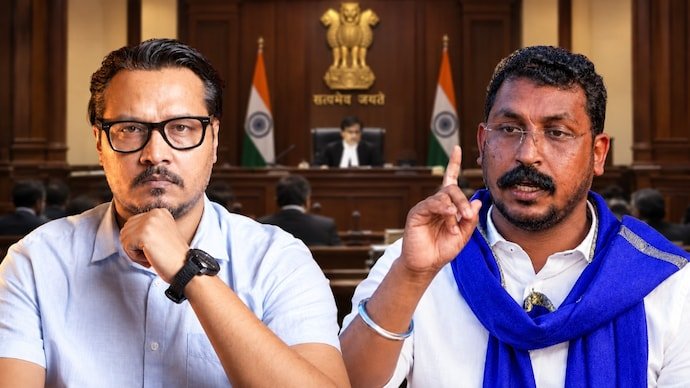
A Delhi court has rejected YouTuber and reservation-reform activist Ajeet Bharti’s anticipatory bail plea in a case registered under the Scheduled Castes and Scheduled Tribes (Prevention of Atrocities) Act, finding that remarks attributed to him about Nagina MP Chandrashekhar Azad prima facie invoked caste hierarchy and caste-based notions of purity and superiority.
In its detailed order, Additional Sessions Judge Saurabh Pratap Singh Laler of the Patiala House Courts focused particularly on an alleged remark that Azad should first make himself “worthy” of marrying a woman from an upper caste. The court found that the language was not merely a passing reference to caste but appeared to connect a person’s suitability for marriage with caste status.
The court consequently held that the ingredients of Section 3(1)(r) of the SC/ST Act were prima facie disclosed. Because Section 18 of the law restricts the grant of anticipatory bail where an offence under the Act is prima facie made out, Bharti was denied pre-arrest protection.
At the same time, the order did not determine Bharti’s guilt. The judge specifically clarified that the observations were confined to deciding the bail application and should not be treated as a final finding on the allegations or the complete merits of the criminal case.
Why the Delhi court focused on caste hierarchy
The central issue before the court was not simply whether Bharti had used caste-related words. The judge examined the context and function of those references in the alleged remarks.
According to the detailed order, the court found that the response contained an “invocation of caste names” that operated as the organising basis of the statement rather than appearing as an isolated reference made during an argument.
The court gave particular importance to the alleged assertion that Chandrashekhar Azad needed to make himself worthy of marrying an upper-caste woman. In the judge’s reasoning, that phrasing created a hierarchy in which an SC person was portrayed as needing to possess something “extra” or be “more worthy” before being considered suitable to marry someone from a higher caste.
The court said the language therefore raised a specific caste-based distinction rather than merely commenting on an individual’s personal suitability for marriage.
That distinction ultimately became decisive for the anticipatory bail application.
What exactly is alleged to have been said?
The case arises from a August 22 YouTube broadcast titled “SB79: Reservation Hatao Andolan Nautanki & More | Saptahik Bakaiti”, according to the complaint and the material discussed in the court proceedings.
The complainant, Balakram Bauddh, is the Delhi State president of the Azad Samaj Party (Kanshi RAM), the political organisation led by Chandrashekhar Azad.
The complaint alleged that Bharti was responding to a viewer who suggested that the commentator’s sister should marry Azad and that such a marriage would somehow resolve or end the dispute over reservation.
According to the allegations recorded in the case, Bharti responded by referring to caste identities and then questioned whether merely being a member of the Chamar community and an MP was sufficient for marriage with an upper-caste woman. The complaint further alleged that he said Azad would first have to make himself worthy of marrying a “Savarna” woman.
The prosecution relied on the broader contents of the video to argue that the remarks were casteist, humiliating and objectionable. The complaint also contained allegations concerning remarks about women and Dr B R Ambedkar.
These remain allegations in the criminal case. The court’s ruling at the bail stage was based on whether the material before it disclosed a prima facie offence for purposes of anticipatory bail.
Why Section 3(1)(r) became the key provision
Section 3(1)(r) of the SC/ST Act deals with intentionally insulting or intimidating a member of a Scheduled Caste or Scheduled Tribe with intent to humiliate that person in a place within public view.
The provision is part of a law specifically designed to address caste-based atrocities and forms of humiliation directed at members of SC and ST communities.
For the purposes of Bharti’s bail plea, the court did not have to establish the offence beyond reasonable doubt. It had to determine whether the available material was sufficient to disclose the ingredients of the provision on a prima facie basis.
The judge concluded that it was.
The alleged reference to a person’s caste and his supposed worthiness to marry across caste lines was particularly significant because the court viewed the statement as reinforcing a social hierarchy rather than simply using caste terminology in passing.
Why anticipatory bail was not available after that finding
The most important legal consequence of the court’s prima facie finding was the operation of Section 18 of the SC/ST Act.
The provision creates a statutory bar on anticipatory bail in cases where the court finds that the provisions of the Act are prima facie attracted.
That meant the judge’s conclusion about Section 3(1)(r) effectively determined the outcome of the bail application.
The defence could argue that Bharti should be protected from arrest, that the allegations did not satisfy the requirements of the SC/ST Act or that other circumstances justified relief. But once the court found a prima facie case under the relevant provision, the statutory restriction on anticipatory bail became the decisive issue.
The court therefore dismissed the application.
The court did not say Bharti must be arrested
An important detail in the order is that denial of anticipatory bail is not the same as a direction to arrest.
The court noted that if the SC/ST Act offences were not involved, it might have considered granting Bharti relief. The judge also observed that the material relevant to the case was already largely in the public domain and that custodial interrogation did not appear necessary merely to preserve or discover the evidence.
This distinction matters because anticipatory bail concerns protection from arrest. Refusing such protection removes that safeguard, but the investigating agency must still act according to law and the requirements of the case.
In other words, the court’s reasoning was driven primarily by the statutory bar created when it found a prima facie SC/ST Act offence, rather than by a finding that prolonged custodial interrogation was essential.
What the defence argued
Bharti’s lawyer, Jai Anant Dehadrai, challenged the applicability of the SC/ST Act provisions invoked against his client.
Among the arguments recorded in the proceedings was the contention that the relevant sections, including Sections 3(1)(r) and 3(1)(s), were not prima facie satisfied.
The defence also argued that the remarks were made in response to what it characterized as a serious provocation involving a family member. The alleged original comment concerned a suggestion that Bharti’s married sister should marry Chandrashekhar Azad.
Another defence contention was that the complainant had not personally been present when the remarks were made and that there was no identified woman who had been insulted in public view as a result of the alleged comments.
The defence also maintained that the remarks were rhetorical and hypothetical rather than a targeted statement against a particular woman.
The court nevertheless considered the caste dimension of the remarks sufficiently specific to cross the prima facie threshold under Section 3(1)(r).
The complaint was filed on August 23
The FIR against Bharti was registered at North Avenue Police Station in Delhi on August 23, following the complaint by Balakram Bauddh.
Besides provisions of the SC/ST Act, the FIR also invoked Section 67 of the Information Technology Act and Sections 196(1)(c) and 351(3) of the Bharatiya Nyaya Sanhita, according to the court proceedings.
The case therefore extends beyond the single caste-related provision that became central to the bail decision.
However, for anticipatory bail, the SC/ST Act became the critical factor because of the specific statutory limitation imposed by Section 18.
Why the “upper caste” marriage reference mattered so much
The court’s most significant observation was its treatment of marriage as the context in which the caste hierarchy was allegedly invoked.
Marriage has historically been deeply intertwined with caste identity in Indian society, particularly through the practice of caste endogamy. Laws and social movements have challenged discriminatory barriers, but caste continues to influence marriage patterns in many communities.
Against that background, the judge viewed the alleged statement differently from a generic insult. The reference to whether an SC person was sufficiently “worthy” to marry an upper-caste woman was interpreted as invoking a hierarchy between social groups.
The court effectively reasoned that the insult lay not simply in the use of a caste name but in suggesting that caste determines whether a person is inherently suitable for marriage with someone from a socially higher group.
That is why the language of purity, hierarchy and superiority became central to the court’s prima facie assessment.
The court distinguished a stray caste reference from the alleged context here
Caste-related words do not automatically establish every element of an offence under the SC/ST Act. The circumstances, intent, target, context and statutory requirements all matter.
What persuaded the Delhi court in this case was its assessment that caste was not incidental to the alleged remark. Instead, caste reportedly formed the basis of the comparison being made about Azad’s marriageability.
The court characterized that distinction as significant because the statement allegedly implied that a member of an SC community needed to become “something more” before being considered worthy of marrying into an upper-caste family.
That, in the court’s prima facie view, transformed the statement from an ordinary personal attack into one that drew upon caste hierarchy to humiliate an SC individual.
Chandrashekhar Azad is a sitting MP and Dalit political leader
Chandrashekhar Azad is the founder and chief of the Azad Samaj Party (Kanshi Ram) and represents the Nagina constituency in the lok Sabha.
He has emerged as a prominent Dalit political voice, particularly among younger sections of the community. His political platform frequently addresses caste discrimination, social justice and the rights of marginalized communities.
That political background is relevant to the context of the case, but it does not by itself determine the legal question. The court was required to examine the specific remarks and whether they prima facie satisfied the statutory provisions relied upon by the prosecution.
The case comes against a wider debate over caste and reservation
Bharti has built a public profile around criticism of India’s reservation system and advocacy for what he describes as reservation reform. His content has often focused on caste policy, affirmative action and political debates surrounding quota systems.
The criminal case therefore sits within a politically charged debate in which arguments about reservation can quickly become arguments about caste identity itself.
That makes the distinction between criticising reservation policy and humiliating a person because of caste particularly important.
People in India can and do disagree sharply over reservation, representation and affirmative action. Those disagreements are legitimate subjects of political discussion. The court’s order, however, focuses on whether the specific language alleged in this case went beyond policy criticism and invoked caste hierarchy in a manner prohibited by the SC/ST Act.
Why the public-view requirement was debated
The defence also questioned whether the necessary public-view element of Section 3(1)(r) was met.
Because the alleged remarks were made during a YouTube programme, the case raises an interesting legal question about how traditional statutory language concerning “public view” interacts with modern digital communication.
Unlike a private conversation, a public online broadcast can potentially reach a large audience and remain available for viewing, sharing and reproduction after the original transmission.
The court’s prima facie conclusion indicates that it was satisfied that the available material was sufficient to attract the provision at the bail stage. A final determination on every factual and legal issue will depend on the subsequent proceedings.
The significance of the court’s “prima facie” finding
The phrase “prima facie” is crucial to understanding the order.
It means that, based on the material currently before the court, there appears to be enough to establish a particular legal proposition for the limited purpose of the proceeding being decided.
It does not mean the prosecution has proved its case beyond reasonable doubt.
That standard applies at trial, where evidence can be tested, witnesses can be examined and the defence can challenge the prosecution’s case in full.
By expressly limiting its observations to the anticipatory bail issue, the Delhi court avoided turning the bail proceeding into a final determination of Bharti’s guilt.
The order leaves the criminal case open
The detailed judgment does not resolve whether Bharti will ultimately be convicted or acquitted.
That decision would require the criminal process to proceed and the evidence to be evaluated under the appropriate standards.
The court also did not make a final determination about every allegation in the FIR. Its central finding for the bail application was that Section 3(1)(r) of the SC/ST Act was prima facie attracted and that Section 18 consequently barred anticipatory bail.
This limited scope is important when interpreting headlines about the case. “Bail denied” does not mean “guilt established”. It means the court did not grant the specific protection from arrest that Bharti sought.
What the case could mean for online caste discourse
The case highlights the increasingly difficult boundary between political commentary, provocative online speech and legally actionable caste-based humiliation.
Social media has dramatically expanded the reach of political commentary. A statement made during a live broadcast can reach thousands or millions of viewers, be clipped into shorter videos and continue circulating long after the original context disappears.
That makes the language used by public commentators more consequential than it might have been in a private conversation.
At the same time, the case demonstrates why courts must carefully separate controversial political speech from conduct that actually satisfies the elements of a criminal offence.
For Bharti, the court has now made one thing clear at the bail stage: the alleged marriage-related remarks were sufficiently rooted in caste hierarchy, in the judge’s prima facie assessment, to trigger the SC/ST Act’s restrictions on anticipatory bail.
A case shaped by one sentence but decided through a larger legal framework
The Delhi court’s order ultimately turned on more than whether Bharti used offensive language.
The decisive question was whether the alleged statement linked a person’s worth to his caste in a way that amounted, prima facie, to intentional humiliation of an SC member in public view.
The judge concluded that the alleged reference to Chandrashekhar Azad needing to become worthy of marrying an upper-caste woman invoked precisely such a hierarchy.
That finding brought Section 3(1)(r) into play. Once the provision was found prima facie applicable, Section 18 restricted the court’s ability to grant anticipatory bail.
The result was therefore driven by the interaction between the alleged language and the specific statutory framework protecting members of Scheduled Castes and Scheduled Tribes.
What happens next for Ajeet Bharti?
Bharti’s anticipatory bail plea has been dismissed, but the underlying criminal proceedings continue.
The investigation and subsequent legal proceedings will determine how the allegations are ultimately tested. Evidence from the YouTube broadcast, the complaint, other digital material and the surrounding circumstances can be examined as the case progresses.
For now, the court has not made a final finding of guilt and has expressly limited the scope of its observations to the bail stage.
The immediate legal significance of the order is that Bharti does not have anticipatory-bail protection in this case. The larger significance lies in the court’s explanation of why it viewed the alleged remarks as invoking caste hierarchy rather than merely containing an offensive reference to caste.
Why this order matters beyond one bail plea
The Ajeet Bharti case is likely to draw attention because it sits at the intersection of free expression, caste discourse, political commentary and the SC/ST Act.
The court’s reasoning emphasizes that context can matter as much as individual words. A caste reference may be viewed differently when it is used to make an argument about social hierarchy, marriage and a person’s supposed worth based on caste.
At the same time, the order carefully preserves the distinction between a prima facie finding and a final verdict.
For now, the legal takeaway is clear: the Delhi court considered the alleged statement about Chandrashekhar Azad’s worthiness to marry an upper-caste woman sufficiently caste-based and humiliating to prima facie attract Section 3(1)(r) of the SC/ST Act. Because that finding activated the statutory bar under Section 18, Ajeet Bharti was denied anticipatory bail.
The criminal case itself remains to be decided on its full merits.
For breaking news and live news updates, like us on Facebook or follow us on Twitter and Instagram. Read more on Latest India on thefoxdaily.com.




COMMENTS 0