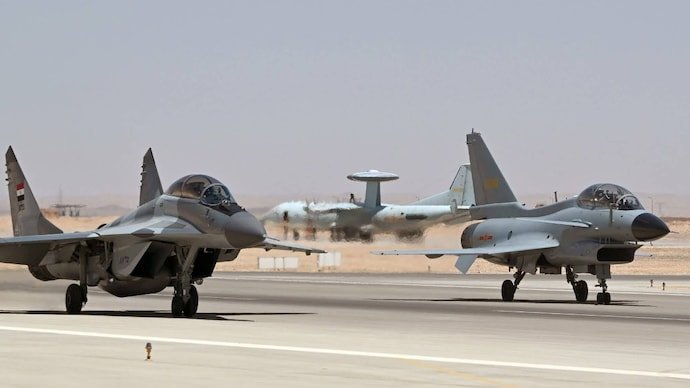
china‘s J-16 fighter jets are taking part in combat training against French-made Rafale aircraft in Egypt, bringing two advanced 4.5-generation fighters together in a rare military exercise. The encounter is being closely watched in India because of the country’s own Rafale fleet, China’s expanding airpower and the growing military relationship between Beijing and Pakistan.
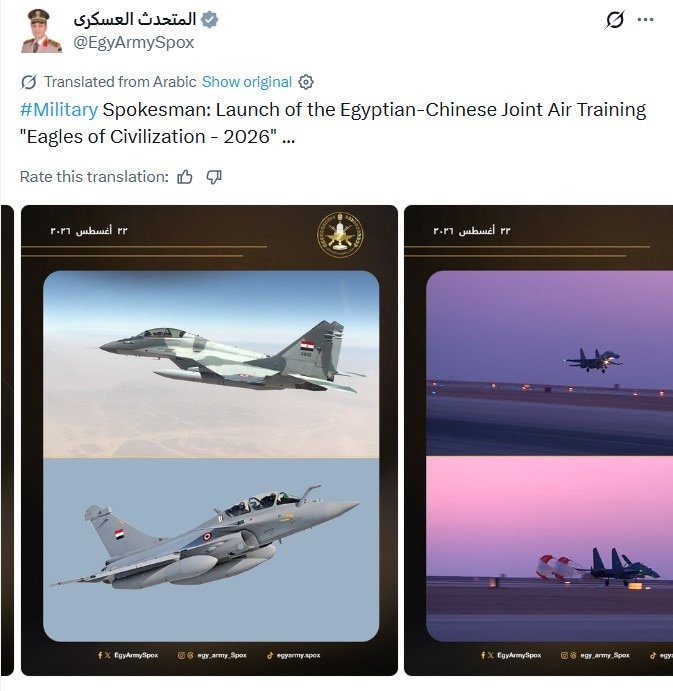
The Eagles of Civilization 2026 exercise began on August 22 and involves the Chinese and Egyptian air forces. The Chinese deployment includes J-16 fighters, while Egypt has brought its Rafales into the training. Egyptian MiG-29s are also participating.
For China, the exercise is an opportunity to operate a heavyweight fighter far from home and train against an advanced Western-designed aircraft. For Egypt, it strengthens military cooperation with Beijing while giving its pilots experience operating alongside Chinese combat aircraft.
For India, however, the most interesting aspect is the opportunity to observe how the J-16 performs in simulated air-combat scenarios involving a Rafale. The exercise does not provide a simple answer to which aircraft is superior, but it can offer useful clues about tactics, aircraft handling and the challenges posed by China’s modern fighter fleet.
What is happening in the China-Egypt air exercise?
The second edition of the Eagles of Civilization exercise began in Egypt on August 22. Chinese and Egyptian personnel are conducting theoretical and practical training, including joint sorties and air-combat exercises.
Chinese military footage released during the exercise showed a J-16 operating close to an Egyptian Rafale during simulated combat manoeuvres. The two aircraft were used in one-on-one air-combat training under controlled exercise conditions.
The encounter is significant because the J-16 has rarely been exposed in this kind of overseas training against a Western-designed fighter.
China also demonstrated an important logistical capability by deploying J-16s roughly 6,000 kilometres to Egypt. The long-distance movement required careful planning and support, highlighting that the exercise is about more than simply putting two fighter types in the same sky.
Long-range deployments test pilots, maintenance crews, ground support, communications, navigation and the ability to sustain combat aircraft away from established domestic bases.
J-16 vs Rafale: Two very different approaches to airpower
The J-16 is a twin-engine, two-seat multirole fighter developed by China’s Aviation Industry Corporation of China. It is a heavy aircraft designed to carry a substantial weapons load while undertaking air-to-air and air-to-ground missions.
The Rafale, developed by France‘s Dassault Aviation, is also a twin-engine multirole fighter. It is designed to perform a wide range of missions, including air superiority, precision strike and reconnaissance.
Both aircraft belong broadly to the 4.5-generation category, meaning they combine advanced radar, avionics, electronic warfare capabilities and modern weapons with a conventional fighter design rather than being stealth aircraft in the fifth-generation sense.
That makes the exercise particularly interesting. The J-16 represents China’s development of a large, long-range fighter platform, while the Rafale represents a highly integrated European combat aircraft that has been adapted for different customers.
But a visual encounter between two aircraft cannot establish which one would win in a real war.
Modern air combat depends on far more than the manoeuvrability of the aircraft. Radar performance, electronic warfare, missile capability, pilot training, airborne early-warning aircraft, data links, ground-based sensors and command-and-control systems can all determine the outcome.
Why one-on-one combat footage should not be overinterpreted
The images released from the exercise may make the encounter look like a direct test between the J-16 and Rafale. In reality, military exercises are carefully controlled environments.
Pilots may be assigned specific scenarios, weapons restrictions and engagement rules. Aircraft may not use their full operational capabilities. Sensitive electronic-warfare systems and classified tactics are also unlikely to be exposed in a routine international exercise.
That means the footage can demonstrate how the aircraft behave in particular training situations, but it cannot prove that one fighter is categorically superior to the other.
The same principle applies to claims about what China may learn from the Rafale.
Chinese pilots can gain experience against the aircraft’s flight characteristics and observe how it behaves during particular manoeuvres. But Egypt’s Rafales are not identical to India’s Rafales. Different countries can operate different weapons, software configurations, electronic-warfare systems, communications equipment and support arrangements.
Consequently, any lessons Beijing gains from the exercise should not automatically be treated as a complete picture of the capabilities of India’s Rafale fleet.
Why India is paying attention to the J-16
The exercise has a direct relevance to India’s security environment because China is steadily expanding the sophistication and scale of its air force.
The J-16 is particularly important because it is a heavyweight fighter capable of carrying a large weapons load and operating over longer ranges. It complements China’s lighter J-10 family and forms part of the country’s broader modernisation of its tactical aviation fleet.
For the Indian Air Force, the question is therefore not simply whether the J-16 can outmanoeuvre a Rafale.
The bigger question is how such aircraft would operate as part of a larger Chinese air campaign involving airborne early-warning aircraft, electronic warfare assets, long-range missiles, ground-based air defence and other fighters.
That networked environment is far more relevant to a real conflict than a one-on-one encounter.
Pakistan’s J-10C connection adds another layer
India’s interest in Chinese fighter developments has also been sharpened by Pakistan’s acquisition of the Chinese-made J-10C.
Pakistan operates the J-10C alongside the jointly developed JF-17 Thunder. The J-10C is a single-engine multirole fighter and belongs to the same broad 4.5-generation category as several modern Western fighters.
Pakistan has also shown interest in acquiring more advanced Chinese combat aircraft, including the J-16. If such a procurement eventually takes place, the J-16 could add a heavier and more capable platform to Pakistan’s fighter inventory.
That would matter to India because the J-16’s capabilities are different from those of the J-10C. A heavier fighter can carry more weapons and potentially support longer-range missions, while its two-seat configuration can also be useful for complex strike and electronic-warfare roles.
There is therefore a strategic reason for Indian planners to monitor the J-16 beyond the immediate Egypt exercise.
What the 2025 India-Pakistan conflict changed
The relevance of the exercise is also connected to the air combat between India and Pakistan in May 2025.
Indian and Pakistani aircraft were involved in hostilities during that confrontation, and the performance of Chinese-origin Pakistani fighters became a major subject of international attention.
India acknowledged that it suffered aircraft losses during the conflict but did not publicly provide a complete breakdown of every aircraft involved. Pakistani claims about the scale of Indian losses and India’s claims about Pakistani aircraft losses have also been contested, making many specific battlefield claims difficult to independently establish.
What is clearer is that the conflict demonstrated how important long-range missiles, sensors, electronic warfare, intelligence and networked air operations have become in modern aerial warfare.
That lesson is more important for India than any simple comparison between individual fighter aircraft.
If Pakistan eventually acquires the J-16, India would have to consider a heavier Chinese fighter operating alongside the J-10C and JF-17. The aircraft would also potentially benefit from China’s broader ecosystem of airborne surveillance, electronic warfare and missile technology.
India’s Rafales are not the same as Egypt’s Rafales
One of the most important qualifications in analysing the Egypt exercise is that Rafale is not a single identical configuration worldwide.
France has supplied the aircraft to several countries, and customer-specific equipment and weapons can differ. India operates Rafales with a configuration tailored to the requirements of the Indian Air Force.
That means Chinese pilots training against Egyptian Rafales cannot automatically be assumed to be training against every capability available to an Indian Rafale squadron.
Operational effectiveness also depends on the aircraft’s weapons, mission-planning systems, pilot proficiency, intelligence support and integration with other Indian military assets.
This distinction is crucial because fighter aircraft are systems rather than isolated machines. A highly capable aircraft can become significantly more effective when connected to a strong intelligence and command network.
The exercise also tests China’s ability to project airpower abroad
There is another aspect of the exercise that India should watch: the deployment itself.
Sending J-16s from China to Egypt is a substantial logistical undertaking. The aircraft travelled thousands of kilometres, requiring aerial refuelling and support arrangements along the way.
China’s ability to move modern combat aircraft far beyond its immediate neighbourhood is strategically relevant. It shows that the People’s Liberation Army Air Force is gaining experience in operating away from its traditional bases.
For Beijing, overseas exercises can provide training in unfamiliar airspace, international coordination and expeditionary logistics. These are different challenges from operating over China’s own territory or nearby waters.
The exercise therefore provides two sets of information: how the J-16 performs during tactical training and how China manages a long-distance fighter deployment.
Why Egypt is an important partner for China
Egypt is a particularly interesting partner because its air force operates equipment from several major military powers.
Its inventory includes American F-16 fighters, French Rafales and Russian-origin aircraft. That gives Egypt experience with multiple aircraft families and makes it a useful training partner for countries seeking exposure to different operational environments.
China’s growing military relationship with Egypt also fits into Beijing’s broader effort to expand defence engagement beyond East Asia.
China has conducted military exercises with other countries that operate Western-designed aircraft. Such engagements allow Chinese forces to train in different environments and expose pilots to aircraft and operational practices outside China’s own fleet.
For Egypt, cooperation with China offers another defence relationship without necessarily requiring it to abandon its existing partnerships with the United States, France or Russia.
What India can actually learn from the J-16-Rafale drill
India should not treat the exercise as a simple scoreboard between the two fighters. Its real value lies in the information that can be extracted from the training environment.
Several areas are likely to be of interest:
- J-16 tactics: How Chinese pilots employ a heavyweight fighter during different air-combat scenarios.
- Long-range operations: What the overseas deployment reveals about China’s ability to sustain combat aircraft far from home.
- Electronic warfare: How Chinese aircraft integrate sensors and electronic systems during complex training.
- Weapons employment: The types of engagement scenarios and tactics used during simulated combat.
- Command and control: How fighters are integrated with supporting aircraft and wider networks.
- Aircrew training: How Chinese pilots adapt to unfamiliar airspace and foreign aircraft.
These observations are potentially more valuable than the close-up videos showing a J-16 and Rafale manoeuvring near each other.
What this means for India’s fighter strategy
The exercise comes as India continues to strengthen its fighter fleet and consider additional Rafale acquisitions.
India’s interest in more Rafales reflects the aircraft’s established role in the Indian Air Force, but the appearance of newer Chinese fighters also highlights the need for India to develop capabilities beyond simply increasing the number of imported aircraft.
Future air warfare will depend increasingly on networks, sensors, long-range weapons, electronic warfare and unmanned systems working alongside conventional fighters.
For India, the J-16 is therefore a reminder that the air-power competition with China is not only about comparing individual aircraft specifications. It is about how quickly each side can integrate aircraft into a larger combat system.
The bigger lesson from the J-16 and Rafale encounter
The Eagles of Civilization exercise will not settle the question of whether China’s J-16 or France’s Rafale is the better fighter. Real combat does not provide the clean conditions of a one-on-one training scenario, and classified capabilities cannot be assessed from public footage alone.
But the drill is still significant.
China is gaining experience deploying a sophisticated heavyweight fighter thousands of kilometres from home while training with an air force that operates Western and Russian aircraft. Egypt is deepening its defence relationship with Beijing. Pakistan already operates Chinese advanced fighters and could potentially add heavier Chinese platforms in the future.
For India, that combination makes the J-16 worth watching closely.
The most important takeaway is not whether a Rafale can defeat a J-16 in a simulated engagement. It is how China is developing the aircraft, integrating it with other systems and learning to deploy it beyond its immediate region.
As air forces increasingly rely on sensors, electronic warfare, long-range missiles and networked operations, the contest will be decided by entire combat ecosystems rather than by the fighter with the most impressive specifications on paper.
For breaking news and live news updates, like us on Facebook or follow us on Twitter and Instagram. Read more on Latest India on thefoxdaily.com.





COMMENTS 0