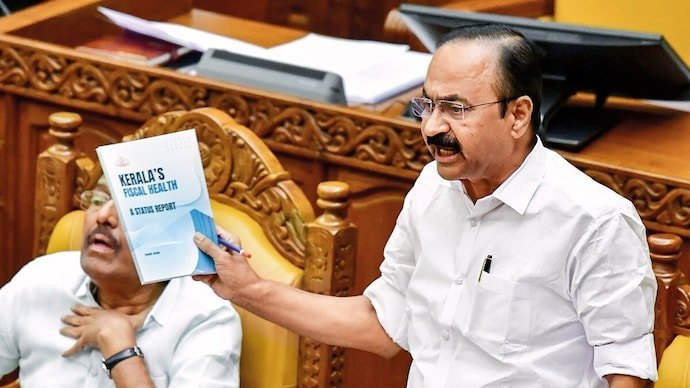
Kerala’s Assembly witnessed a heated political showdown after a debate over reduced plan fund allocations for local self-government institutions escalated into a war of words between the ruling United Democratic Front (UDF) government and the Opposition Left Democratic Front (LDF). The dispute culminated in an Opposition walkout after the Speaker rejected an adjournment motion seeking a detailed discussion on the issue.
At the center of the controversy is the government’s decision to reduce plan fund allocations by more than Rs 1,500 crore, a move the Opposition says has severely affected panchayats, municipalities, and corporations responsible for delivering essential public services. The ruling government, however, argues that the cuts are an unavoidable consequence of financial commitments inherited from the previous administration and the state’s constrained fiscal position.
The episode reflects more than a routine political disagreement. It exposes the growing challenges Kerala faces in balancing developmental spending, fiscal discipline, and local Governance at a time when states across India are grappling with rising expenditure, debt obligations, and limited revenue growth.
What Triggered the Assembly Confrontation?
The controversy began when an Opposition legislator moved an adjournment motion alleging that the reduction in plan funds had disrupted the functioning of local self-government institutions across Kerala.
The Opposition argued that the funding cuts have affected the implementation of development projects, delayed infrastructure works, and placed additional financial pressure on local administrations responsible for providing essential civic services.
After the Chief Minister responded to the allegations, the Speaker declined to admit the adjournment motion, leading Opposition members to stage a walkout in protest.
Understanding Plan Funds in Kerala
Plan funds are financial allocations earmarked for development activities rather than routine administrative expenditure. These funds enable local governments to undertake projects aimed at improving infrastructure, Public health, sanitation, Education, drinking water, roads, and community welfare.
Local self-government institutions rely heavily on these allocations because they serve as the primary implementing agencies for many state-sponsored development initiatives.
Any reduction in plan funds can therefore directly affect the pace of development at the grassroots level.
Why the Government Says the Cuts Were Necessary
The state government defended the reduction by citing severe fiscal constraints and what it described as unrealistic budget planning under the previous administration.
According to the government’s explanation, development projects approved under earlier budgets significantly exceeded the state’s actual financial capacity. As revenues fell short of projected expenditure, proportional reductions became necessary across multiple departments.
The government maintains that the current cuts are not the result of new Policy choices but rather an attempt to restore fiscal stability while honoring essential financial commitments.
The Opposition’s Counterargument
The Opposition strongly rejected the government’s explanation, arguing that it unfairly shifts responsibility onto the previous administration.
Opposition leaders contend that adequate funds remain available and should be released to local bodies to ensure uninterrupted implementation of development projects.
They also disputed the government’s interpretation of previous budget practices, emphasizing that many ongoing projects naturally continue across financial years as spillover works.
From the Opposition’s perspective, reducing allocations at a time when local governments face increasing responsibilities undermines Kerala’s decentralized governance model.
Why Local Self-Government Matters in Kerala
Kerala has long been regarded as one of India’s pioneers in decentralized governance. Since the People’s Planning Campaign launched in the late 1990s, local governments have played a significant role in planning and executing development projects.
The state’s panchayats, municipalities, and municipal corporations oversee numerous sectors, including:
- Rural infrastructure.
- Urban development.
- Primary healthcare.
- Public sanitation.
- Water supply.
- Agricultural support.
- Housing initiatives.
- Local welfare schemes.
Because of this extensive responsibility, changes in funding allocations have immediate consequences for communities across the state.
Kerala’s Fiscal Challenges Explained
The debate also highlights broader financial pressures affecting Kerala.
Like many Indian states, Kerala faces multiple fiscal challenges, including:
- High committed expenditure on salaries and pensions.
- Growing interest payments on public debt.
- Increasing welfare obligations.
- Infrastructure investment requirements.
- Revenue constraints.
Balancing developmental expenditure with fiscal sustainability has become one of the state’s most difficult governance challenges.
How Budget Planning Influences Development
Budget planning involves estimating available revenue while prioritizing expenditure across sectors.
If projected spending substantially exceeds actual resources, governments may later need to postpone projects, reduce allocations, or restructure development plans.
This appears to be one of the central disagreements in the current political debate, with each side offering different interpretations of earlier budgeting decisions and financial projections.
Timeline of the Current Funding Dispute
| Stage | Development |
|---|---|
| Previous Budget Cycle | Large number of development projects approved. |
| Current Financial Review | Government identifies fiscal constraints. |
| Plan Fund Decision | Allocations reduced by over Rs 1,500 crore. |
| Assembly Debate | Opposition seeks discussion through adjournment motion. |
| Speaker’s Decision | Motion rejected; Opposition stages walkout. |
The sequence demonstrates how financial decisions evolved into a wider political confrontation inside the Assembly.
Potential Impact on Local Development Projects
If reduced allocations continue, local governments may need to reprioritize spending.
Possible consequences include:
- Delayed road construction.
- Postponed drinking water projects.
- Slower housing initiatives.
- Reduced maintenance of public infrastructure.
- Deferred community development schemes.
However, the actual impact will depend on how available resources are redistributed and whether supplementary funding becomes available later in the financial year.
Comparison: Government and Opposition Positions
| Issue | Government Position | Opposition Position |
|---|---|---|
| Reason for Fund Cuts | Financial constraints and earlier budget commitments. | Government failed to release available funds. |
| Previous Budget Planning | Projects exceeded realistic financial capacity. | Spillover projects are a normal budgeting practice. |
| Impact on Local Bodies | Necessary temporary adjustment. | Development activities have been adversely affected. |
| Available Resources | Fiscal discipline remains essential. | Existing balances should be released immediately. |
Why This Matters Beyond Kerala Politics
The dispute reflects a broader national challenge faced by many state governments.
Across India, states are attempting to finance ambitious development programs while managing debt, maintaining welfare commitments, and complying with fiscal responsibility norms.
As urbanization accelerates and infrastructure demands grow, the financial health of local governments has become increasingly important for economic development.
Kerala’s debate therefore offers insights into wider questions about fiscal management and decentralized governance throughout the country.
The Importance of Transparent Fiscal Communication
Financial policy often becomes politically contentious because budget figures involve projections, revisions, and changing economic conditions.
Clear communication regarding available resources, expenditure commitments, and funding priorities helps build public confidence and reduces uncertainty among local administrations responsible for implementing development projects.
Regardless of political differences, transparency remains essential for maintaining trust in public financial management.
A Larger Question: Can States Balance Welfare and Fiscal Discipline?
One of the most important issues emerging from the debate is the long-term sustainability of state finances.
Citizens increasingly expect governments to deliver quality public services, social welfare programs, and modern infrastructure simultaneously.
Meeting these expectations requires careful balancing between:
- Development spending.
- Debt management.
- Revenue generation.
- Administrative efficiency.
- Long-term fiscal sustainability.
The Kerala Assembly debate illustrates how difficult these trade-offs have become for state governments across India.
The disagreement over plan funds is not merely about accounting figures. It reflects competing visions of fiscal responsibility, development priorities, and the role of local governments in delivering public services.
Future Outlook
The immediate Political Controversy may continue as both the government and the Opposition defend their interpretations of Kerala’s financial position. Future Assembly sessions are likely to revisit questions surrounding budget execution, development spending, and the financial autonomy of local self-government institutions.
Much will depend on the state’s revenue performance, expenditure management, and any future decisions regarding supplementary allocations. If fiscal conditions improve, additional funds could help accelerate pending development projects. Conversely, continued financial pressures may require further prioritization of public expenditure.
Beyond the political exchanges, the episode highlights a broader governance challenge facing Indian states: ensuring that fiscal responsibility does not come at the expense of grassroots development. As Kerala continues to balance ambitious welfare commitments with economic realities, the effectiveness of its local governments will remain a key indicator of the state’s long-term development model.
For breaking news and live news updates, like us on Facebook or follow us on Twitter and Instagram. Read more on Latest India on thefoxdaily.com.






COMMENTS 0