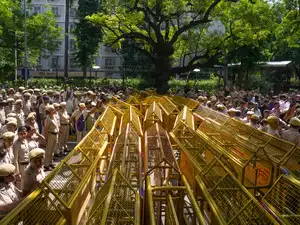
The Supreme Court has underlined the need to maintain a balance between the constitutional right to protest and the right to livelihood of people affected by prolonged demonstrations. The court observed that while citizens have the right to express dissent and organise protests, that freedom cannot come at the cost of disrupting the daily lives and economic activities of others indefinitely.
A three-member bench made it clear that the indefinite occupation of protest sites is unacceptable. The observations highlight the difficulties faced by traders, shopkeepers and other people whose livelihoods may be affected when demonstrations continue for extended periods and public spaces remain occupied.
The court’s position reflects the need to protect democratic forms of protest while ensuring that public spaces remain accessible and that businesses and ordinary citizens are not subjected to prolonged disruption.
Supreme Court stresses balance between protest and livelihood
The Supreme Court’s observations centre on the competing rights of two groups: people seeking to exercise their right to protest and those whose ability to work, conduct business and earn a living may be affected by demonstrations.
The right to protest is an important part of democratic participation. It allows citizens and organisations to raise concerns, challenge decisions and draw attention to public issues. However, the court indicated that exercising this right does not mean demonstrators can occupy a location indefinitely or prevent others from carrying out their everyday activities.
The emphasis on balancing these interests is particularly significant in areas where prolonged demonstrations affect commercial establishments, transport, public access and routine economic activity.
The court’s observations suggest that the exercise of one constitutional freedom must take account of its consequences for other people. Protest arrangements therefore need to consider not only the concerns of organisers but also the rights and interests of residents, traders and other members of the public.
Indefinite occupation of protest sites unacceptable
A key aspect of the Supreme Court’s position was its observation that indefinite occupation of protest sites cannot be accepted. The court’s remarks underline the distinction between the right to hold a demonstration and the unrestricted occupation of a public location for an extended period.
Protests can sometimes require public spaces to draw attention to an issue and enable participants to gather. However, when demonstrations continue without a clear end and substantially interfere with the activities of others, the resulting disruption can become a serious concern.
For traders and business owners, prolonged restrictions can affect customer access, deliveries, daily operations and revenue. Even when commercial establishments remain open, blocked roads or occupied public areas can make it difficult for customers and employees to reach them.
The court’s observations reinforce the importance of ensuring that demonstrations are conducted in a manner that respects the rights of people who are not participating in them.
Traders’ associations asked to involve protest organisers in damage claims
The Supreme Court also directed traders’ associations to involve protest organisers in their claims for damages. This direction is important because it brings protest organisers into the process of addressing the losses allegedly suffered by businesses during demonstrations.
Traders’ associations represent commercial establishments and business owners who may face financial difficulties when protests disrupt access to markets or commercial areas. By asking these associations to involve the organisers, the court has indicated that claims arising from such disruptions should take account of the parties involved in the demonstrations.
The direction also points towards the importance of addressing disputes through an appropriate process rather than treating the economic consequences of protests as a matter that can be ignored.
However, the available information does not specify the amount of damages claimed, the individual businesses involved or the final liability of any particular protest organiser. The direction to involve organisers should therefore not be interpreted as a final determination that they are automatically responsible for every loss claimed by traders.
Delhi Police defends its actions at protest sites
Delhi Police defended its actions at protest locations, citing the disruption caused by ongoing demonstrations. The police position highlights the administrative and law-and-order challenges that authorities may face when protests continue for an extended period.
Authorities are required to manage public gatherings while also considering public movement, access to essential services and the interests of people living or working in affected areas. Prolonged demonstrations can create difficulties when roads, commercial locations or other public spaces become difficult to access.
The police defence also forms part of the wider debate over how authorities should respond to demonstrations without unnecessarily restricting the right to peaceful assembly.
The Supreme Court’s observations place this issue within the broader requirement of balancing public order, democratic freedoms and the economic rights of people affected by protests.
Why the right to livelihood matters in protest-related disputes
The right to livelihood is closely connected with a person’s ability to sustain themselves and their family through work or business. For traders, daily commercial activity may be essential to meeting expenses, paying employees and maintaining their establishments.
When demonstrations continue for long periods in commercially important locations, the effects can extend beyond the immediate protest area. Customers may avoid the affected market, employees may face difficulties reaching workplaces, and businesses may experience interruptions to regular operations.
Small traders and shopkeepers can be particularly vulnerable because even a temporary reduction in business activity may affect their ability to meet routine financial obligations.
This is why the court’s emphasis on balancing protest rights with livelihood concerns carries wider significance. It recognises that public demonstrations take place within shared spaces and that their impact can extend to people who have no direct involvement in the issue being protested.
Balancing democratic freedoms with public convenience
The Supreme Court’s observations do not suggest that the right to protest should be eliminated or that demonstrations should be prevented simply because they inconvenience others. Instead, the central issue is how protests can take place without imposing indefinite restrictions on public movement and economic activity.
Organisers, authorities and affected communities may need to consider practical arrangements that allow demonstrations while reducing disruption. These can include suitable protest locations, arrangements for public access and measures to ensure that commercial establishments and essential services remain accessible.
Such an approach can help protect the ability of citizens to express dissent while preventing prolonged demonstrations from placing an unfair burden on others.
What the Supreme Court’s observations mean
The court’s remarks underline an important principle: Constitutional Rights must be exercised with consideration for the rights of others. The freedom to protest remains significant, but it cannot automatically justify the indefinite occupation of public spaces or prolonged interference with people’s livelihoods.
The direction involving traders’ associations and protest organisers also highlights the importance of addressing claims arising from alleged losses during demonstrations. It brings attention to the economic consequences of protests and the need for an appropriate process to examine such claims.
Ultimately, the Supreme Court has called for a balance that protects democratic participation without allowing the interests of traders, workers and ordinary citizens to be overlooked. The challenge for authorities and protest organisers is to ensure that the right to raise public concerns can coexist with the right of others to move freely and earn their livelihood.
For breaking news and live news updates, like us on Facebook or follow us on Twitter and Instagram. Read more on Latest India on thefoxdaily.com.






COMMENTS 0