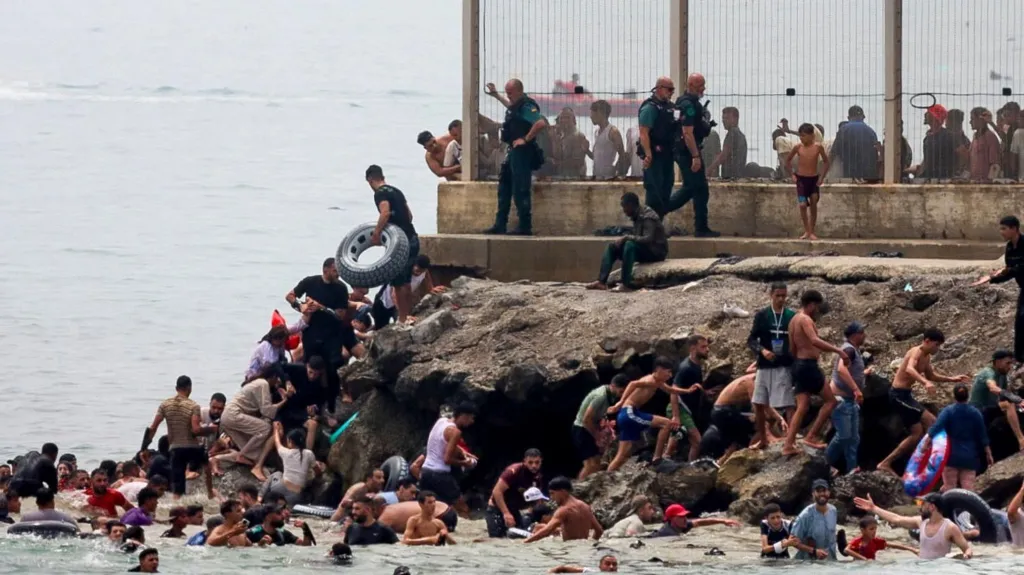
A sudden and unprecedented wave of migrants crossing from Morocco into Spain‘s North African city of Ceuta has become one of the most significant migration events in recent European history. Around 50,000 people entered the Spanish territory within hours, overwhelming local authorities, straining emergency services, and reigniting political debates over Immigration, Border Security, and humanitarian responsibilities.
The incident resulted in dozens of deaths, with many migrants reportedly drowning while attempting dangerous sea crossings or losing their lives during chaotic crowd movements. Spain immediately deployed military personnel and security forces to stabilize the situation, while European leaders reacted with concern over the implications for the Schengen Area and the broader European Union migration framework.
The crisis extends beyond a single border crossing. It reflects deep-rooted economic challenges, regional instability, legal complexities, and diplomatic tensions that continue to shape migration between Africa and Europe.
What Happened at the Ceuta Border?
Ceuta, a Spanish autonomous city located on the northern coast of Africa, experienced an extraordinary influx of migrants arriving from neighboring Morocco by both land and sea. Videos circulating online showed thousands swimming around coastal barriers, using inflatable tubes, or rushing through border gates as security forces struggled to regain control.
According to Spanish authorities, approximately half of those who crossed later returned to Morocco, while thousands remained inside Spanish territory awaiting processing.
The tragedy was compounded by significant loss of life. Humanitarian organizations reported that many victims drowned during dangerous sea crossings, while others died amid overcrowding and panic near border entry points.
Where Is Ceuta and Why Is It So Important?
Ceuta is one of two Spanish autonomous cities located on the African continent, alongside Melilla. Although geographically surrounded by Morocco, both cities are politically part of Spain and therefore represent the European Union’s only permanent land borders with Africa.
The city has strategic importance because anyone entering Ceuta successfully reaches European Union territory. This makes it one of the most attractive but also heavily guarded migration routes into Europe.
| Feature | Ceuta |
|---|---|
| Political Status | Autonomous city of Spain |
| Location | Northern coast of Africa |
| Border | Shares a land border with Morocco |
| EU Membership | Part of Spain and the European Union |
| Strategic Importance | One of the EU’s only land borders with Africa |
Why Did So Many Migrants Attempt the Crossing?
The exact trigger behind the mass movement remains under Investigation, but several factors appear to have converged simultaneously.
Economic Pressures
Many migrants cited unemployment, limited economic opportunities, and hopes for a better future in Europe. North African migration toward Europe has long been driven by income disparities, youth unemployment, and limited career prospects.
Legal Confusion
Spanish officials suggested that recent legal developments regarding migrant deportation procedures may have been misunderstood by human trafficking networks or migrant communities. While authorities believe misinformation played a role, activists argue that legal rulings alone cannot explain a movement of this magnitude.
Smuggling Networks
Human smuggling organizations often exploit rumors and rapidly changing migration policies. False promises regarding asylum or easier entry into Europe can quickly spread through migrant communities, encouraging dangerous journeys.
Long-Term Migration Trends
The Ceuta incident is part of a broader migration pattern affecting the Mediterranean region. Routes through Spain have become increasingly active as migrants adapt to changing border enforcement elsewhere in Europe.
Humanitarian Cost of the Crisis
Beyond the political headlines lies a profound humanitarian tragedy.
Many migrants risked their lives by swimming around breakwaters, crossing rough waters without life jackets, or attempting dangerous land crossings through crowded border areas.
Among those arriving were:
- Young adults seeking employment opportunities.
- Families traveling with children.
- Individuals fleeing poverty and instability.
- People hoping to seek asylum within Europe.
Emergency responders faced enormous challenges providing medical care, temporary shelter, food, and humanitarian assistance to thousands of arrivals within a very short period.
Spain’s Immediate Response
The Spanish government rapidly deployed military units, police forces, and emergency personnel to restore order and reinforce border security.
Officials also began processing arrivals while coordinating with Moroccan authorities to manage returns where legally permitted.
Spanish Prime Minister Pedro Sánchez described the incident as a serious challenge to Spain’s territorial sovereignty and emphasized that the country would protect its borders while respecting humanitarian obligations.
How Europe Reacted
The migration surge quickly became a European issue rather than solely a Spanish one.
Several neighboring countries announced enhanced monitoring of their own borders amid concerns that migrants could continue traveling deeper into Europe through the Schengen free movement zone.
The incident also revived political debates that have shaped European migration policy for years.
Supporters of stricter immigration controls argued that stronger external borders are necessary to protect the Schengen Area.
Others emphasized that humanitarian responsibilities require coordinated European solutions rather than unilateral restrictions.
Understanding the Schengen Area
The Schengen Area allows passport-free Travel across much of Europe. While this arrangement facilitates trade, tourism, and business, it also means that migration management at external EU borders affects all participating countries.
Whenever a large-scale border incident occurs in Spain, Greece, or Italy, governments across Europe often reassess internal security measures.
| Issue | Potential Impact |
|---|---|
| Large migration arrivals | Pressure on reception facilities |
| Border management | Increased security deployments |
| EU cooperation | Calls for coordinated migration policy |
| Political debate | Immigration becomes a major election issue |
Migration Between Africa and Europe: A Bigger Picture
The Ceuta crisis highlights broader migration dynamics affecting Europe.
Migration is influenced by numerous interconnected factors, including economic inequality, armed conflict, climate pressures, demographic growth, labor demand, and family reunification.
Spain has historically served as one of Europe’s principal gateways for migrants arriving from North and West Africa.
Border crossings fluctuate significantly each year depending on weather conditions, diplomatic cooperation, enforcement strategies, and regional events.
Government and International Challenges
Managing migration requires balancing several competing priorities:
- Protecting national borders.
- Saving lives at sea.
- Combating human trafficking.
- Respecting international refugee law.
- Processing asylum claims fairly.
- Maintaining cooperation with neighboring countries.
These objectives frequently create policy tensions, particularly during sudden mass migration events.
Why This Crisis Matters Beyond Spain
Although the events unfolded in Ceuta, their consequences extend well beyond Spain’s borders.
The incident raises questions about the future of European migration governance, border infrastructure, humanitarian preparedness, and diplomatic cooperation between the European Union and neighboring countries.
For policymakers, the crisis demonstrates how rapidly migration patterns can change.
For humanitarian organizations, it reinforces the urgent need for safe migration pathways and stronger rescue capabilities.
For European governments, it highlights the importance of coordinated responses rather than isolated national measures.
Comparison With Previous Migration Surges
Europe has experienced multiple migration emergencies over the past decade, but each has had distinct causes and characteristics.
| Migration Event | Main Route | Primary Drivers |
|---|---|---|
| Mediterranean crossings | Libya to Italy | Conflict and instability |
| Eastern Mediterranean route | Turkey to Greece | War and refugee movements |
| Ceuta border surge | Morocco to Spain | Economic migration, legal uncertainty, border dynamics |
Expert Insight: Why Border Crises Are Becoming More Complex
Modern migration crises are rarely caused by a single event. Instead, they emerge from a combination of economic hardship, demographic pressures, misinformation, organized smuggling networks, evolving immigration laws, and geopolitical developments.
Advances in mobile communication also allow information accurate or otherwise to spread rapidly among migrant communities, potentially influencing migration decisions within hours.
As a result, governments increasingly require flexible border management systems capable of responding to sudden, large-scale movements while upholding humanitarian standards.
What Happens Next?
Spanish authorities are expected to continue reviewing asylum requests, coordinating with Moroccan officials, and strengthening border security.
European institutions may also revisit discussions surrounding migration management, burden-sharing among member states, and external border protection.
The humanitarian response will remain equally important, particularly for vulnerable migrants requiring medical assistance, temporary accommodation, or international protection.
Conclusion
The unprecedented migration surge into Ceuta represents far more than a local border incident. It illustrates the growing complexity of migration management in an interconnected world where economic opportunity, humanitarian need, legal frameworks, and international politics frequently collide.
While Spain works to restore stability along its border, the broader questions remain unresolved: how Europe can secure its external borders, protect vulnerable people, combat trafficking networks, and develop long-term migration policies that balance security with humanitarian responsibilities.
The events in Ceuta are likely to influence future discussions on European migration policy, cross-border cooperation, and regional stability for years to come, making this one of the most consequential migration developments in recent times.
For breaking news and live news updates, like us on Facebook or follow us on Twitter and Instagram. Read more on Latest World on thefoxdaily.com.






COMMENTS 0