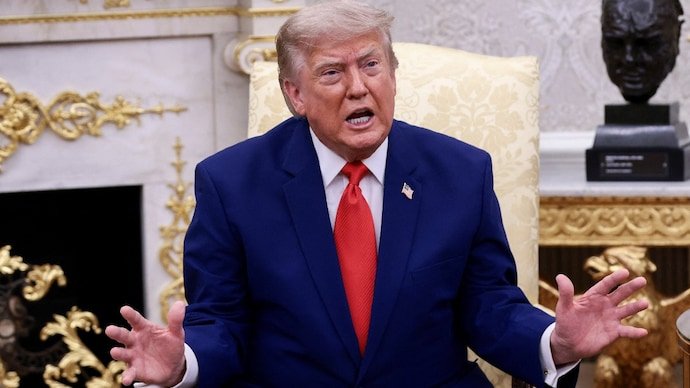
CNN, Politico and MS NOW have sued the Trump administration over President Donald Trump’s decision to bar the three outlets from covering the White House, escalating a dispute over press access, presidential media policy and First Amendment protections.
The lawsuit was filed after journalists from the three organizations were denied entry to the White House and, in two cases, had their press credentials confiscated. The dispute also disrupted the long-standing Television press pool on Monday, after CNN was removed from an assignment to provide shared video coverage of the president’s activities.
The three outlets argue that the administration’s actions violated their constitutional rights and amounted to retaliation for reporting the president disliked. The White House and Republican officials, however, have defended the policy and criticized what they describe as biased or unfair coverage by major news organizations.
Why Trump banned CNN, Politico and MS NOW
Trump announced the ban Friday in a post on Truth Social, saying the three organizations were being excluded because of what he described as their constant reporting of “FAKE NEWS.”
The decision immediately created uncertainty inside the White House. Several senior administration officials were reportedly caught off guard by the announcement, according to officials familiar with the situation. Trump had previously discussed the possibility of restricting access for specific reporters and outlets during his current term, but those earlier discussions did not result in similar action.
White House Chief of Staff Susie Wiles was not at the White House when the decision was announced, according to a person familiar with the matter. Her absence may have contributed to confusion among staff as the new policy was implemented.
The practical consequences became visible the following day when reporters from all three outlets attempted to enter the White House.
Reporters denied entry and credentials confiscated
MS NOW reporter Akayla Gardner, CNN reporter Betsy Klein and Politico reporter Cheyenne Haslett were denied access when they arrived at the White House on Saturday to report on administration activities.
Gardner said an MS NOW photographer was also denied access, while one of the network’s producers was permitted to enter the White House grounds. The differing treatment was not immediately explained.
Klein and Haslett had their White House press credentials confiscated when they attempted to enter. Workspaces normally used by CNN and MS NOW inside the White House were also left empty.
The restrictions have raised broader questions about the government’s authority to control access to presidential events when the affected organizations are being excluded because of the content of their reporting.
First Amendment experts and the White House Correspondents’ Association criticized the move, with the association describing the turning away of credentialed journalists as unconstitutional.
The First Amendment lawsuit
The 27-page lawsuit, filed in the U.S. District Court for the District of Columbia, argues that the administration violated the outlets’ First Amendment protections for speech and newsgathering as well as their due process rights.
The three organizations and their reporters are seeking a temporary restraining order that would prevent enforcement of the ban and restore the journalists’ White House hard passes. Those credentials provide authorized reporters with access to the White House complex for news coverage.
The plaintiffs include Gardner, Haslett and Klein, along with CNN, Politico and MS NOW. The defendants named in the lawsuit include Trump, White House Communications Director Steven Cheung, Secret Service Director Sean Curran and Wiles.
The news organizations argue that the president made his motive clear by directly linking the access restrictions to his objections to their reporting.
The outlets said they brought the lawsuit to protect their First Amendment rights and to challenge the principle that the government should not determine what independent news organizations can report or publish.
They also argued that revoking journalists’ credentials without notice or an opportunity to challenge the decision threatened press freedom and the public’s access to independent reporting about the government.
White House defends the president’s decision
The White House press office directed questions about the lawsuit to Trump’s Truth Social post defending the ban.
In a Monday morning post, Trump characterized the media dispute as an “assault” on the news media and argued that the affected organizations represented a threat to National Security. The administration has not accepted the news organizations’ interpretation that the restrictions constitute unconstitutional retaliation.
Vice President JD Vance also defended Trump’s decision. Vance said the administration was not banning media outlets but was instead declining to provide what he called “special access” to organizations that engage in what he characterized as propaganda.
That description differs from Trump’s own announcement, which explicitly said he was “banning” the three outlets.
Treasury Secretary Scott Bessent similarly criticized major media organizations, arguing in a CNBC interview that the balance of coverage from legacy media had become significantly distorted and referring to perceived bias.
Sen. John Barrasso, a Wyoming Republican, also defended the administration during an interview on NBC’s “Meet the Press.” Asked whether Trump’s action violated the Constitution, Barrasso said he did not believe it did and argued that journalists have an obligation to report fairly.
Federal judge schedules hearing
U.S. District Judge Timothy Kelly scheduled a hearing for Wednesday to consider the news organizations’ request for emergency relief. The Trump administration was ordered to respond to the plaintiffs’ claims by Tuesday.
Kelly’s involvement adds another layer of significance to the case because the judge was appointed by Trump in 2017.
The judge has previously handled a dispute involving White House access and CNN. In 2018, Kelly presided over the administration’s removal of the press credentials of CNN correspondent Jim Acosta following a contentious presidential news conference.
Kelly ordered the administration to temporarily restore Acosta’s press pass. The administration later agreed to restore his hard pass permanently.
The earlier case does not determine the outcome of the current lawsuit, but it establishes that questions over presidential control of press credentials have previously reached Kelly’s courtroom.
Why the White House TV pool matters
The legal dispute has already affected how television networks share coverage of the president.
CNN was scheduled to provide television pool coverage of Trump on Monday. The assignment had been made before Trump announced the ban.
A television pool is designed to allow multiple news organizations to obtain coverage of events when space, security or logistics make it impractical for every outlet to send its own camera crew. One network provides the camera and production resources, while the resulting footage and audio are distributed to other participating organizations.
The arrangement has been used by presidential administrations of both political parties for decades. Pool footage can also reach organizations beyond the five primary television networks, including C-SPAN, Newsmax, One America News Network and international news organizations.
After CNN reporter Betsy Klein was turned away from the White House on Saturday, the White House issued updated press guidance late Sunday night. The guidance, issued at 10:55 p.m. Eastern time, removed CNN from the television pool assignment for Monday.
Other networks refuse to replace CNN
The other four members of the television pool NBC, ABC, CBS and Fox News declined to take CNN’s place for Monday’s coverage.
As a result, the television pool did not provide shared coverage of Trump’s activities that day.
In a joint statement, the five networks said the public has an important interest in receiving accurate and independent information about its government and argued that an administration should not restrict a news organization because it objects to the organization’s reporting.
The decision represented a rare disruption to a system designed specifically to ensure that presidential events can be covered and shared among competing news organizations.
The change did not end all television coverage of the White House. Individual networks can continue covering events that are open to the press outside the formal pool system. NBC News, for example, said its reporters would continue reporting on administration activities.
Print and radio pools also remained in operation, while television pool arrangements involving other parts of the administration continued. CNN was still scheduled to provide pool coverage of Secretary of State Marco Rubio on Monday.
A broader dispute over presidential press access
The conflict with CNN, Politico and MS NOW follows other disputes between the Trump administration and news organizations.
Trump previously barred The Associated Press from the Oval Office, Air Force One and certain other events after the news organization declined to adopt the president’s preferred term “Gulf of America” for the body of water commonly known as the Gulf of Mexico.
The Associated Press sued the administration over the access restrictions, and that case remains ongoing.
Jameel Jaffer, director of Columbia University’s Knight First Amendment Institute, described the latest restrictions as part of what he characterized as a broader pattern of efforts by Trump to limit press access.
His assessment reflects one side of an ongoing constitutional and press-freedom debate. The administration and its Republican defenders have presented the issue differently, arguing that the president and his officials should not be required to provide special access to organizations whose coverage they consider unfair or biased.
The constitutional question at the center of the case
The central legal question is not simply whether the White House can regulate physical access to presidential events. Administrations routinely establish security rules, space limitations and credentialing procedures for journalists.
The more difficult issue is whether government officials may exclude particular news organizations because they object to the content or viewpoint of their reporting.
The First Amendment protects freedom of speech and freedom of the press, but disputes involving government-controlled spaces can also involve questions of access, due process and the government’s authority to manage limited physical resources.
Those issues are particularly significant at the White House because presidential activities are of substantial public interest and because journalists with press credentials serve as a conduit between government officials and the broader public.
The administration’s defense emphasizes its distinction between ordinary press access and what it considers special access granted by the government. The news organizations, meanwhile, contend that the restrictions were imposed specifically because of their reporting and therefore represent unconstitutional viewpoint discrimination.
The federal court will have to consider those competing arguments as it evaluates the request for emergency relief.
What happens next
The immediate focus will be Wednesday’s hearing before Judge Kelly and the administration’s response to the lawsuit. The court’s consideration of the temporary restraining order could determine whether the reporters regain their White House credentials while the broader legal dispute continues.
The television pool dispute also illustrates the practical consequences of the access restrictions beyond the three organizations directly targeted by the administration. Because the participating networks declined to replace CNN, the normal shared television coverage of the president’s activities was temporarily interrupted.
The case could ultimately become an important test of the relationship between presidential control of White House access and constitutional protections for the press. Regardless of the eventual legal outcome, the dispute has already renewed a longstanding question in American Politics: how far an administration can go in controlling access to the presidency when its stated reason for doing so is dissatisfaction with news coverage.
For breaking news and live news updates, like us on Facebook or follow us on Twitter and Instagram. Read more on Latest World on thefoxdaily.com.


COMMENTS 0