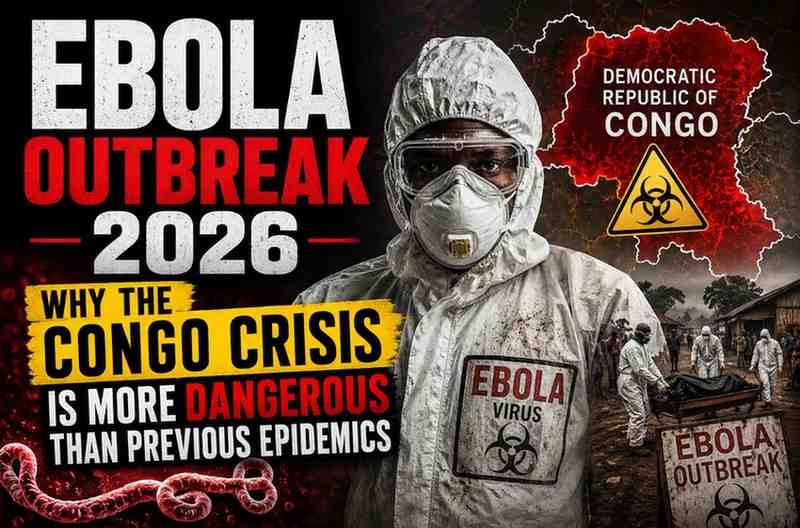
The response to the Ebola outbreak in eastern Congo is showing signs of progress in some areas, but the overall Health emergency remains serious as infections continue to rise elsewhere. The World Health Organisation has reported encouraging developments in Ituri province, where transmission is declining in some of the areas most affected by the outbreak.
At the same time, the situation in North Kivu is moving in the opposite direction. Weekly cases there have nearly doubled over a two-week period, increasing from about 100 to more than 200. The sharp rise highlights the difficulty of controlling a disease outbreak across a large and geographically challenging region.
WHO Director-General Tedros Adhanom Ghebreyesus said the contrasting Trends mean the outbreak cannot be viewed as a single, uniform epidemic. Instead, health authorities are dealing with multiple transmission patterns in different locations, with some communities showing improvement while others continue to experience rapid growth in cases.
More than 7,200 cases and over 3,500 deaths have been reported across seven provinces, according to the WHO. The figures underline the scale of the crisis and explain why progress in one province has not yet translated into overall control of the outbreak.
Ituri Shows Signs of Improvement
Ituri has emerged as one of the areas where the Ebola response is beginning to show measurable progress. According to the WHO, transmission is declining in some of the province’s most affected areas.
The outbreak in Ituri is being driven by the Bundibugyo virus species, a relatively rare member of the Ebola virus family. This makes the response particularly important because the epidemiological characteristics and transmission patterns of an outbreak can vary depending on the virus species involved and the circumstances in which transmission occurs.
Tedros said health authorities were beginning to see evidence that efforts to control transmission were gaining ground in parts of Ituri. The improvement does not mean the province is free of Ebola, but declining transmission can provide an important opportunity for health teams to strengthen surveillance, identify infections earlier and prevent further chains of transmission.
The development also illustrates why outbreak control has to be assessed locally. A national case total can continue to rise even when transmission is declining in particular districts or provinces.
South Kivu Reports No New Cases Since May
South Kivu provides another example of progress within the wider outbreak. Tedros said the province had reported no new Ebola cases since May.
A sustained period without newly reported cases is an important development for disease-control teams, although it does not automatically mean that transmission risks have disappeared. Ebola responses require continued surveillance because undetected infections or gaps in monitoring can allow transmission to resume.
For health authorities, the absence of new cases provides an opportunity to maintain monitoring while directing resources toward locations where infections are increasing more rapidly.
The contrasting situations in South Kivu, Ituri and North Kivu demonstrate the complexity of the current outbreak. While one location may be moving toward better control, another can experience a significant increase in infections at the same time.
North Kivu Cases Are Rising Quickly
The most concerning development highlighted by the WHO is the rapid increase in Ebola cases in North Kivu.
Tedros said weekly cases had nearly doubled over the previous two weeks, rising from approximately 100 cases to more than 200. Such a rapid increase places additional pressure on local health systems and outbreak-response teams.
North Kivu is also a difficult environment in which to manage an infectious disease outbreak. The size of the affected area, the number of communities involved and the need to identify transmission chains can make it difficult for response teams to maintain a complete picture of how the virus is spreading.
Tedros described the geographical scale as one reason it is difficult to characterize the situation simply as one epidemic. His description of “many outbreaks in many places” reflects the fragmented nature of transmission across the affected region.
For public-health officials, this means that controlling Ebola requires more than a single province-wide strategy. Different communities can face different transmission risks, requiring surveillance and response operations to be adapted to local circumstances.
Why the Overall Case Count Remains Serious
The latest figures reported by the WHO show why the recent improvements in parts of Ituri and South Kivu need to be viewed in context.
More than 7,200 cases and more than 3,500 deaths have been reported across seven provinces. The scale of these numbers demonstrates that the outbreak remains a major public-health emergency despite signs of improvement in selected areas.
The difference between the total number of cases and the weekly trend in individual provinces is particularly important. Overall figures describe the accumulated impact of the outbreak, while weekly numbers can provide an indication of where transmission is accelerating or slowing.
When cases decline in one location but increase sharply elsewhere, the national or regional total may continue to rise. This is why health authorities must monitor both the overall epidemic and individual transmission hotspots.
The situation also demonstrates the importance of sustained response efforts. Ebola outbreaks can change quickly, meaning a decline in transmission needs to be maintained over time before authorities can consider an area to be moving toward sustained control.
WHO Urges Caution Despite Encouraging Trends
WHO officials have emphasized that the signs of progress should not be interpreted as evidence that the outbreak is close to being contained.
Maria Van Kerkhove, WHO’s director for epidemic and Pandemic management, said the organization could be cautiously optimistic about developments in some areas but needed to remain realistic about the challenges ahead.
Her warning reflects an important feature of infectious disease surveillance: short-term changes in case numbers do not necessarily establish a long-term trend. Health authorities need to observe transmission patterns over time to determine whether an apparent decline is sustained.
This is especially important in an outbreak that is affecting multiple provinces simultaneously. A decline in cases can be genuine in one location while a separate transmission cluster is growing elsewhere.
That makes continued surveillance essential even in places where recent results appear encouraging.
What “Many Outbreaks in Many Places” Means
The WHO’s description of the situation as “many outbreaks in many places” is significant because it captures the operational challenge facing the response.
In a geographically concentrated outbreak, health authorities may be able to focus resources around a relatively defined transmission zone. A wider outbreak involving several provinces requires a more complex network of surveillance, laboratory testing, case management, infection prevention and community engagement.
Different areas can also be at different stages of transmission. One community may be recording new cases regularly, another may have only sporadic infections, while a third may have gone weeks without a newly reported case.
This creates a constantly changing public-health landscape. Response teams must identify where transmission is active, determine how cases are connected and ensure that emerging clusters are detected before they expand.
The situation in North Kivu shows how quickly the balance can shift. A rise from around 100 weekly cases to more than 200 in two weeks represents a substantial increase and reinforces the need for rapid detection and containment measures.
The Role of Surveillance in Ebola Control
Surveillance is one of the most important tools available during an Ebola outbreak. Health workers need to identify suspected infections, investigate contacts and monitor communities where transmission may be occurring.
Early identification can make it easier to isolate patients and investigate potential transmission chains. It can also help authorities identify geographic areas where additional response resources are needed.
In a fragmented outbreak, surveillance becomes even more important because transmission may not follow a single predictable pattern. A decrease in one location should therefore not lead to a reduction in vigilance elsewhere.
The absence of new cases in South Kivu and declining transmission in parts of Ituri can provide useful evidence about where response efforts are having an effect. Meanwhile, the increase in North Kivu provides an indication of where additional attention is required.
Why the Outbreak Remains Difficult to Control
Ebola response operations face several challenges when infections spread across large and densely populated areas. Health teams must maintain access to affected communities while continuing to detect cases and investigate contacts.
The geography of eastern Congo adds another layer of complexity. When transmission occurs across numerous locations, response teams cannot rely on a single intervention or a single local health facility to contain the disease.
The outbreak also requires consistent coordination between local health authorities and international partners. Case detection, laboratory confirmation, treatment and surveillance must work together for the response to remain effective.
Any interruption in those systems can make it harder to understand where the virus is spreading.
Another challenge is that an apparent improvement can be temporary. A decline in reported cases may reflect genuine reductions in transmission, but health officials must also consider whether cases are being detected and reported consistently.
That is why WHO officials are emphasizing trends over time rather than treating a short-term reduction as proof that an area has fully controlled Ebola.
What Happens Next in the Ebola Response
The immediate priority for health authorities is to sustain the progress seen in parts of Ituri and South Kivu while responding to the rapid increase in North Kivu.
In Ituri, declining transmission provides an opportunity to strengthen existing control measures and ensure that new cases are detected quickly. In South Kivu, continued surveillance will be important after the reported absence of new cases since May.
North Kivu presents the more urgent challenge because of the recent acceleration in weekly infections. The increase means health authorities need to maintain close monitoring of transmission patterns and identify the locations driving the rise.
The broader objective is not simply to reduce the number of cases temporarily, but to interrupt transmission consistently across affected communities.
The WHO’s assessment therefore contains two messages at once. There are genuine signs that Ebola control efforts are producing progress in parts of eastern Congo. But those gains exist alongside an expanding and deadly outbreak in other areas.
A Mixed Picture for Congo’s Ebola Response
The latest Ebola situation in eastern Congo cannot be summarized as either a clear improvement or an uncontrolled expansion. The evidence points to a more complicated picture.
Ituri is showing encouraging signs, with transmission declining in some of its most affected areas. South Kivu has reported no new cases since May. Yet North Kivu has seen weekly cases nearly double in just two weeks, while the outbreak overall has spread across seven provinces.
That combination explains why WHO officials remain cautious. Progress in disease control is often uneven, particularly when an outbreak involves multiple transmission zones.
For now, the central challenge is to turn localized improvements into sustained control while preventing the rapidly rising transmission in North Kivu from generating further outbreaks elsewhere.
The WHO’s latest assessment makes clear that the response has gained ground in some places, but the wider epidemic remains active. With more than 7,200 reported cases and over 3,500 deaths, the scale of the crisis continues to demand sustained surveillance and response efforts across the affected provinces.
For health authorities, the coming period will be critical in determining whether the encouraging trends in Ituri can be maintained and whether the surge in North Kivu can be brought under control.
For breaking news and live news updates, like us on Facebook or follow us on Twitter and Instagram. Read more on Latest World on thefoxdaily.com.





COMMENTS 0