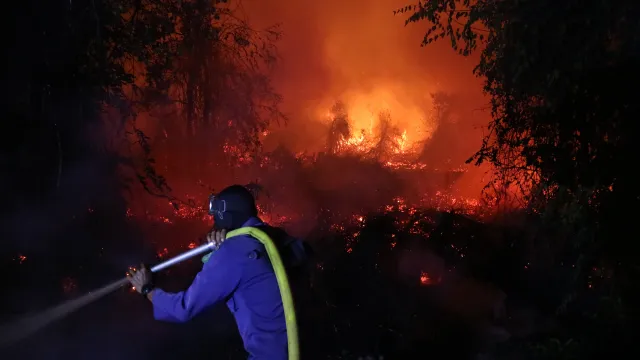
South Sumatra has turned to both firefighting operations and a traditional religious appeal for rain as a worsening wildfire crisis blankets parts of Indonesia in thick haze. About 3,000 people gathered in Palembang on Tuesday for salat istisqa, a special Islamic prayer for rain, while emergency crews continued fighting fires across forests and peatlands.
The mass prayer came as South Sumatra recorded the highest number of wildfire hot spots in Indonesia, according to the latest satellite data cited by the Environment Ministry. Prolonged dry weather, rising fire risks and a strengthening El Nino pattern have created difficult conditions for authorities attempting to contain fires across the region.
The smoke has affected visibility in several cities and spread beyond Indonesia’s borders to neighbouring Malaysia and Brunei. Roads and public facilities in Palembang were covered by haze, with visibility deteriorating so severely that motorists were using headlights even during daylight hours.
The extraordinary scene of thousands gathering to pray while aircraft and helicopters continued firefighting operations captured the scale of a crisis that has become a recurring feature of Indonesia’s dry season.
Why South Sumatra held a mass prayer for rain
The prayer was held in the courtyard of the South Sumatra governor’s office in Palembang, the provincial capital. Residents stood together to perform salat istisqa, a prayer traditionally performed by Muslims during periods of drought when communities seek rainfall.
South Sumatra Governor Herman Deru said authorities had already been working with relevant agencies to address the fires and drought conditions. He described the prayer as an additional response, reflecting the role of faith and community solidarity during an environmental emergency.
The gathering was not a substitute for firefighting. Emergency crews were simultaneously conducting suppression operations, while authorities were using weather-modification techniques in an attempt to increase rainfall over areas affected by fires.
The decision to hold a public prayer nevertheless carried symbolic importance. Thousands of residents gathered while smoke from nearby fires reduced visibility, demonstrating how directly the prolonged dry spell was affecting everyday life.
South Sumatra has recorded the country’s highest number of hot spots
The scale of the wildfire problem is reflected in satellite observations.
According to the latest data from Indonesia’s Environment Ministry, South Sumatra recorded 1,429 hot spots, the highest number among Indonesian provinces. West Kalimantan followed with 1,226 hot spots, while Central Kalimantan recorded 811.
Hot spots detected by satellites are an important indicator of potential fires, although they do not necessarily correspond one-for-one with individual fires or indicate the size of a particular blaze. They are nevertheless useful for identifying areas where fire activity is concentrated and where authorities may need to direct firefighting resources.
South Sumatra’s position at the top of the latest hot-spot count illustrates the pressure facing the province as dry conditions persist.
Nearly 940 square kilometres burned in July
The wildfire crisis has also caused extensive land damage.
Data from Indonesia’s Forestry Ministry showed that nearly 940 square kilometres of land were burned in July alone. More than 20 square kilometres of that total was in South Sumatra.
The figures demonstrate why the current situation is more than a short-lived episode of smoke. Fires affecting forest and peatland can continue spreading underground or across dry vegetation, making them difficult to extinguish once they become established.
Peat fires present a particularly difficult challenge. When peatlands dry out, fire can penetrate beneath the surface and continue smouldering even when flames are no longer visible. This can make conventional firefighting more complicated and contribute to prolonged smoke emissions.
El Nino and the prolonged dry season are worsening fire conditions
Indonesia’s National Disaster Management Agency has linked the worsening fire situation to a strengthening El Nino pattern and an extended dry season.
El Nino is a recurring Climate pattern associated with changes in ocean temperatures and atmospheric circulation across the tropical Pacific. Its effects can extend far beyond the Pacific itself. In Indonesia, El Nino conditions can contribute to reduced rainfall and drier conditions in parts of the country, increasing the likelihood that vegetation and peatlands will become vulnerable to fire.
The relationship is important because weather conditions can determine how easily fires start and spread. Dry vegetation acts as fuel, while a lack of rainfall reduces the natural moisture that would otherwise slow or extinguish smaller fires.
Once large fires develop, the absence of rain can make firefighting considerably more difficult. This creates a cycle in which dry conditions increase fire risk, fires produce smoke and haze, and emergency agencies have to deploy more resources to prevent the situation from worsening.
Indonesia is using aircraft to fight the fires
Authorities have expanded aerial operations as ground crews battle fires across difficult terrain.
Indonesia has deployed 30 aircraft for cloud-seeding and water-bombing operations over Kalimantan, while 22 helicopters have been deployed in Sumatra.
Weather modification is being used to support firefighting by attempting to encourage rainfall in areas where suitable clouds are present. Salt particles can be dispersed into clouds as part of cloud-seeding operations, with the objective of encouraging precipitation.
The technique is not a guaranteed way to produce rain. Its effectiveness depends on atmospheric conditions, including whether suitable clouds are available. That makes it a supporting measure rather than a replacement for direct firefighting and prevention efforts.
Water-bombing aircraft and helicopters, meanwhile, can deliver water directly to fire zones, particularly where fires are difficult to reach from the ground.
Police arrest 72 people over suspected fire-setting
Authorities are also pursuing people suspected of deliberately starting some of the fires.
Police have arrested 72 people suspected of involvement in starting forest and peatland fires. Four companies are also under investigation over allegations that fire was used as an inexpensive method of clearing land.
The investigations highlight one of the most persistent challenges behind Indonesia’s seasonal fire problem: the role of land-clearing practices.
Fire can be a relatively cheap method of clearing vegetation for agriculture and plantations, but uncontrolled burning can quickly spread beyond the intended area. When conditions are exceptionally dry, the risk becomes much greater.
The situation involves both commercial activity and traditional agricultural practices. Plantation owners and traditional farmers have used burning to clear land, but the environmental consequences can become severe when fires escape control or spread into forest and peatland.
Why peatland fires are especially difficult to control
One of the less visible aspects of Indonesia’s wildfire crisis is the role of peat.
Peatlands consist of layers of partially decomposed organic material accumulated over long periods. When these areas remain wet, they can store large amounts of carbon and resist burning. During prolonged dry conditions, however, the peat can lose moisture and become highly vulnerable to fire.
Unlike a fire moving only across surface vegetation, a peat fire can smoulder below the ground. That creates several problems for firefighters. Flames may disappear temporarily while combustion continues beneath the surface, and a fire can re-emerge later if conditions remain dry.
These characteristics help explain why Indonesia’s forest and peatland fires can produce persistent haze rather than disappearing quickly after an initial firefighting effort.
The haze is becoming a regional problem
The consequences of the fires are not confined to the locations where flames are burning.
Smoke has spread across several Indonesian cities and has also reached Malaysia and Brunei. Regional haze has long been a source of tension in Southeast Asia because smoke from Indonesian fires can Travel across national borders depending on wind and atmospheric conditions.
Dense haze can interfere with transportation by reducing visibility on roads and affecting aviation conditions. It can also disrupt normal daily activities and create serious concerns for Public health, particularly for people WHO are sensitive to air pollution.
The impact is therefore broader than the area directly consumed by fire. A relatively remote forest or peatland fire can affect urban populations hundreds of kilometres away when weather conditions carry the smoke toward populated areas.
Why Indonesia’s wildfire problem keeps returning
Forest and peatland fires are a recurring dry-season problem in Indonesia. The reasons are both environmental and human.
Seasonal drying creates conditions in which vegetation becomes easier to ignite. Extended drought can intensify those conditions. Human activity can then provide the initial ignition, whether through land clearing, accidental burning or deliberate fire-setting.
Once a fire starts in sufficiently dry conditions, controlling it becomes more difficult. This is especially true when it reaches peatland.
The result is a problem that cannot be solved simply by extinguishing individual fires. Prevention, land management, enforcement and early detection are all important parts of limiting the scale of future outbreaks.
What the mass prayer reveals about the crisis
The gathering in Palembang was unusual, but its significance goes beyond religion.
Holding a public prayer for rain while emergency crews were actively fighting fires reflects how severe the drought conditions have become. Authorities are using modern tools such as satellite monitoring, aircraft, helicopters and cloud-seeding operations, while residents are turning to a traditional religious practice for relief.
It also demonstrates that the crisis has become a community-wide concern. Thick haze affecting roads, buildings and public spaces makes the environmental emergency visible in everyday life.
For South Sumatra residents, rainfall would provide more than temporary relief. Sustained precipitation could increase soil and vegetation moisture, reduce fire intensity and make suppression efforts easier. But the longer-term challenge remains preventing fires from starting and limiting the conditions that allow them to spread.
What happens next in Indonesia’s wildfire crisis?
The immediate priority for authorities is to contain existing fires, protect populated areas and reduce the spread of haze. Weather-modification efforts will continue where conditions allow, while ground teams and aircraft work to suppress active fire zones.
Law enforcement investigations are also likely to remain an important part of the response. The arrests and company investigations indicate that authorities are attempting to identify people or organisations responsible for at least some of the fires rather than treating the entire crisis as a purely Natural Disaster.
The longer-term outlook will depend heavily on rainfall and the evolution of dry conditions. If the dry season continues without significant precipitation, the risk of additional fires could remain elevated.
The South Sumatra prayer therefore comes at a moment when Indonesia is confronting both an immediate firefighting emergency and a deeper land-management challenge. Rain could provide critical short-term relief, but preventing another severe haze episode will require more than favourable weather.
For now, the combination of record-level hot-spot activity in South Sumatra, extensive land burned across Indonesia, cross-border haze and the deployment of large-scale firefighting resources shows the seriousness of the crisis. The mass prayer in Palembang offered a striking reminder that when the rains fail, the consequences can reach far beyond the forests where the fires begin.
For breaking news and live news updates, like us on Facebook or follow us on Twitter and Instagram. Read more on Latest World on thefoxdaily.com.





COMMENTS 0