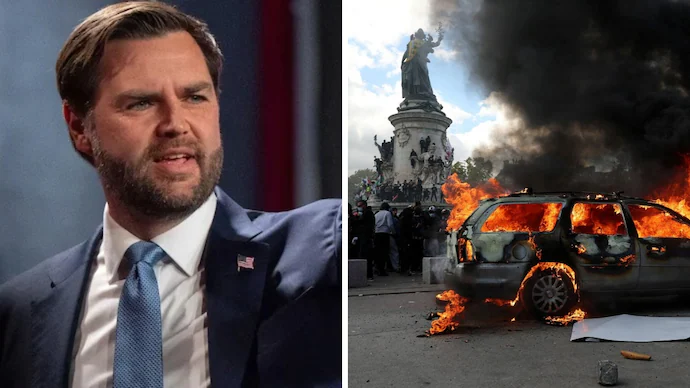
US Vice President JD Vance has blamed immigration and diversity policies for violent protests in France, warning that the unrest should serve as a lesson for Americans. In a post on X on Sunday, October 18, 2026, Vance accused Western liberal governments of neglecting questions of assimilation and social compatibility, linking the violence in French cities to broader debates over immigration policy.
Vance shared footage reportedly showing a city hall engulfed in flames and urged French authorities to stop the violence before more landmarks were damaged. He also connected the unrest to domestic US Politics, claiming that congressional Democrats wanted a similar future for the United States.
His remarks came after demonstrations over education, working conditions and public spending escalated into widespread disorder across France. According to the supplied report, approximately 550,000 people participated in demonstrations nationwide, including an estimated 110,000 in Paris. More than 1,200 people were arrested, while Prime Minister Sébastien Lecornu said 150 police officers had been injured.
Vance’s comments have placed immigration, integration and public order at the centre of a transatlantic political debate. However, his claims about the causes of the French unrest and the intentions of US congressional Democrats are political assertions, rather than conclusions established by the reported protest figures alone.
What JD Vance Said About Immigration and France’s Riots
In his post on X, Vance argued that Western governments had pursued immigration and diversity policies without adequately addressing whether newcomers were being integrated into their host societies.
“Western liberals imported the third world into France and other countries in the name of diversity and compassion. They ignored fundamental questions of assimilation and compatibility,” Vance wrote.
He added that warnings about the potential consequences of these policies had been ignored and called on France to bring the violence under control.
“I pray that France, a beautiful country of amazing people, will stop this madness before more of its landmarks burn,” he said.
The vice president’s message framed the unrest as evidence of what he considers the risks associated with immigration and diversity policies. His argument centred on assimilation, a term generally used to describe the process through which immigrants adopt aspects of a host country’s language, customs and social practices.
However, the reported immediate triggers for the demonstrations included concerns about education, working conditions and public spending. The supplied account does not establish that immigration was the direct cause of the protests or that immigration policy explains the actions of those involved in vandalism and looting.
France Protests Escalate Into Widespread Violence
The unrest erupted during nationwide demonstrations on Saturday, October 17, as protesters gathered over rising living costs, concerns about education and deteriorating public services. What began as a series of demonstrations escalated into clashes, arson, vandalism and looting in several French cities.
France’s Interior Ministry estimated that approximately 550,000 people participated in the demonstrations nationwide, including around 110,000 in Paris. Protest organisers reported a higher turnout, illustrating the difference between official estimates and figures provided by groups involved in the rallies.
French Prime Minister Sébastien Lecornu said 1,200 people had been arrested and 150 police officers injured during the unrest. The scale of the violence prompted renewed concerns about public safety, damage to public infrastructure and the challenges facing authorities in separating peaceful demonstrators from those committing criminal acts.
In Paris, masked individuals vandalised shops and restaurants, while burning barricades and clashes with riot police contributed to the disorder. Police used tear gas as confrontations intensified in parts of the capital.
Violence and property damage were also reported in Lyon, Marseille, Lille, Rouen, Nantes and Toulouse. The incidents included attacks on commercial premises and public buildings, with some groups taking advantage of the demonstrations to loot shops.
City Hall Fire and Attacks on Public Buildings
One of the most striking incidents involved a fire at the historic city hall in Limoges. The footage shared by Vance showed a municipal building engulfed in flames, which he used to reinforce his warning about the consequences of what he described as failed immigration and integration policies.
Other cities also experienced attacks on public property. In Marseille, individuals reportedly broke into municipal headquarters, where vandals toppled a bust of Marianne, France’s national symbol, smashed television sets and spray-painted an anarchist symbol on a wall.
In Lyon, the city’s tourism centre was reportedly set ablaze. Municipal buildings in Marseille and Lille were also targeted, while businesses in several locations suffered damage and theft.
The incidents demonstrated the extent to which the demonstrations had deteriorated in some areas. However, the reported damage and arrests do not establish that all demonstrators participated in violence. The protests also drew large numbers of people expressing concerns about economic conditions, education and public spending.
Luxury Stores Targeted as Looting Spreads
Commercial properties were among the targets during the unrest. In Bordeaux, looters reportedly smashed storefronts and targeted high-end retailers, including Apple, Louis Vuitton and Hermès. Videos shared on social media showed individuals breaking into luxury shops and carrying away merchandise.
In Paris, masked groups vandalised shops and restaurants as confrontations with police continued. Similar incidents across other cities added to the economic damage caused by the unrest.
French authorities have distinguished between the right to participate in peaceful demonstrations and criminal acts such as arson, looting and attacks on public buildings. That distinction has become central to the government’s response as it attempts to restore order while addressing the concerns that brought demonstrators onto the streets.
Macron Vows Legal Action Against Those Responsible
French President Emmanuel Macron condemned the violence and promised legal consequences for people responsible for vandalism, attacks and looting.
“Those who carried out vandalism, attacked administrative offices or businesses, or carried out looting — even in our town halls, will be prosecuted and punished,” Macron said.
The president’s remarks underscored the government’s determination to hold those responsible for criminal acts accountable. The authorities face the challenge of investigating incidents across multiple cities while distinguishing individual offenders from the wider crowds that participated in the demonstrations.
The violence has also intensified political disagreements over the causes of the unrest. While Vance attributed the disorder to immigration and diversity policies, French political debate has included concerns about living costs, public services, education, social inequality and the conduct of demonstrators and law enforcement.
Vance Links French Unrest to US Immigration Debate
Vance’s intervention extended the French unrest into an American political debate over immigration, national identity and integration. By telling Americans to pay attention to developments in France, he presented the violence as a warning about policies he opposes in the United States.
His post specifically targeted congressional Democrats, whom he accused of seeking a similar future for America. However, the supplied account provides no evidence that Democratic lawmakers have advocated for the violence seen in France or that their immigration policies would necessarily produce comparable events.
The distinction between political criticism and established causation is important. Vance’s comments represent his interpretation of the unrest, while the reported demonstrations were driven by several stated grievances, including education, working conditions, rising living costs and public spending.
Immigration and integration can be subjects of public debate, but determining why a protest turns violent requires evidence about the participants, their motives and the circumstances surrounding specific incidents. The available protest figures and reports of property damage do not, on their own, establish immigration as the cause of the violence.
Vance’s remarks nevertheless highlight how unrest in one country can become part of political messaging in another. Images of burning buildings and damaged public property can carry considerable emotional weight, particularly when leaders use them to argue that opponents’ policies pose a threat to public order.
What the France Riots Mean for the Immigration Debate
The events in France have brought renewed attention to questions about immigration, integration, social cohesion and the management of large demonstrations. Vance has used the unrest to argue that Western governments should give greater consideration to assimilation and compatibility when developing immigration policies.
His intervention also reflects a broader political disagreement over the relationship between immigration and social stability. Critics of liberal immigration policies often emphasise integration challenges, while other explanations for public disorder focus on economic hardship, political alienation, public services and the actions of individuals or organised groups.
These explanations are not interchangeable, and the circumstances of each incident matter. The fact that violence occurred during a nationwide protest does not establish that a single policy or social group was responsible for the entire episode.
For France, the immediate priorities remain restoring public order, investigating criminal offences and addressing the concerns raised by demonstrators. For the United States, Vance’s comments have turned the unrest into another point of contention in the debate over immigration and the direction of national policy.
The central question is whether the violence will be treated primarily as a law-and-order problem, a reflection of deeper social and economic grievances, or evidence supporting broader arguments about immigration and integration. The reported events establish the scale of the disorder, but determining its causes requires more than the political interpretations offered in its aftermath.
For breaking news and live news updates, like us on Facebook or follow us on Twitter and Instagram. Read more on Latest World on thefoxdaily.com.






COMMENTS 0