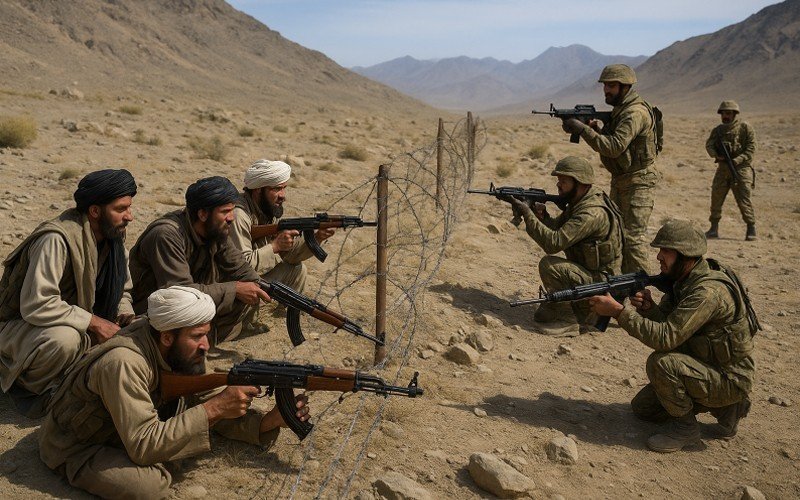
Pakistan has intensified its Counterterrorism operations after a deadly attack on a Pakistan Rangers headquarters in Karachi, with authorities announcing that security forces killed 29 militants during intelligence-based operations conducted near the Pakistan-Afghanistan border. The military action reflects Islamabad’s continuing effort to combat militant groups operating in border regions while addressing a renewed surge in attacks targeting security personnel and public infrastructure.
The latest developments come amid deteriorating security conditions across several provinces, particularly Khyber Pakhtunkhwa and Balochistan, where militant violence has increased in recent years. Pakistani officials maintain that many armed groups continue to exploit difficult terrain along the border, while the issue remains a major source of tension between Islamabad and Kabul.
The operation also underscores the strategic importance of Border Security as Pakistan seeks to disrupt militant networks, dismantle logistical bases and prevent further attacks on military and civilian targets.
What Happened?
According to Pakistan’s Information Minister, security forces launched an intelligence-based ground operation targeting militant hideouts following recent terrorist incidents, including an attempted assault on the Pakistan Rangers headquarters in Karachi.
The government stated that the operation focused on militant camps near the Pakistan-Afghanistan border and was supported by precision strikes against locations identified through intelligence gathering.
Authorities reported that 29 militants were killed during the combined operations.
Operation Focused on Border Regions
Officials said the primary ground operation was conducted in the Bajaur district of Khyber Pakhtunkhwa, an area located close to the Afghanistan border and historically affected by militant activity.
In addition to the ground offensive, Pakistan stated that precision strikes targeted alleged militant facilities in border areas where armed groups were believed to maintain operational bases.
According to official statements, security forces also destroyed weapons caches and ammunition stockpiles during the operation.
Background: The Karachi Rangers Headquarters Attack
The latest military action follows an attack on a Pakistan Rangers installation in Karachi.
Pakistani authorities reported that militants attempted to storm the paramilitary facility, leading to an armed confrontation.
According to official accounts:
- Three Pakistani soldiers lost their lives.
- Three attackers were killed during the firefight.
- One suspected militant was reportedly captured after being injured.
The attack demonstrated that militant groups continue to retain the capability to target heavily guarded security installations.
Who Are the Groups Named by Pakistan?
Pakistani officials stated that the latest operations targeted militants associated with Jamaat-ul-Ahrar and individuals described by the government as belonging to “Fitna al Khwarij.”
Islamabad has increasingly used this terminology while referring to militant organizations involved in attacks against Pakistani security forces.
Authorities allege that these networks operate across difficult border terrain and maintain logistical support structures capable of facilitating cross-border movement.
Understanding Operation Ghazab Lil Haq
The recent operation forms part of Pakistan’s broader counterterrorism campaign known as “Operation Ghazab Lil Haq.”
According to Pakistani officials, the campaign was launched following a series of security incidents along the Pakistan-Afghanistan border.
The stated objectives include:
- Neutralizing militant infrastructure.
- Disrupting cross-border infiltration.
- Destroying weapons stockpiles.
- Preventing future attacks on security personnel.
- Improving border security.
The operation represents one of Pakistan’s continuing efforts to respond to evolving militant threats in its western frontier regions.
Timeline of Recent Security Developments
| Period | Major Development |
|---|---|
| February 2026 | Pakistan launches Operation Ghazab Lil Haq. |
| June 2026 | Attack targets Pakistan Rangers headquarters in Karachi. |
| June 28 | Ground operation conducted near Bajaur district. |
| June 28–29 | Precision strikes carried out against alleged militant hideouts. |
| Latest announcement | Pakistan reports 29 militants killed. |
The Afghanistan Border Remains a Security Challenge
The Pakistan-Afghanistan border stretches approximately 2,600 kilometres across mountainous terrain, making surveillance and enforcement particularly challenging.
The region has long been affected by militant activity, smuggling networks and complex tribal dynamics that complicate security operations.
Both governments have repeatedly exchanged accusations regarding militant movements across the border, making border management a central issue in bilateral relations.
Pakistan’s Concerns Over Cross-Border Militancy
Pakistani authorities have consistently argued that several militant organizations continue to operate from areas near the border.
Islamabad has called for stronger cooperation to prevent cross-border infiltration and dismantle armed networks that allegedly use remote areas for planning and training.
The Afghan authorities have previously rejected allegations that they support militant activities against Pakistan, reflecting ongoing diplomatic tensions between the two neighbours.
Rise in Militant Attacks Across Pakistan
Pakistan has witnessed an increase in attacks targeting security personnel, police stations and government facilities over recent years.
Many of these incidents have occurred in:
- Khyber Pakhtunkhwa.
- Balochistan.
- Border districts adjacent to Afghanistan.
- Urban centres with significant security infrastructure.
Authorities say these attacks require increasingly intelligence-driven responses rather than conventional military deployments alone.
Why Intelligence-Based Operations Matter
Modern counterterrorism operations increasingly rely on intelligence rather than large-scale troop movements.
Such operations generally aim to:
- Identify militant leadership.
- Minimize civilian casualties.
- Target logistics hubs.
- Capture operational intelligence.
- Reduce collateral damage.
When successful, intelligence-led missions can disrupt militant planning while limiting prolonged armed engagements.
Weapons and Logistics Networks Remain Key Targets
Beyond eliminating armed fighters, counterterrorism campaigns increasingly focus on dismantling the infrastructure that supports militant organizations.
Destroying weapons storage sites, communication facilities, transportation routes and supply networks can significantly reduce a group’s operational capability even if some members remain active.
This explains why authorities often emphasize the destruction of arms caches alongside casualty figures.
Regional Security Implications
The latest operation highlights broader security concerns affecting South Asia.
Persistent instability along the Pakistan-Afghanistan border has implications beyond bilateral relations, influencing regional trade routes, refugee management, counterterrorism cooperation and border infrastructure development.
Continued militant activity also places pressure on governments to strengthen intelligence sharing and improve border monitoring technologies.
Comparison: Ground Operations vs Precision Strikes
| Approach | Primary Objective | Advantages |
|---|---|---|
| Ground Operation | Neutralize militants directly | Allows arrests and intelligence collection |
| Precision Strike | Destroy fixed targets | Rapid response against identified locations |
| Combined Operation | Maximize operational impact | Disrupts both personnel and infrastructure |
Challenges Facing Pakistan’s Counterterrorism Strategy
Despite repeated security operations, Pakistan continues to face several long-term challenges.
These include difficult terrain, evolving militant tactics, border management complexities, intelligence coordination and the need to balance security operations with civilian protection.
Counterterrorism experts generally note that sustained security gains often depend on combining military action with Governance, economic development and regional cooperation.
Why the Latest Operation Matters
The announcement demonstrates Pakistan’s intention to respond forcefully to attacks on its security institutions while maintaining pressure on militant organizations operating near the border.
It also reflects the growing emphasis on intelligence-led operations rather than conventional military offensives, a trend increasingly observed in counterterrorism strategies worldwide.
However, casualty figures and operational claims made during active security operations are often difficult to independently verify while investigations remain ongoing.
Future Outlook
Pakistan is expected to continue intelligence-driven operations against militant groups operating in border regions while strengthening surveillance and security infrastructure along the Afghanistan frontier. Counterterrorism efforts are also likely to focus on disrupting recruitment networks, financing channels and logistical support systems that enable militant activity.
At the same time, regional security will continue to depend on effective border management, diplomatic engagement and sustained cooperation aimed at reducing cross-border violence. Whether these operations lead to lasting improvements will depend on both security outcomes and broader political developments in the region.
Conclusion
Pakistan’s announcement that 29 militants were killed near the Afghanistan border marks another significant phase in its ongoing counterterrorism campaign following the Karachi Rangers headquarters attack. The operations underscore Islamabad’s determination to confront militant networks through intelligence-led missions while reinforcing border security.
Although military operations can disrupt armed groups and destroy their infrastructure, long-term regional stability will ultimately require a combination of effective security measures, improved cross-border coordination and sustained efforts to address the underlying drivers of militancy. As security challenges continue to evolve, Pakistan’s border regions are likely to remain at the centre of the country’s National Security strategy.
For breaking news and live news updates, like us on Facebook or follow us on Twitter and Instagram. Read more on Latest World on thefoxdaily.com.






COMMENTS 0