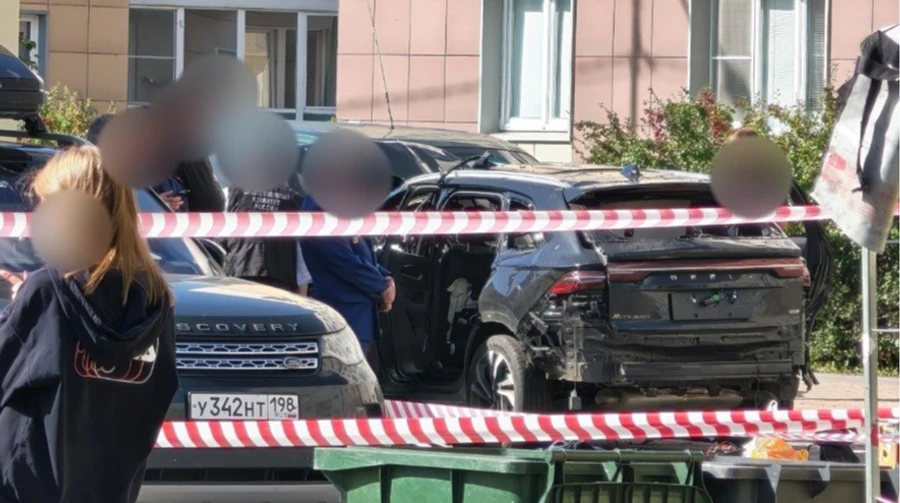
A Russian serviceman was killed and his wife injured in a vehicle incident in St Petersburg on Thursday, adding to a series of attacks and explosions inside Russia involving military personnel and people connected to the country’s war effort in Ukraine.
The incident occurred in the Pushkinsky district on the outskirts of Russia’s second-largest city. Russia’s Investigative Committee confirmed that a serviceman was killed and his wife was receiving medical treatment after the vehicle caught fire. The committee opened a criminal Investigation and said investigators and forensic specialists were examining the scene.
Local Russian media reported that the vehicle was destroyed in an explosion and that the deceased serviceman held the rank of lieutenant colonel. That rank and other details about his military role had not been officially confirmed by the Investigative Committee at the time of the initial reports.
The cause of the blast and who may have been responsible also remained unclear. Ukraine had not immediately claimed responsibility, while Russian authorities had not publicly attributed the incident to Kyiv.
What happened in St Petersburg?
The incident took place on Thursday morning in the Pushkinsky area, with reports placing it around the Kolpinskoye Highway in the Slavyanka area.
The serviceman was in the car with his wife when the vehicle caught fire. The man died, while his wife was taken for medical treatment.
Russia’s Investigative Committee subsequently confirmed the identities of the victims in broad terms, saying the deceased was a serviceman from one of the military units and the injured woman was his wife.
Local outlet Fontanka reported that the serviceman was a lieutenant colonel from Russia’s aerospace or air-defence forces. Other local reports described the incident as an explosion involving a suspected improvised explosive device, but those details were not immediately confirmed by Russia’s top investigative authority.
The distinction matters because the official investigation was initially described as involving a vehicle fire rather than formally confirming a deliberate bombing.
Investigators were examining the scene and preparing forensic examinations to determine what caused the vehicle to catch fire and whether an explosive device had been used.
No immediate claim of responsibility
One of the most important unanswered questions is who was behind the incident.
There was no immediate Ukrainian claim of responsibility. That is significant because Kyiv has acknowledged some operations targeting Russian military personnel inside Russia, while denying involvement in other high-profile attacks.
Russian authorities have previously accused Ukraine of orchestrating assassinations and sabotage operations against military officers and other people associated with the war. In some cases, Ukrainian officials or Security services have later acknowledged involvement; in others, responsibility has remained disputed.
Until investigators establish what happened in St Petersburg, it would be premature to assign responsibility for Thursday’s blast.
The lack of an immediate attribution also distinguishes the incident from several previous cases in which Russian authorities or Ukrainian officials quickly presented competing accounts of an attack.
The latest incident follows other attacks
The St Petersburg incident comes after several explosions and targeted attacks in Russia involving people connected to the country’s military or wartime infrastructure.
On August 5, the director of a factory supplying drones to the Russian military was badly wounded when his vehicle exploded near Yekaterinburg. His driver was killed.
Investigators did not publicly identify who was responsible for that incident, and no group immediately claimed responsibility.
The attack was nevertheless significant because it targeted a figure associated with Russia’s military-industrial system. Drone production has become increasingly important to the war in Ukraine, making companies involved in the sector strategically relevant.
The blast near Yekaterinburg also demonstrated that attacks involving war-linked targets have not been confined to Moscow or areas immediately adjacent to Ukraine.
A series of attacks has raised security concerns
Russia has experienced a number of deadly attacks and attempted assassinations since the Kremlin launched its full-scale invasion of Ukraine in February 2022.
The targets have varied considerably. Some have been senior military officers, while others have included individuals involved in Russia’s defence industry or prominent supporters of the war.
Earlier this year, Russia’s Federal Security Service said security measures would be strengthened around senior military and government officials following a series of assassination attempts in Russian cities.
The security challenge is complicated by the Nature of the attacks. Explosives placed inside or underneath vehicles can potentially target individuals during their daily routines, making conventional protection more difficult.
At the same time, investigators must determine whether an explosion is actually a deliberate attack, an accident or another form of criminal incident before assigning responsibility.
Restaurant bombing in Moscow adds to the pattern
The St Petersburg incident also follows a deadly explosion at an upscale Italian restaurant in Moscow.
Russian state media reported that at least five people were killed, including the person who detonated the bomb. Russian officials did not immediately identify suspects behind the incident.
The Russian Embassy in Rome blamed Ukraine for the explosion and described it as an attempt to intimidate the Italian community in Russia. The Russian Foreign Ministry reposted the embassy statement without adding a separate attribution.
Moscow Mayor Sergei Sobyanin described the explosion as a terrorist act but did not publicly establish who had carried it out.
The competing claims surrounding attacks such as this illustrate why attribution has become one of the most sensitive elements of reporting violence inside Russia during the Ukraine war.
Ukraine has acknowledged some targeted operations
Ukraine has not denied carrying out every attack inside Russia.
One of the clearest examples came in December 2024, when Ukraine’s SBU security service said it had organised the killing of Lieutenant General Igor Kirillov, who headed Russia’s military forces responsible for nuclear, biological and chemical protection.
Kirillov was killed by a bomb hidden in a scooter outside his apartment building in Moscow. The attack came one day after Ukraine’s security service announced criminal charges against him.
The case demonstrated that Ukrainian security services have been willing to claim responsibility for operations targeting senior Russian military figures.
But the pattern is not uniform. Ukrainian authorities have also denied involvement in prominent attacks, particularly where Moscow has directly or indirectly blamed Kyiv.
The Darya Dugina case remains an example of disputed responsibility
Darya Dugina, a Russian nationalist commentator and the daughter of influential political thinker Alexander Dugin, was killed in August 2022 when an explosive device placed in her SUV detonated near Moscow.
Russian authorities treated the killing as an assassination and accused Ukrainian actors of involvement. Ukraine denied responsibility.
Dugina was 29 and worked for a Russian nationalist television channel. Her father, a prominent supporter of President Vladimir putin‘s decision to send Russian forces into Ukraine, was widely believed to have been the intended target.
The circumstances of that attack showed how difficult it can be to establish responsibility in politically charged cases. Russian authorities presented one account, while Ukraine rejected involvement.
The St Petersburg incident could similarly become the subject of competing narratives unless investigators establish clear evidence about the cause and perpetrators.
Why military personnel are increasingly vulnerable
Russia’s war in Ukraine has created a wider category of potential targets inside the country.
Military commanders are obvious targets because of their direct connection to Russian operations. But the definition of a war-linked figure can also extend to defence-industry executives, weapons manufacturers, military researchers and others involved in supplying the armed forces.
The drone factory executive injured near Yekaterinburg is an example of that broader target set.
Russia’s military-industrial complex has become increasingly important as the war has continued. Facilities producing drones, ammunition and other equipment are central to sustaining military operations.
That means attacks on people associated with defence production can have a symbolic significance even when the immediate physical impact is limited.
For Russian authorities, preventing such attacks is therefore both a conventional security challenge and a matter of protecting confidence in the country’s internal security system.
Attacks inside Russia have a wider psychological impact
Beyond their immediate casualties, targeted attacks can have an impact far beyond the location where they occur.
For military personnel and officials, the possibility of an attack away from the battlefield can alter perceptions of personal security. Vehicles, homes and ordinary travel routes can become potential points of vulnerability.
For the wider public, repeated explosions can reinforce the perception that the war has consequences inside Russia itself.
This is particularly relevant in major urban areas such as Moscow and St Petersburg. Attacks in such cities can attract considerably more attention than incidents in remote regions because of their proximity to political and economic centres.
However, the strategic impact of any individual attack depends on several factors, including the identity of the target, the circumstances of the attack, the response from Russian authorities and whether a perpetrator can be identified.
Russia’s response will be closely watched
The immediate priority for Russian investigators is to establish exactly what happened in St Petersburg.
That means determining the cause of the fire, examining the remains of the vehicle, collecting forensic evidence and reconstructing the movements of the victims before the incident.
If investigators establish that an explosive device was used, the next challenge will be identifying who planted it and whether the attack was specifically intended for the serviceman.
Authorities will also examine whether the victim had a role that could explain why he might have been targeted.
At this stage, those questions remain unanswered.
A broader security problem created by the war
The latest St Petersburg case highlights a difficult security problem that has emerged during the Russia-Ukraine conflict: the battlefield is not the only place where military-linked violence is occurring.
Russia has faced drone attacks, sabotage allegations, assassination attempts and explosions in different parts of the country. Ukraine has acknowledged some operations but denied involvement in others, while Russian authorities have frequently pointed toward Ukrainian security services.
That makes careful attribution particularly important.
Calling an incident a Ukrainian operation before evidence is established can turn an investigation into a political claim. Conversely, refusing to consider the possibility of a targeted attack could overlook a broader security threat.
The St Petersburg investigation therefore carries significance beyond the death of one serviceman. Its findings could help determine whether the incident was an isolated act of violence or part of a wider campaign against Russian military and defence-linked personnel.
What happens next?
The next key development will depend on the findings of Russia’s criminal investigation.
If forensic evidence confirms that an explosive device caused the vehicle’s destruction, investigators will likely focus on how the device was obtained, planted and detonated and whether the serviceman was specifically targeted.
Authorities will also have to determine whether there are connections to other recent attacks involving Russian military personnel or defence-industry figures.
For now, no responsibility has been established for the St Petersburg incident. Ukraine has not immediately claimed involvement, and Russian authorities have not publicly attributed the attack to Kyiv.
That leaves the case in an early investigative stage.
What is already clear is that the killing adds another entry to a growing list of violent incidents inside Russia involving people linked to the country’s war effort. Whether it represents another deliberate operation targeting military personnel, a separate criminal act or something else will depend on evidence that investigators have yet to make public.
For breaking news and live news updates, like us on Facebook or follow us on Twitter and Instagram. Read more on Latest World on thefoxdaily.com.




COMMENTS 0