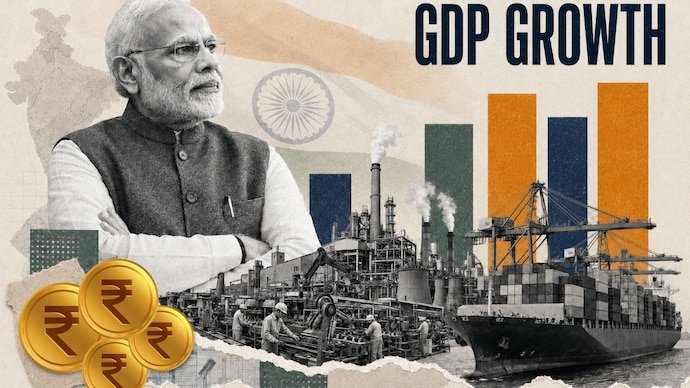
India’s latest 7.8% GDP growth figure has moved beyond a simple argument over whether the economy is expanding rapidly. The sharper debate now concerns something more fundamental: whether the public, investors and economists can fully trust the process by which the number was calculated.
The first-quarter growth estimate for 2026-27, released after a major overhaul of India’s national accounts, showed real GDP expanding 7.8% year-on-year and nominal GDP rising 10.3%. The figures were stronger than many expectations and offered a positive picture of economic resilience despite global disruptions and higher energy costs. :contentReference[oaicite:0]{index=0}
But the headline number quickly came under scrutiny after former Finance Secretary Subhash Chandra Garg argued that growth would look dramatically weaker if the latest quarter were compared with figures from the previous GDP series. His calculation suggested a growth rate of only about 2.6%, triggering a wider argument over base-year changes, revisions and the credibility of India’s economic statistics.
That alternative calculation has since faced strong criticism from economists who say it mixes numbers from two different statistical systems. Yet the controversy has not disappeared, largely because a separate question remains unanswered to the satisfaction of every critic: why were earlier GDP estimates revised so substantially under the new series, and has the government explained those revisions clearly enough?
That is where the contrasting assessments of former Chief Economic Advisers Arvind Subramanian and KV Subramanian become important. Speaking in separate assessments, both rejected the idea that India’s growth should simply be rewritten as 2.6%. But while Arvind Subramanian raised serious concerns about transparency and public trust, KV Subramanian argued that the 7.8% figure is broadly credible and that the alternative calculation is conceptually wrong.
What exactly triggered the GDP controversy?
The dispute began with the transition to a new GDP series using 2022-23 as the base year, replacing the earlier 2011-12 base year. The new series was introduced in February 2026 as part of an effort to update India’s national accounts and better reflect changes in the structure of the economy.
Changing the base year is not unusual. National statistical agencies periodically update their systems because economies change over time. New industries emerge, consumption patterns shift, businesses change their reporting practices and previously unavailable datasets become accessible.
The difficulty arises when people compare a number calculated under an older methodology with another number produced under the new one. That can create apparent changes in growth that are actually caused partly by differences in measurement.
This is the central problem with the 2.6% calculation criticised by both former CEAs. Arvind Subramanian called it an “apples to oranges” comparison because it uses figures belonging to different series rather than comparing equivalent observations under the same methodology.
Why the 2.6% figure has been challenged
Garg’s argument focused on the sharp revision to the previous year’s GDP level. An earlier estimate for the relevant quarter had placed GDP at roughly Rs 86 lakh crore, while the corresponding estimate under the new series was closer to Rs 80 lakh crore.
His contention was that the downward revision materially changed the base against which the latest quarter’s growth was calculated. Using the old series as a reference point, he argued, produced a dramatically weaker growth estimate.
But the problem is that the old-series and new-series estimates are not directly interchangeable. Once the statistical methodology, price measures, classifications and data sources change, a figure from the previous system does not automatically remain an appropriate denominator for calculating growth under the new system.
This is why the 2.6% figure cannot simply be presented as an alternative official GDP estimate. It is a calculation derived by mixing incompatible series, and economists who have examined the controversy have said that this methodological problem is substantial.
The more legitimate question is what caused the revision and whether enough information has been published for outsiders to independently understand it.
Arvind Subramanian: 7.8% may be directionally right, but trust is weak
Arvind Subramanian has taken a nuanced position. He does not endorse the 2.6% calculation, but he also does not believe the government’s explanation has fully settled the controversy.
His view is that the latest data appears to point in the correct broad direction: economic activity is improving. At the same time, he has questioned whether the magnitude of the reported growth is fully convincing when compared with other indicators of economic wellbeing.
That distinction is important. An economy can genuinely be growing while the precise growth rate remains subject to measurement uncertainty. GDP is a constructed statistical estimate, not a direct physical reading of national economic activity.
Subramanian’s concern is therefore less about replacing 7.8% with 2.6% and more about the credibility gap created by insufficient explanation.
He has argued that the government should publish enough data and methodological detail for independent researchers to reconstruct the calculations and understand why earlier estimates changed.
Why revisions matter so much
GDP revisions are a normal part of economic statistics. Initial estimates are often compiled with incomplete information, and later estimates incorporate more comprehensive data from businesses, government accounts, tax records and other sources.
India’s new system also introduces updated data sources and methodological changes intended to improve measurement. Recent explanations from the statistical authorities have highlighted more granular price information, broader deflator coverage and other methodological improvements. :contentReference[oaicite:1]{index=1}
The existence of revisions, therefore, is not evidence of manipulation by itself. Every major economy revises national accounts as better information becomes available.
The issue is whether revisions are adequately explained and whether outsiders can determine why a particular year or quarter moved sharply in one direction.
That is where transparency becomes crucial. Without a sufficiently detailed historical back series and clear methodological documentation, even legitimate statistical revisions can create the appearance of political manipulation.
KV Subramanian calls the 2.6% estimate “absolutely bogus”
KV Subramanian has taken a much harder line against the alternative interpretation. He described Garg’s 2.6% estimate as “absolutely bogus” and argued that it contains a fundamental conceptual error.
His analogy was straightforward: comparing economic output across two different measurement systems and then interpreting the resulting numerical difference as actual economic decline is like weighing the same person in pounds one year and kilograms the next and concluding that the person suddenly lost weight.
His argument is that the correct comparison must use GDP figures generated using the same statistical framework. Once that principle is accepted, the dramatic collapse from the reported 7.8% growth to 2.6% no longer follows.
KV Subramanian has also rejected the suggestion that the government deliberately lowered an earlier GDP estimate to make the newest growth rate appear stronger.
Could the revision have been designed to inflate growth?
This is perhaps the most politically sensitive part of the controversy.
The suspicion arises because a lower estimate for the previous year can mathematically increase the growth rate recorded in the following year, all else being equal. That does not mean the revision was made for that purpose, but it explains why the change has attracted scrutiny.
KV Subramanian’s response is that the new methodology was announced in February 2026, months before the latest GDP results became available. He argues that officials could not have known in advance what the eventual September-era figures would be and therefore could not have designed the February revision specifically to manufacture the later growth rate.
The government’s statistics authorities have similarly argued that the revisions reflect methodological improvements and updated datasets rather than a systematic attempt to lower historical numbers. The statistics secretary has said revisions in recent years have moved in both directions rather than consistently downward. :contentReference[oaicite:2]{index=2}
That is an important distinction. Statistical revisions can affect subsequent growth rates without being intentionally designed to do so.
Why Arvind Subramanian still sees a trust deficit
Arvind Subramanian’s criticism goes beyond the GDP series itself. He argues that public confidence in official statistics depends on the credibility of the broader statistical ecosystem.
He has cited controversies and institutional concerns involving the census, consumer expenditure data and other official indicators as reasons why the government’s latest economic claims are sometimes met with skepticism before they are fully examined.
His underlying argument is that statistical credibility is cumulative. If trust in several official datasets has weakened, even a technically valid new GDP methodology may be viewed with suspicion unless the government provides unusually clear documentation.
This is why his preferred approach is essentially trust and verify: publish the data, explain the methodology, disclose revisions and allow independent economists to test the assumptions.
His position is not that every government statistic is false. It is that the burden of proof becomes higher when historical revisions are large and when economic conditions appear inconsistent with the headline number.
Why 7.8% can coexist with weak jobs or wages
One of the strongest challenges to the government’s growth narrative concerns the difference between aggregate output and everyday economic experience.
A country can record high GDP growth while particular groups experience weak wage gains, limited job creation or financial stress. GDP measures the value of economic production; it does not directly measure how evenly the benefits of that production are distributed across households.
That distinction explains why questions about employment and wages do not automatically disprove a 7.8% GDP figure.
Arvind Subramanian has nevertheless argued that weak employment growth, subdued wage gains and fragile private investment should make policymakers and statisticians examine the headline number more carefully.
The broader lesson is that GDP should never be treated as the only measure of economic Health. Employment, real wages, household consumption, investment, productivity and business confidence all provide additional information.
KV Subramanian points to investment, credit and construction
KV Subramanian’s defence of the GDP figure is built around a different set of indicators. He has pointed to strong growth in vehicle sales, capital expenditure, bank credit, capital-goods production and construction as evidence that the Indian economy is operating at a much stronger pace than a 2.6% growth estimate would suggest.
Among the figures he cited were around 12% growth in capital expenditure by listed companies, an 11% increase in government investment, 20% growth in bank credit, 16% growth in capital-goods production and 15% growth in construction activity.
He also highlighted double-digit growth in passenger and transport vehicle sales as a proxy for consumer and business activity.
Those indicators do not independently prove that GDP must be exactly 7.8%. But taken together, they make a sharp slowdown to 2.6% difficult to reconcile with several major areas of economic activity.
The most important distinction: real GDP versus nominal GDP
Part of the confusion in the public debate comes from the difference between real GDP and nominal GDP.
Real GDP attempts to measure changes in the volume of economic production after adjusting for price changes. Nominal GDP measures output at current prices and therefore includes the effect of Inflation.
For the April-June quarter of 2026-27, the official data showed real GDP growth of 7.8%, while nominal GDP increased 10.3%. :contentReference[oaicite:3]{index=3}
That gap is normal because prices and production volumes can grow at different rates. But the distinction becomes especially important when comparing numbers across different GDP series, because changing deflators and price datasets can alter both nominal and real calculations.
Understanding the difference helps explain why simply taking two headline output figures from separate statistical frameworks and calculating a percentage change can produce a misleading result.
India’s new GDP series changes more than the base year
The transition to a 2022-23 base year is not merely a matter of replacing one calendar reference with another. India’s statistical authorities have also updated data sources, classifications and methods used in the national accounts.
Recent explanations have highlighted the move toward more detailed pricing information and an expanded set of deflators. The statistical authorities say these changes are intended to better capture the modern economy, including structural shifts in business activity and the growing importance of newer sectors and data sources. :contentReference[oaicite:4]{index=4}
This is important because the Indian economy has changed considerably since the previous base year was established. Digital payments, formal tax reporting, services, platform businesses and changes in the informal economy can make older statistical assumptions less representative over time.
A revised methodology can therefore produce different historical estimates without implying that one set of numbers was deliberately fabricated.
But transparency can still improve
This is where the two former CEAs surprisingly converge.
Despite their sharp disagreement over the reliability of the 2.6% calculation, both Arvind and KV Subramanian have argued that the government should explain the revised GDP methodology in greater detail.
Arvind Subramanian has called for virtually complete transparency, including the underlying data and rationale for major historical revisions. KV Subramanian has also said that questions should be addressed openly and that a comprehensive sources-and-methods document would help outside economists examine the figures.
That agreement is revealing because it identifies the real weakness in the debate. Even when statisticians follow legitimate procedures, economic statistics cannot command lasting confidence if the public cannot understand how major revisions occurred.
Why this matters beyond one GDP number
The dispute is not simply an argument between economists. GDP data influences monetary policy, fiscal planning, investor expectations, business decisions and international comparisons.
If growth is genuinely close to 8%, India can reasonably expect stronger tax revenues, higher investment potential and greater confidence about medium-term development. But if headline growth is substantially overstating improvements in living standards, policymakers risk overlooking problems in employment, household demand or private investment.
That is why credible statistics matter even when the numbers are politically inconvenient.
Investors in particular need consistency. They do not necessarily require GDP estimates to remain unchanged; they need to know that revisions follow understandable rules and that the same rules are applied across good and bad years.
The trust problem may outlast the 2.6% argument
The 2.6% estimate has a serious methodological weakness because it compares observations from different statistical systems. That makes it unsuitable as a straightforward substitute for the official 7.8% figure.
But dismissing that calculation does not automatically resolve every concern surrounding the new GDP series.
The more difficult question is whether the government can make the revised historical data sufficiently transparent that researchers, businesses and ordinary citizens can understand the changes without relying on political interpretations from either side.
This distinction matters because statistical credibility is not established by winning an argument over one percentage point. It is built over years through predictable revisions, accessible data, independent scrutiny and clear communication.
What the government needs to clarify
The current controversy points toward several areas where greater disclosure would reduce uncertainty.
First, the government needs to explain the historical revisions in accessible terms, particularly the large changes in quarterly GDP levels under the new series.
Second, researchers need sufficient back-series data to make consistent comparisons over time. Without a complete and transparent historical record, even technically correct statistics can become difficult for the wider public to interpret.
Third, policymakers should distinguish clearly between changes caused by new economic information and changes caused by changes in methodology.
Fourth, the statistical system must maintain credibility regardless of whether the resulting growth rate is high or low. Transparency cannot be applied only when the data is under criticism.
What the 7.8% figure does tell us
Despite the dispute, the latest data does provide evidence of substantial economic momentum. The official release shows real GDP growth of 7.8% for the first quarter of FY2026-27, while several other indicators cited by economists point to solid domestic activity. :contentReference[oaicite:5]{index=5}
That does not mean every part of the economy is performing equally well. Strong aggregate growth can coexist with uneven employment outcomes, weaker household purchasing power in some segments and subdued investment in particular sectors.
Nor does one quarter determine the trajectory of the entire fiscal year. Growth can accelerate or weaken as energy prices, exports, domestic demand, government spending and private investment change.
The responsible conclusion is therefore neither that India’s economy is secretly growing at 2.6% nor that every indicator confirms exactly 7.8%. The available evidence supports a stronger economy than the alternative calculation suggests, while legitimate questions remain about how the new series should be interpreted.
The real fault line is trust, not just growth
India’s GDP debate has now moved past the headline clash between 7.8% and 2.6%. The methodological criticism of the lower figure is substantial, and the official 7.8% estimate is supported by a range of economic indicators. Yet the controversy has exposed a deeper issue that cannot be settled by dismissing one calculation.
Arvind Subramanian’s warning is essentially about credibility: when earlier data has been revised and the methodology is changing, the government must provide enough information for independent observers to verify the results. KV Subramanian’s defence is that the new series is technically sound and that revisions are a normal feature of modern national accounting.
Both arguments can be true at the same time.
India can have a statistically defensible GDP growth rate while still having a transparency problem around revisions. The government can be right to reject the 2.6% calculation while still having a responsibility to explain the historical changes more fully.
Ultimately, the most valuable outcome from this controversy would not be victory for one economist over another. It would be a stronger statistical system in which high growth numbers are easier to verify, revisions are easier to understand and public trust does not depend on which side of the political debate a reader happens to occupy.
That is where the dust around the latest GDP figures may finally settle and where the real test of India’s economic data credibility begins.
For breaking news and live news updates, like us on Facebook or follow us on Twitter and Instagram. Read more on Latest Business on thefoxdaily.com.






COMMENTS 0