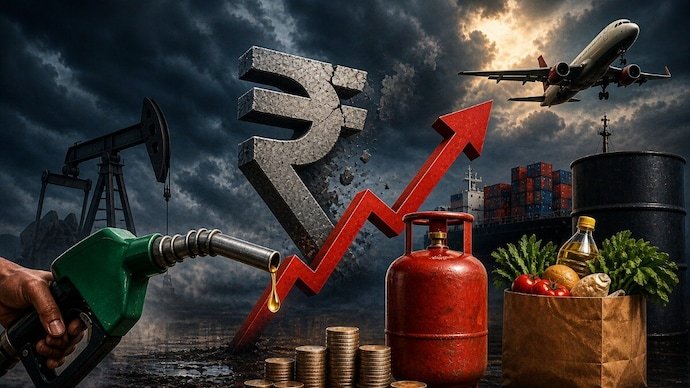
After nearly two years of improving Inflation conditions and relative stability in household expenses, a familiar concern is beginning to reappear: rising prices.
The immediate trigger comes from a combination of global factors. Energy Markets have become volatile due to tensions in West Asia, Crude Oil Prices have moved higher, and inflation in major economies such as the United States has proven more persistent than many policymakers expected.
While India is not currently facing an inflation crisis, economists and policymakers are increasingly warning that the margin of safety is narrowing. The concern is not that prices will suddenly surge overnight, but that higher energy costs could gradually spread through the economy, increasing the cost of transportation, food distribution, manufacturing, and everyday consumer goods.
For millions of Indian households, the question is simple: will monthly expenses start rising again? The answer depends largely on what happens to global oil prices in the coming months.
Why Oil Prices Matter More to India Than Many Other Countries
India is one of the world’s largest energy consumers but relies heavily on imported crude oil to meet domestic demand. This dependence creates a direct link between Global energy markets and household budgets.
When international crude oil prices rise, the impact is not limited to petrol pumps. Energy serves as a foundational input across the economy. Transportation companies, airlines, manufacturers, logistics providers, agricultural businesses, and retailers all face higher operating costs.
Eventually, many of these additional costs are passed on to consumers.
This makes oil one of the most powerful inflation drivers in India’s economic system.
How a Rise in Crude Oil Travels Through the Economy
Most people associate higher oil prices with more expensive petrol and diesel. However, the real impact extends far beyond fuel stations.
The inflation transmission process typically follows several stages:
| Stage | Impact |
|---|---|
| Higher Crude Oil Prices | Increases import costs for India |
| Costlier Fuel | Raises transportation and logistics expenses |
| Higher Business Costs | Affects manufacturing, packaging, and distribution |
| Retail Price Increases | Consumer goods become more expensive |
| Broader Inflation | Household budgets come under pressure |
This chain reaction explains why economists closely monitor energy prices even when inflation appears under control.
Why Your Grocery Bill Could Be Affected
One of the most overlooked aspects of inflation is the role energy plays in getting food from farms to dining tables.
Agricultural products require transportation, storage, refrigeration, packaging, and distribution. Every stage depends on energy.
When diesel costs rise, transporting fruits, vegetables, grains, dairy products, and packaged foods becomes more expensive. Those costs eventually appear on supermarket shelves.
Additionally, petroleum-derived products are used extensively in packaging materials, plastics, chemicals, and fertilizers.
This means higher crude oil prices can indirectly influence Food Inflation even if agricultural production remains stable.
FMCG Price Hikes Could Be the First Warning Signal
Fast-moving consumer goods (FMCG) companies often serve as an early indicator of inflationary pressure.
Many manufacturers are already facing higher costs for:
- Edible oils.
- Packaging materials.
- Transportation.
- Energy consumption.
- Agricultural raw materials.
Initially, companies may absorb some of these increases to protect market share. However, when cost pressures persist, businesses generally have limited options.
They either raise prices, reduce product quantities through shrinkflation, or accept lower profit margins.
History suggests that sustained input cost increases eventually find their way to consumers.
The Return of Imported Inflation
Economists often use the term “imported inflation” to describe situations where global price increases enter a country’s economy through international trade.
India is particularly vulnerable because of its dependence on imported energy.
When crude oil becomes more expensive internationally, the country pays more for imports. If the rupee weakens against the US dollar simultaneously, the impact becomes even stronger.
Since oil is priced globally in dollars, currency movements can amplify inflationary pressures.
This is one reason policymakers closely monitor both energy prices and exchange rates when assessing inflation risks.
What the RBI’s Inflation Forecast Is Telling Us
The Reserve Bank of India’s latest inflation outlook offers important clues about future risks.
Although inflation remains within a manageable range, the central bank has become more cautious about the coming year.
Its revised projections suggest inflationary pressures may strengthen during the latter half of the fiscal year.
| Period | Projected CPI Inflation |
|---|---|
| Q1 FY27 | 4.2% |
| Q2 FY27 | 5.1% |
| Q3 FY27 | 5.9% |
| Q4 FY27 | 5.4% |
| FY27 Average | 5.1% |
The projections do not indicate runaway inflation, but they do suggest that the period of continuously easing prices may be ending.
The RBI‘s decision to maintain a neutral policy stance reflects this uncertainty.
How Geopolitical Tensions Affect Household Budgets
Many consumers struggle to understand how events thousands of kilometers away can affect their daily expenses.
The answer lies in global energy markets.
Conflicts involving major oil-producing regions often create fears about supply disruptions. Even when actual production remains unchanged, uncertainty alone can push prices higher.
Financial Markets react quickly to geopolitical risks because energy shortages can have widespread economic consequences.
As a result, tensions in West Asia frequently influence fuel costs, transportation expenses, and inflation expectations around the world.
For India, which imports most of its oil requirements, these developments cannot be ignored.
The Hidden Inflation Risk Most People Miss
When consumers think about inflation, they often focus on visible price increases such as fuel or grocery bills.
However, one of the biggest risks is what economists call “inflation expectations.”
If businesses believe costs will continue rising, they may increase prices proactively. Workers may demand higher wages. Suppliers may negotiate higher contracts.
These behaviors can create a self-reinforcing cycle that makes inflation more persistent.
This is why central banks pay close attention not only to current inflation but also to public expectations about future prices.
Will Fuel Prices Rise Immediately?
Not necessarily.
Several factors can temporarily cushion consumers from rising global crude prices.
These include:
- Government tax adjustments.
- Oil marketing company pricing strategies.
- Exchange rate movements.
- Existing fuel inventories.
- Market competition.
However, if crude oil remains elevated for an extended period, these buffers become harder to maintain.
Historically, prolonged increases in oil prices eventually influence domestic fuel costs either directly or indirectly.
Comparison: Inflation Risks Today vs Post-Pandemic Inflation
| Factor | Post-Pandemic Period | Current Situation |
|---|---|---|
| Food Inflation | Very High | Moderate |
| Supply Chain Disruptions | Severe | Limited |
| Energy Prices | Highly Volatile | Rising Again |
| Consumer Demand | Recovering | Stable |
| Inflation Risk | Broad-Based | Building Gradually |
This comparison highlights why economists are concerned but not alarmed. Current conditions are far more stable than the inflation surge experienced after the pandemic, yet risks are clearly increasing.
What Indian Families Should Expect Over the Next Few Months
For most households, the most likely scenario is not a sudden inflation shock but a gradual increase in selected expenses.
Areas most vulnerable to price increases include:
- Transportation costs.
- Packaged food products.
- Personal care items.
- Household essentials.
- Travel expenses.
- Utility-related services.
Whether these increases become significant will depend largely on the trajectory of global crude oil prices and geopolitical developments.
If energy markets stabilize, inflation may remain manageable. If oil prices continue rising sharply, the pressure on household budgets could become more noticeable.
An Overlooked Insight: Inflation Is Becoming More Global Than Ever
One important trend often missed in inflation discussions is the growing interconnectedness of the global economy.
Today’s inflation is rarely driven by a single domestic factor.
Weather events in one region can affect food prices elsewhere. Geopolitical conflicts can influence fuel costs worldwide. Supply chain disruptions can impact manufacturing across continents.
This means inflation management is becoming increasingly complex for governments and central banks.
For India, maintaining price stability will require not only sound domestic policies but also resilience against global economic shocks.
Future Outlook: Should Households Be Concerned?
There is no immediate reason for panic, but there is good reason for vigilance.
India’s inflation situation remains significantly better than during the post-pandemic surge, and the economy continues to benefit from stable growth, improving supply chains, and relatively controlled food prices.
However, the risks are clearly rising. Elevated crude oil prices, geopolitical uncertainty, weather-related disruptions, and imported inflation pressures could gradually push household costs higher over the coming months.
The biggest lesson for consumers is that inflation rarely arrives all at once. It often begins with small increases in transportation, energy, and manufacturing costs before spreading more broadly through the economy.
For now, Indian households are unlikely to face an immediate inflation shock. But the period of steadily falling price pressures may be ending, and the coming months could determine whether inflation remains manageable or once again becomes one of the country’s biggest economic concerns.
For breaking news and live news updates, like us on Facebook or follow us on Twitter and Instagram. Read more on Latest Business on thefoxdaily.com.






COMMENTS 0