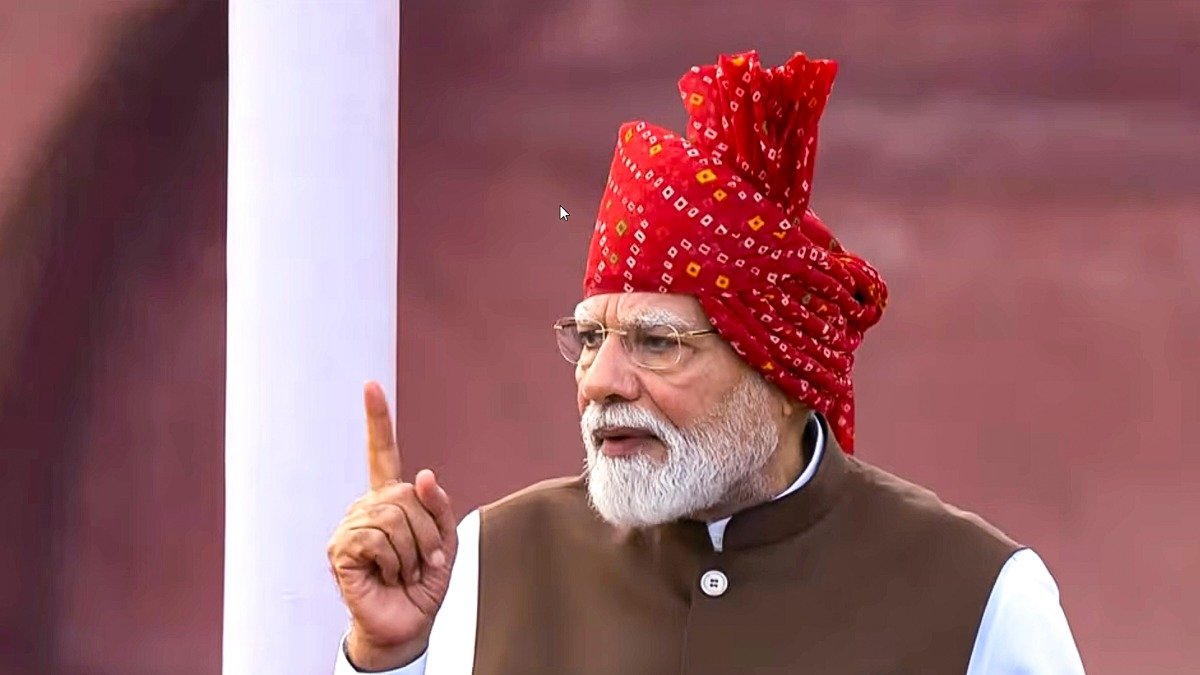
Prime Minister Narendra Modi has announced a nationwide talent identification programme for children aged 5 to 15 years, as India steps up preparations for its long-term Olympic ambitions. In his Independence Day address from the Red Fort in New Delhi, Modi said India should aim to participate in at least three-fourths of the events at the 2036 Olympics.
The announcement puts early talent identification at the centre of India’s broader sports strategy. The proposed programme is intended to find children with sporting potential across the country and provide selected prospects with specialised training aimed at developing them into world-class athletes.
Modi’s announcement comes as India prepares to host the 2030 Commonwealth Games in Ahmedabad, Gujarat, giving the country another major sporting platform before the 2036 Olympic target.
India wants to expand its Olympic footprint
India has made progress across several sports in recent years, but Modi said the country still faces a major gap in the number of Olympic events in which Indian athletes are able to compete.
Speaking at the Red Fort, he pointed to the country’s growing sporting ecosystem, including the Target Olympic Podium Scheme (TOPS), Khelo India Games, University Games, Beach Games, Winter Games, sports training, sports medicine and sports nutrition.
“India’s performance is improving,” Modi said, while also highlighting India’s ambition to become a strong contender to host the 2036 Olympics.
He noted that the Olympic programme contains around 40 disciplines and nearly 350 events, but India is unable to qualify for a significant proportion of them.
The issue is not simply about winning medals. A country that wants a broader presence at the Olympics needs athletes capable of meeting qualification standards across a much wider range of disciplines.
What is the new nationwide talent hunt?
The proposed nationwide programme is designed to address that gap by identifying potential athletes much earlier in their development.
Children between 5 and 15 years old will be included in the talent hunt, with the stated aim of finding promising sporting talent in different parts of India.
Modi said the programme would search for prospects “in every corner of the country” and provide selected children with special training to help them develop into world-class athletes.
The age range is significant because sporting development often requires years of structured training before an athlete reaches senior international competition. A nationwide identification system could therefore create a longer pipeline between discovering a child with potential and preparing that athlete for elite competition.
Why identifying talent early matters
India’s Olympic ambitions depend not only on the performance of established athletes but also on creating a steady supply of future competitors.
A young athlete may show physical or technical potential long before reaching the level required for international competition. Identifying that potential early can allow training programmes to be planned over a longer period.
The challenge, however, is making sure talent identification does not become limited to children WHO already have access to professional sporting facilities.
Modi specifically framed the initiative as a search for talent across the country. That approach could be important because India’s sporting talent is spread across urban centres, smaller towns and rural communities.
The effectiveness of the programme will ultimately depend on how successfully promising children are connected with coaches, facilities, Sports science, nutrition and appropriate competition opportunities after they are identified.
From talent discovery to world-class athletes
Finding talented children is only the first stage of the process. Developing them into elite athletes requires sustained support over many years.
The Prime Minister’s reference to sports training, sports medicine and sports nutrition in his Independence Day speech points to the wider Infrastructure needed to turn raw potential into international performance.
For young athletes, appropriate coaching is particularly important. A talent identification programme must be able to determine which sport and training Environment best suit an individual’s physical and technical abilities.
Long-term development also requires access to competition. Young athletes need opportunities to test themselves against increasingly strong opponents as they progress through different levels of their Careers.
In that sense, the proposed talent hunt is best understood as the beginning of a pipeline rather than a standalone selection exercise.
India’s 2036 target: at least three-fourths of Olympic events
Modi said India should aim to participate in at least three-fourths of the events at the 2036 Olympics.
That represents a substantial expansion of India’s Olympic participation. Rather than concentrating primarily on sports where India has traditionally performed well, the target points towards building strength across a much broader collection of disciplines.
The Prime Minister also described it as a matter of concern that India is unable to compete in at least two-thirds of Olympic events because athletes are not qualifying.
The distinction between participation and medals is important. Qualifying for more events would not automatically mean India wins more medals. But a larger pool of Olympic competitors would give India A wider base from which future medal contenders could emerge.
2030 Commonwealth Games provide an important milestone
The 2036 Olympic ambition comes just four years after India is scheduled to host the 2030 Commonwealth Games in Ahmedabad, Gujarat.
The formal handover took place during the closing ceremony of the 2026 Glasgow Games, with Ahmedabad set to host the centenary edition of the Commonwealth Games.
Ahmedabad will become only the second Indian city to host the Commonwealth Games, following New Delhi’s hosting of the 2010 edition.
The 2030 Games can serve as an important intermediate stage in India’s sporting development. Hosting a major multi-sport event requires competition venues, training facilities and supporting infrastructure, while the event itself provides opportunities for athletes to compete at a high level on home soil.
Ahmedabad Games could strengthen the athlete pipeline
The 2030 Commonwealth Games are also relevant to the talent hunt because India will have a major multi-sport event on home ground before the 2036 Olympic target.
The development of sporting infrastructure for Ahmedabad can potentially support athletes beyond the Commonwealth Games themselves. The Narendra Modi Stadium complex is among the major venues around which the Ahmedabad Games will be centred.
For India’s longer-term plans, the value of such infrastructure will depend on whether facilities remain useful for training and competition after major events have ended.
The same principle applies to talent. Identifying children through a national programme will have lasting value only if those athletes continue receiving appropriate support throughout their development.
Khelo India and the broader sports ecosystem
Modi also highlighted the role of programmes and systems that have expanded India’s sporting ecosystem, including Khelo India and TOPS.
Khelo India has provided a platform for competitions across different age groups and sporting categories, while TOPS has focused on supporting athletes with Olympic and other major international ambitions.
The new talent hunt could complement such initiatives by focusing more heavily on the earliest stage of the athlete-development pathway.
That creates a potential progression from identification to structured development and eventually elite competition. The important question will be how smoothly these different stages connect.
Why the 5-15 age group is significant
The programme’s focus on children as young as five makes the initiative broader than a conventional search for near-elite athletes.
At the younger end of the range, the objective would necessarily be identifying potential rather than selecting athletes based on established international performance. Children’s physical abilities and sporting interests can change considerably as they grow.
That makes long-term development and flexibility particularly important. A child identified as promising in one discipline may eventually develop differently as their physical characteristics and interests change.
For the programme to have lasting impact, talent identification would therefore need to be treated as an ongoing process rather than a single test or selection event.
Reaching talent beyond major cities
One of the biggest opportunities presented by a nationwide programme is the possibility of expanding India’s talent pool beyond established sporting centres.
India’s geographical size means a centralised approach alone may struggle to identify every promising athlete. A search that reaches different regions could uncover children who might otherwise never enter organised elite sport.
But discovery is only useful if identified athletes can subsequently access appropriate facilities and coaching.
That means the long-term success of the programme could depend on the support available after selection, particularly for children from areas where specialised sporting infrastructure is limited.
India’s Olympic ambition goes beyond medals
The Prime Minister’s announcement frames India’s Olympic goal as a broader participation challenge rather than simply a medal-count target.
Competing in more events would require development across a wider range of sports. That could mean expanding India’s competitive presence in disciplines where the country currently has a smaller international athlete base.
A larger Olympic delegation could also create more opportunities for athletes from different sporting backgrounds to reach the world’s biggest multi-sport stage.
However, a broader participation target must be balanced with quality. The objective cannot simply be to send more athletes; competitors need the preparation and qualification standards required to perform effectively at the international level.
What could happen next?
The next important stage will be turning the announcement into a functioning national programme with clear mechanisms for identifying, assessing and developing young athletes.
The available details establish the core ambition: children aged 5 to 15 will be searched for sporting potential across India, with selected prospects receiving specialised training.
The broader sports ecosystem will then have to connect those young prospects with the appropriate development pathways.
India’s 2030 Commonwealth Games will provide a major milestone along that journey, while the 2036 Olympic target gives the athlete-development effort a longer time horizon.
A long road from a five-year-old prospect to an Olympic athlete
The most important aspect of the announcement is the time horizon. A child identified through the programme may have more than a decade of development ahead before the 2036 Olympics.
That makes the initiative fundamentally different from a short-term Olympic preparation campaign. Its success will depend on whether India can sustain investment in coaching, facilities, sports science, nutrition and competition opportunities over many years.
Modi’s target of competing in at least three-fourths of Olympic events is therefore not simply a goal for India’s athletes who are already competing internationally. It is a target for the next generation.
The nationwide talent hunt announced on Independence Day is intended to find that generation early. The real test will be whether those identified today can be given the support necessary to reach the Olympic stage in 2036.
For breaking news and live news updates, like us on Facebook or follow us on Twitter and Instagram. Read more on Latest India on thefoxdaily.com.





COMMENTS 0