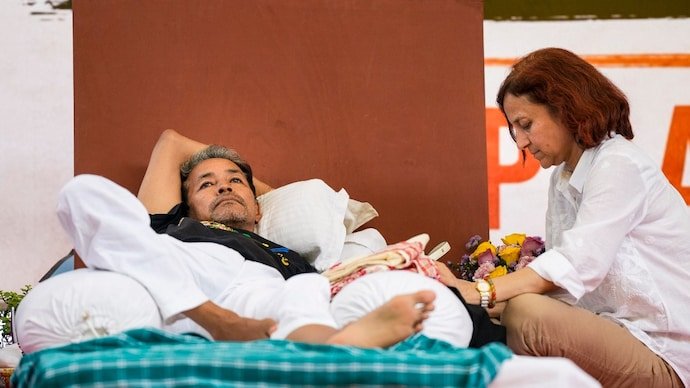
The legal battle surrounding Education Reform advocate Sonam Wangchuk has entered a crucial new phase after his wife, Gitanjali J. Angmo, approached the Delhi High Court challenging an earlier order that declined to interfere with his treatment at Safdarjung Hospital. The appeal raises significant constitutional and legal questions about personal liberty, informed consent, patient autonomy, and the extent of the state’s authority to intervene during prolonged hunger strikes.
The High Court has agreed to hear the appeal, bringing renewed focus not only to Wangchuk’s ongoing Hunger Strike but also to broader debates surrounding individual rights and state responsibility when a person’s Health is at serious risk.
Why Has Sonam Wangchuk’s Wife Approached the High Court?
According to the appeal, Gitanjali J. Angmo argues that Sonam Wangchuk is effectively being confined inside Safdarjung Hospital without being formally arrested or detained under any law.
She contends that neither Wangchuk nor his family has meaningful control over decisions regarding his treatment, raising concerns about whether his Constitutional Rights are being adequately protected.
The appeal also questions whether medical intervention can continue without the patient’s informed consent when the individual is consciously undertaking a voluntary hunger strike as a form of protest.
What Is the Core Legal Issue?
The case extends beyond one activist’s hospitalization and touches on an important legal principle:
- Can a competent adult refuse medical treatment?
- Does the government have the authority to intervene solely to preserve life?
- Where should courts draw the line between individual autonomy and public responsibility?
- What constitutes informed consent during a medical emergency?
- Can someone be kept in a government hospital without formal detention?
These questions have frequently emerged in cases involving hunger strikes, end-of-life decisions, and medical ethics around the world.
Background: Why Was Sonam Wangchuk Hospitalised?
Sonam Wangchuk has been on an indefinite hunger strike since June 28 to demand greater accountability and transparency in India‘s competitive examination system following controversies surrounding entrance examinations.
As his fast continued, concerns about his deteriorating health intensified. On the 21st day of the hunger strike, Delhi Police shifted him from Jantar Mantar to Safdarjung Hospital, citing medical concerns and previous court directions requiring authorities to monitor his health.
The transfer immediately sparked debate among supporters, WHO questioned whether the move interfered with his peaceful protest.
What Did the Delhi High Court Earlier Say?
In its earlier order, the Delhi High Court declined to issue an interim direction transferring Wangchuk to a private hospital.
The court observed that:
- Authorities were monitoring his medical condition.
- The decision to shift him was not arbitrary.
- Medical professionals should determine the appropriate treatment.
- There was no evidence of force violating his bodily integrity.
- The government acted within its authority considering his health condition.
The court emphasized that treatment decisions should remain with the attending medical team following established medical protocols.
Timeline of Key Developments
| Date | Development |
|---|---|
| June 28 | Sonam Wangchuk began an indefinite hunger strike. |
| July 16 | Delhi High Court directed authorities to monitor his health and medically intervene if required. |
| Day 21 of Fast | Delhi Police shifted Wangchuk to Safdarjung Hospital. |
| Sunday | Single judge refused interim relief seeking transfer to a private hospital. |
| Monday | Gitanjali J. Angmo filed an appeal challenging the earlier order. |
Understanding Informed Consent in Medical Law
One of the central issues in the appeal is the concept of informed consent.
In medical ethics, informed consent generally means that a patient who has the mental capacity to make decisions has the right to:
- Receive complete information about treatment.
- Understand potential risks and benefits.
- Accept or refuse medical intervention.
- Choose between available treatment options.
- Participate in decisions affecting their own healthcare.
The appeal argues that these principles should remain applicable even when a patient is engaged in a voluntary hunger strike.
Balancing Individual Rights and State Responsibility
Courts frequently face difficult questions when an individual’s personal choices create life-threatening situations.
Governments generally have a responsibility to protect life and maintain public order, while constitutional democracies also recognize personal liberty, bodily autonomy, and freedom of expression.
The present case illustrates the legal challenge of balancing these competing responsibilities without undermining either public safety or individual rights.
Why the Case Matters Beyond Sonam Wangchuk
Although the immediate dispute concerns Wangchuk’s treatment, the outcome could influence how future cases involving hunger strikes, civil protests, and emergency medical intervention are handled.
Legal experts note that judicial observations on informed consent and state intervention may become important references in similar constitutional matters involving patient autonomy.
The case therefore has significance beyond the current protest and may contribute to broader discussions about medical ethics and civil liberties in India.
Connection to the Ongoing Education Reform Movement
The legal proceedings are unfolding alongside Wangchuk’s larger campaign seeking reforms in India’s competitive examination system.
His protest has drawn support from students, educators, activists, and political leaders who argue that greater transparency and accountability are necessary to strengthen public confidence in national entrance examinations.
While the court proceedings focus on his medical treatment, the wider movement continues to highlight concerns surrounding examination governance and institutional accountability.
What Could Happen Next?
The Division Bench of the Delhi High Court will hear Angmo’s appeal to determine whether the earlier order requires reconsideration.
The court may examine several important issues, including:
- The legality of Wangchuk’s continued stay at Safdarjung Hospital.
- The scope of informed consent during prolonged hunger strikes.
- The balance between medical necessity and personal autonomy.
- Whether additional safeguards are required regarding treatment decisions.
- The extent of state authority in similar future situations.
The outcome could clarify legal standards governing medical intervention during peaceful protests.
Conclusion
Sonam Wangchuk’s wife, Gitanjali J. Angmo, has brought a fresh constitutional challenge before the Delhi High Court by questioning both the legality of his continued hospitalization and the extent to which informed consent has been respected during his treatment. While the government maintains that medical intervention was necessary to protect his health, the appeal argues that personal liberty and patient autonomy cannot be overlooked.
As the High Court considers the matter, the case has evolved beyond an individual legal dispute into a wider debate about constitutional rights, medical ethics, and the responsibilities of the state during public protests. Whatever the court ultimately decides, its observations are likely to have lasting significance for future cases involving hunger strikes, patient consent, and civil liberties in India.
For breaking news and live news updates, like us on Facebook or follow us on Twitter and Instagram. Read more on Latest India on thefoxdaily.com.






COMMENTS 0