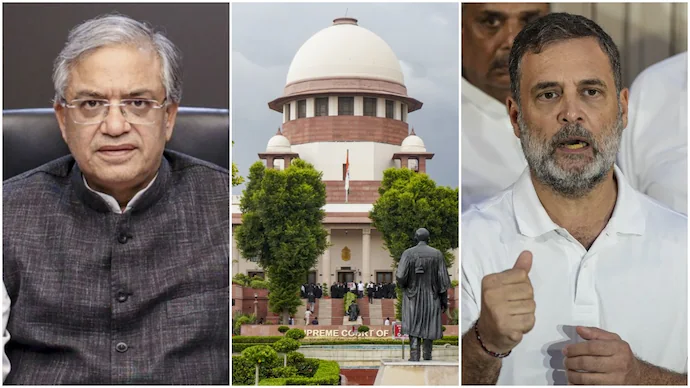
The Supreme Court on Tuesday said it was aware of developments surrounding allegations against the Election Commission of India (ECI) and would examine all aspects of the matter as it heard petitions challenging the poll body’s functioning and alleged irregularities in the Special Intensive Revision (SIR) of electoral rolls.
“We know everything, we will examine,” Chief Justice of India Surya Kant said during the hearing after senior advocate Abhishek Manu Singhvi, appearing for Congress leader Rahul Gandhi and other INDIA bloc leaders, urged the court to direct the preservation of file notings and internal communications related to the Commission’s decisions.
The petitioners have questioned whether key decisions concerning the electoral roll revision exercise were taken collectively by the Election Commission or unilaterally. They have also raised concerns about whether the Commission’s functioning complies with the constitutional and statutory framework governing the institution.
The bench, comprising Chief Justice Surya Kant and Justices Joymalya Bagchi and V Mohana, adjourned the hearing and granted the petitioners 10 days to file their rejoinder to the counter-affidavit submitted by the Election Commission on Monday. The matter was tentatively listed for further hearing on November 17.
Supreme Court to Examine Election Commission’s Decision-Making Process
A central issue before the Supreme Court is the decision-making process within the Election Commission, particularly whether decisions concerning the SIR exercise were taken after consultation among the commissioners.
During the hearing, Singhvi argued that the preservation of internal records was necessary to establish how the decisions were made and whether they reflected a unanimous position or the view of individual officeholders.
“This whole issue depends on the decision-making process, consultation, and whether the decision was unanimous or not unanimous. Let file notings, etc be preserved,” Singhvi told the bench.
The request for preserving file notings and internal communications is significant because such records could help establish how the Commission considered and approved decisions related to the electoral roll revision exercise.
The petitioners have alleged that several important decisions concerning the SIR process were taken in the name of the Commission despite objections from the other two Election Commissioners, Sukhbir Singh Sandhu and Vivek Joshi.
The Supreme Court did not issue an interim direction during Tuesday’s hearing. The bench said it would examine the issues raised and gave the petitioners time to respond to the Election Commission’s affidavit before the next hearing.
Indian Express Report Raises Questions About SIR Decisions
The allegations concerning the Commission’s decision-making have emerged against the backdrop of a report by The Indian Express, which claimed that at least 14 important decisions related to the SIR exercise were taken despite objections recorded by Election Commissioners Sukhbir Singh Sandhu and Vivek Joshi.
The report has become part of the wider dispute over whether decisions concerning the electoral roll revision process were reached through collective deliberation or taken despite disagreement among members of the Commission.
The petitioners have argued that examining the internal decision-making process is necessary to determine whether the Commission acted in accordance with the legal framework governing its functioning.
The Election Commission, however, has rejected allegations of unilateral decision-making. In its counter-affidavit filed on Monday, the Commission maintained that decisions concerning the SIR exercise were taken unanimously.
The competing claims place the Commission’s internal procedures at the centre of the case. While the petitioners have sought access to records that could clarify how decisions were reached, the ECI has defended the process described in its affidavit.
Form 6 Allegations Trigger Exchange Between Lawyers
The hearing also featured arguments over Form 6, which is used for the inclusion of names in electoral rolls. Senior advocate Menaka Guruswamy, appearing for Trinamool Congress MP Dola Sen, argued that the Election Commission’s counter-affidavit supported the petitioners’ submissions.
Guruswamy alleged that the ECI had tampered with Form 6 and issued a press release claiming that the Supreme Court had approved the form.
The allegation prompted a response from senior advocate Maninder Singh, who appeared for the Election Commission. He rejected the submission and described it as “rhetoric” intended for an audience outside the courtroom.
The exchange formed part of the broader dispute over the conduct of the SIR exercise and the Commission’s public statements concerning its procedures.
The Election Commission has denied that Form 6 was amended. Its position differs from the allegations raised by the petitioners, leaving the issue among the matters contested before the court.
The court did not make a finding on the Form 6 allegations during Tuesday’s hearing. The matter remains part of the wider proceedings concerning the Commission’s functioning and the legal framework governing electoral roll revision.
Election Commission Denies Unilateral Decision-Making
In its counter-affidavit submitted on Monday, the Election Commission denied allegations that Chief Election Commissioner Gyanesh Kumar had taken decisions unilaterally.
The Commission maintained that decisions related to the SIR exercise were unanimous. This directly contradicts the petitioners’ allegations that certain decisions were taken despite objections from Election Commissioners Sukhbir Singh Sandhu and Vivek Joshi.
The affidavit forms an important part of the proceedings because it sets out the ECI’s response to the claims made in the petitions. The petitioners have been given 10 days to file a rejoinder, allowing them to respond to the Commission’s submissions before the matter is heard again.
The Supreme Court’s decision to grant time for the rejoinder means the parties will have an opportunity to place their respective positions before the bench as the case proceeds.
No final determination on the disputed allegations was made during Tuesday’s hearing. The court has indicated that it will examine the issues raised in the petitions and the responses submitted by the parties.
Plea Seeks Action Against Chief Election Commissioner Gyanesh Kumar
The petitions also question the functioning of Chief Election Commissioner Gyanesh Kumar and whether the Commission’s decisions comply with the constitutional and statutory provisions governing the electoral body.
The Election Commission has opposed the plea seeking to restrain Kumar from functioning as Chief Election Commissioner. In its counter-affidavit, the Commission argued that such a request was not maintainable under Article 324(5) of the Constitution.
Article 324(5) provides that the Chief Election Commissioner can be removed in the same manner and on the same grounds as a judge of the Supreme Court. The provision establishes a specific constitutional framework for the removal of the head of the Election Commission.
The Commission has relied on this provision in opposing the petitioners’ request concerning Kumar’s continued functioning as CEC.
The petitioners, meanwhile, have questioned whether the Commission’s conduct and decision-making comply with Article 324 and the statutory requirements governing its operations.
The dispute therefore involves both the specific allegations concerning the SIR exercise and broader questions about the constitutional framework governing the Election Commission’s functioning.
What Is the Special Intensive Revision of Electoral Rolls?
The Special Intensive Revision, or SIR, is the electoral roll revision exercise at the centre of the petitions. The proceedings before the Supreme Court include allegations about how decisions related to this exercise were taken and whether the Commission followed the required decision-making procedures.
Electoral rolls are central to the administration of elections because they record the names of eligible voters. The procedures used to revise these lists and the decisions made by the Election Commission can therefore attract legal scrutiny when their compliance with applicable rules is challenged.
In this case, the petitioners have focused on the Commission’s internal decision-making process, the alleged lack of agreement among commissioners on certain matters and the disputed claims concerning Form 6.
The ECI has denied the allegations of unilateral decisions and amendments to Form 6. It has also maintained that decisions related to the SIR exercise were unanimous.
The Supreme Court will examine the competing submissions as the proceedings continue. Tuesday’s hearing did not resolve the underlying disputes or establish whether the allegations were proven.
Supreme Court Lists Matter for November 17
The Supreme Court adjourned the hearing after considering the submissions made by lawyers representing the petitioners and the Election Commission.
The bench granted the petitioners 10 days to file their rejoinder to the counter-affidavit submitted by the ECI on Monday. The matter was tentatively listed for further hearing on November 17.
No interim direction was issued during Tuesday’s proceedings, including on the request to preserve file notings and internal communications.
The next hearing is expected to continue consideration of the petitions challenging the Commission’s functioning, the allegations surrounding the SIR exercise and the issues raised in the ECI’s counter-affidavit.
For now, the petitioners’ allegations and the Commission’s responses remain contested positions before the court. The Supreme Court has said it will examine the issues, but it has not yet delivered a final ruling on the claims.
For breaking news and live news updates, like us on Facebook or follow us on Twitter and Instagram. Read more on Latest India on thefoxdaily.com.






COMMENTS 0