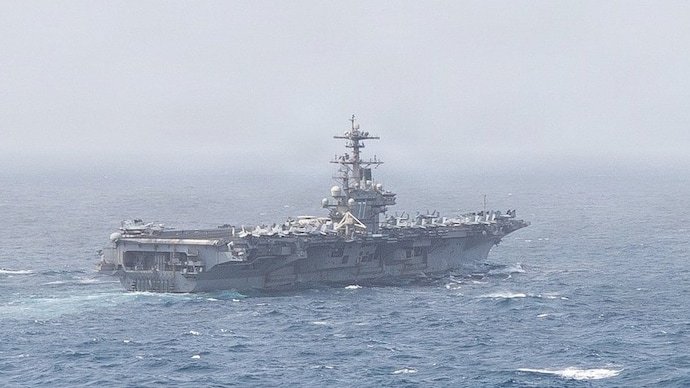
Just days after the United States and Iran agreed to suspend military operations and revive diplomatic negotiations, tensions have flared once again over one of the world’s most strategically important waterways—the Strait of Hormuz. Rather than disagreements over missiles or nuclear facilities, the immediate trigger is Article 5 of the recently signed memorandum of understanding (MoU), a provision intended to restore commercial navigation after months of disruption.
Instead of creating confidence between the two rivals, the clause has exposed sharply different interpretations regarding who controls maritime traffic during the transition period. Washington argues that Article 5 guarantees unrestricted commercial navigation for international shipping, while Tehran insists the agreement recognizes Iran’s authority to supervise vessel movements until the reopening process is fully completed.
The disagreement has already contributed to renewed military exchanges, attacks on commercial vessels and emergency diplomatic efforts in Doha. Beyond the immediate crisis, the dispute illustrates how even carefully negotiated ceasefire agreements can unravel when key provisions lack a shared interpretation.
What Is Article 5 of the US-Iran Memorandum of Understanding?
Article 5 is one of the most significant provisions within the ceasefire framework because it governs the reopening of the Strait of Hormuz, a maritime corridor through which approximately one-fifth of the world’s seaborne oil trade normally passes.
Its primary objectives include restoring commercial shipping, ensuring safe passage for civilian vessels, removing military hazards from the waterway and gradually returning maritime operations to normal.
Broadly, the clause requires Iran to:
- Facilitate safe passage for commercial vessels.
- Provide transit without additional charges during the agreed transition period.
- Remove military obstacles affecting navigation.
- Complete demining and maritime safety operations.
- Coordinate with neighboring Gulf states on the future management of shipping.
Although these objectives appear straightforward, the agreement reportedly leaves room for differing interpretations regarding operational control while implementation remains underway.
Why the Strait of Hormuz Matters to the World
The Strait of Hormuz is widely regarded as one of the most strategically important maritime chokepoints on the planet.
Located between Iran and Oman, the narrow passage connects the Persian Gulf with the Gulf of Oman and the Arabian Sea, serving as the primary export route for crude oil and liquefied natural gas from several Gulf producers.
Any disruption affects far more than regional Politics. It influences:
- Global crude oil prices.
- International shipping costs.
- Energy security across Asia and Europe.
- Inflation through higher transportation expenses.
- Financial market stability.
Countries such as India, China, Japan, South Korea and many European economies closely monitor developments because a significant portion of their imported energy passes through this corridor.
Understanding the Different Interpretations of Article 5
The current crisis stems less from the wording of Article 5 than from how each side believes it should be implemented.
Washington’s Position
The United States views the agreement as guaranteeing the immediate restoration of unrestricted commercial navigation. From Washington’s perspective, international shipping should operate freely without additional operational restrictions beyond standard maritime safety requirements.
American officials have also emphasized broader international coordination involving Gulf partners and maritime organizations to maintain secure shipping lanes.
Tehran’s Position
Iran agrees that commercial traffic should resume but argues that the memorandum recognizes Tehran’s responsibility for supervising navigation during the implementation period.
Iranian officials contend that temporary oversight is necessary while military hazards are removed, maritime infrastructure is restored and security risks remain elevated following weeks of conflict.
This divergence has transformed Article 5 from a confidence-building measure into the central source of diplomatic friction.
Timeline: How the Hormuz Crisis Escalated
| Date / Phase | Key Development |
|---|---|
| Conflict Period | Military operations disrupt commercial shipping through the Strait of Hormuz. |
| Ceasefire Agreement | US and Iran sign an MoU including Article 5 to restore maritime traffic. |
| Transition Phase | Commercial vessels begin preparing to resume normal transit. |
| Latest Escalation | Commercial ships come under attack, triggering renewed military responses. |
| Current Stage | Diplomatic negotiations shift to Doha to resolve disagreements over Article 5. |
Why Commercial Shipping Became the Immediate Flashpoint
International shipping companies rely on predictable navigation rules. Even minor uncertainty regarding military inspections, approved routes or security guarantees can significantly affect vessel movements.
Following recent attacks on commercial ships, several shipping operators reportedly altered routes, delayed departures or temporarily suspended planned transits through the strait until greater clarity emerged.
Maritime insurers also closely monitor such developments because elevated geopolitical risks typically translate into higher insurance premiums and increased operating costs.
The Economic Importance of the Strait of Hormuz
Few waterways have greater influence over the global economy.
| Sector | Potential Impact of Disruption |
|---|---|
| Energy Markets | Higher global crude oil prices. |
| Shipping | Longer routes and increased freight costs. |
| Manufacturing | Higher production costs due to expensive fuel. |
| Consumers | Potential increases in fuel and transportation prices. |
| Financial Markets | Greater volatility driven by geopolitical uncertainty. |
How the Latest Military Escalation Unfolded
The fragile ceasefire came under pressure after commercial vessels transiting the Strait of Hormuz were attacked. The incidents prompted the United States to launch strikes against Iranian military infrastructure, arguing the operations were necessary to protect international shipping.
Iran rejected those accusations, maintaining that the American strikes violated both international law and the recently negotiated memorandum. Tehran subsequently launched retaliatory military operations against US-linked regional targets, bringing both sides dangerously close to another broader confrontation.
Although both governments later agreed to suspend further military activity ahead of fresh negotiations, mutual distrust remains high.
Why Doha Talks Matter
The decision to resume negotiations in Doha reflects the recognition that military responses alone cannot resolve differing legal interpretations of Article 5.
Diplomats are expected to focus on several critical issues:
- Rules governing commercial vessel movements.
- Temporary maritime security arrangements.
- Verification mechanisms for compliance.
- Coordination with regional Gulf states.
- Preventing future incidents involving civilian shipping.
A successful outcome would reduce immediate tensions while preserving broader negotiations on regional security and nuclear issues.
Why This Matters for India
India is among the world’s largest importers of crude oil, with a significant share of supplies originating from Gulf producers connected through the Strait of Hormuz.
Any prolonged disruption could affect:
- Crude oil imports.
- Domestic fuel prices.
- Shipping and logistics costs.
- Industrial production expenses.
- Inflation across multiple sectors.
For policymakers and businesses alike, developments in Hormuz remain closely linked to India’s broader energy security strategy.
The International Legal Dimension
The dispute also highlights the complex interaction between bilateral agreements and established principles of international maritime law.
While coastal states possess recognized rights within their territorial waters, international shipping lanes also operate under widely accepted legal frameworks designed to facilitate global commerce. Reconciling those overlapping responsibilities often requires detailed implementation mechanisms, especially following armed conflict.
The current disagreement illustrates how legal ambiguity can rapidly evolve into geopolitical confrontation if practical enforcement measures are not clearly defined.
Expert Insight: Why Ceasefire Agreements Often Face Early Tests
History shows that the first weeks after a ceasefire are frequently the most fragile. Even when political leaders agree to halt military operations, operational questions concerning implementation, monitoring and interpretation can generate new disputes.
Article 5 represents a textbook example of this challenge. Both governments publicly support reopening commercial navigation, yet each believes the agreement grants it greater authority over the transition process.
Without mutually accepted implementation procedures, misunderstandings can quickly escalate into military incidents despite broader diplomatic commitments.
Possible Scenarios Going Forward
Scenario 1: Diplomatic Breakthrough
Negotiators agree on detailed operational rules, commercial traffic gradually normalizes and broader discussions continue on regional security.
Scenario 2: Managed Tensions
Military operations remain limited while disagreements persist, creating periodic disruptions but avoiding full-scale conflict.
Scenario 3: Collapse of the Understanding
If Article 5 cannot be implemented consistently, renewed attacks could undermine the broader ceasefire and significantly increase regional instability.
Future Outlook
The coming negotiations will determine whether Article 5 evolves into a durable framework for restoring confidence or remains a source of recurring confrontation. Much will depend on whether both sides can establish shared operational procedures for commercial shipping while respecting broader security concerns.
Beyond the immediate dispute, the outcome will influence global energy markets, maritime trade and regional Diplomacy. A stable Strait of Hormuz remains essential not only for the Middle East but also for economies across Asia, Europe and beyond that depend on uninterrupted energy supplies.
Conclusion
Article 5 was originally designed to facilitate peace by restoring safe commercial navigation through one of the world’s most important maritime corridors. Instead, differing interpretations have transformed it into the central battleground of the post-ceasefire period.
The dispute demonstrates that successful diplomacy depends not only on reaching agreements but also on establishing clear mechanisms for implementing them. As US and Iranian negotiators meet in Doha, their ability to bridge these differences could determine whether the Strait of Hormuz returns to stability or once again becomes the epicenter of global geopolitical tension.
For breaking news and live news updates, like us on Facebook or follow us on Twitter and Instagram. Read more on Latest World on thefoxdaily.com.





COMMENTS 0