A maritime chokepoint nearly 3,000 kilometres from India could soon become a major problem for the Indian economy.
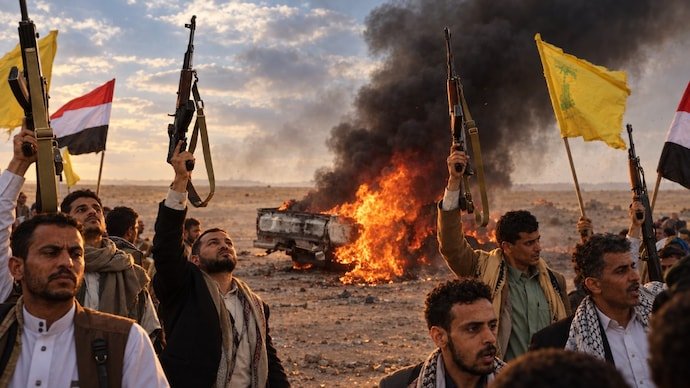
The Bab el-Mandeb Strait, the narrow passage linking the Red Sea with the Gulf of Aden and the Indian Ocean, has become the latest flashpoint in the widening Middle East crisis. Houthi forces have made rapid gains along Yemen’s western coastline, capturing the strategic port of Mocha and advancing into areas around the strait, including the strategically important Perim Island.
The development matters far beyond Yemen. Bab el-Mandeb is one of the principal maritime links between Europe, the Middle East and Asia. When ships pass through it, they can continue north through the Red Sea and Suez Canal rather than making the much longer journey around Africa.
For India, that route has two major functions. It helps bring energy supplies toward Asian markets and provides an important commercial corridor for Indian exports and imports moving between India and Europe.
That makes the latest Houthi advance particularly dangerous. If shipping companies begin avoiding Bab el-Mandeb because of attacks, blockades or prohibitively expensive insurance, India could face a combination of higher oil prices, more expensive freight, longer delivery times and weaker export competitiveness.
The danger becomes even greater because the Strait of Hormuz, the other major energy chokepoint in the region, is already under severe strain.
What is the Bab el-Mandeb Strait?
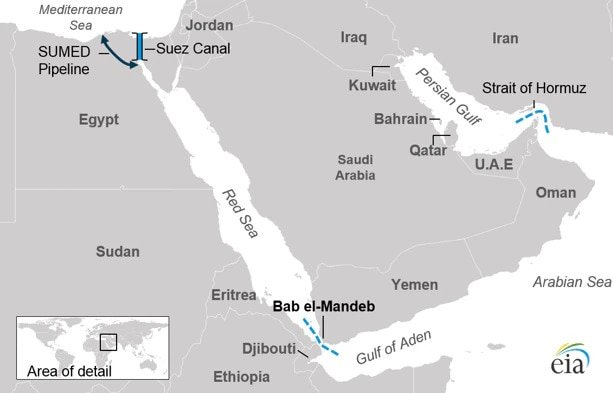
Bab el-Mandeb is a narrow waterway at the southern entrance to the Red Sea, separating Yemen from the African side of the Red Sea around Djibouti and Eritrea.
Its name is commonly translated as “Gate of Tears”, a reference to the dangers historically associated with navigating the passage.
Geographically, its importance is difficult to overstate. A vessel travelling between Asia and Europe can enter the Gulf of Aden, pass through Bab el-Mandeb, sail north through the Red Sea and then enter the Suez Canal. From there, it can reach the Mediterranean and European ports.
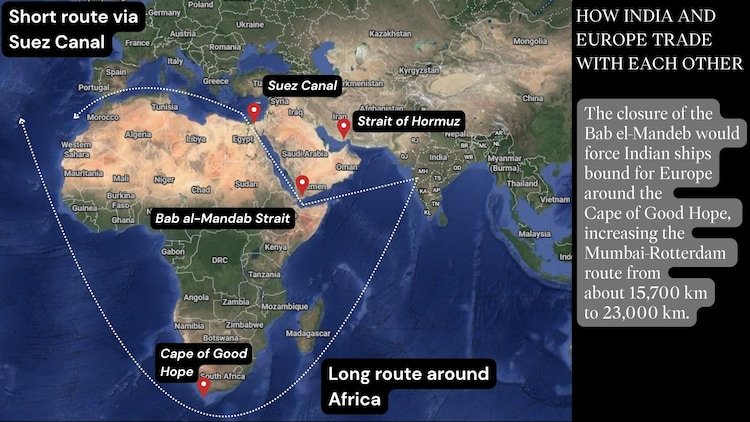
The alternative is to sail around the Cape of Good Hope at the southern tip of Africa. That route is dramatically longer and requires more fuel, more crew time and more days at sea.
That difference turns Bab el-Mandeb into much more than a narrow strip of water. It is effectively a shortcut connecting some of the world’s most important trading regions.
Why Bab el-Mandeb matters to the global oil market
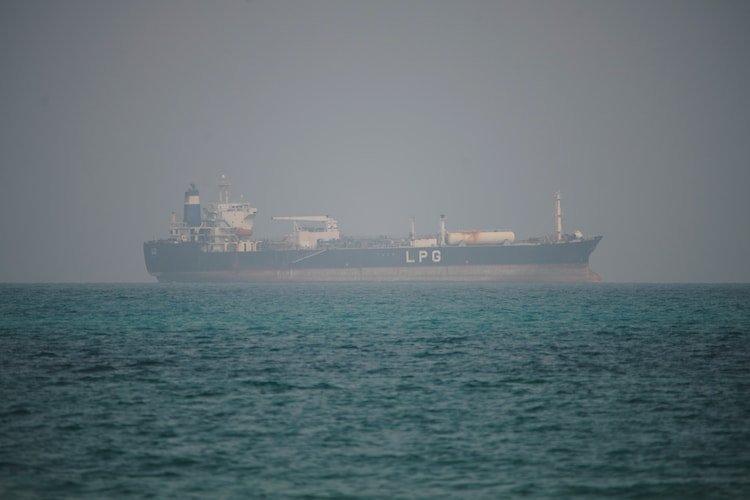
Oil flows through Bab el-Mandeb in both directions, connecting energy producers and consumers across the Middle East, Europe and Asia.
Before the latest security disruptions, the waterway carried substantial volumes of crude oil, condensate and petroleum products. The scale of that traffic, however, has already fallen sharply because shipping companies have been avoiding the Red Sea amid Houthi attacks and security concerns.
Available energy-market data shows the change clearly. Oil flows through Bab el-Mandeb averaged about 9.3 million barrels per day in 2023, but fell to around 4.1 million barrels per day in 2024 and approximately 4.2 million barrels per day during the first half of 2025.
That decline is important because it demonstrates something that is sometimes overlooked in discussions about maritime chokepoints: a waterway does not have to be physically sealed to create an economic shock.
If ships believe that sailing through an area is too dangerous or too expensive, traffic can collapse without a formal closure.
That is exactly why the latest Houthi territorial gains are being watched so closely.
How the Houthis moved closer to controlling the chokepoint
The Houthis, formally known as Ansar Allah, have been a major force in Yemen’s civil war for more than a decade.
The movement seized Yemen’s capital, Sanaa, in 2014 and subsequently established control over large parts of northern and western Yemen. Its territorial expansion eventually triggered a Saudi-led military intervention in 2015.
The conflict produced years of devastating fighting but failed to remove the Houthis from power in the areas they controlled.
A United Nations-brokered truce in 2022 significantly reduced large-scale fighting, but it did not produce a permanent political settlement. The latest escalation threatens to undo much of that fragile calm.
In September 2026, Houthi forces rapidly expanded their presence along Yemen’s Red Sea coast. They captured Mocha, a strategically located historic port city, and moved toward the Hanish Islands and areas close to the Bab el-Mandeb.
The capture of Perim Island, also known as Mayun, is particularly significant because the island sits directly inside the strait. Its location gives whoever controls it a potentially valuable position for monitoring and influencing maritime traffic.
The Houthis have subsequently claimed control over Bab el-Mandeb, although the practical ability to completely stop international shipping is a different question from claiming territorial control.
Why the Houthi advance is different from previous attacks
The Houthis have threatened Red Sea shipping before. Their attacks on commercial vessels during the previous phase of the regional conflict forced numerous shipping companies to abandon the Red Sea-Suez route.
But the latest development is different because the group is strengthening its territorial position around the actual maritime chokepoint.
Previously, a ship could potentially pass through the waterway while relying on naval escorts, military surveillance and risk-management measures. A stronger Houthi presence on the coastline and strategically positioned islands could make that calculation more difficult.
For commercial shipping companies, the question is not simply whether a missile will actually hit a vessel. It is whether the probability of an attack is high enough to make the route commercially unattractive.
That distinction is crucial.
Shipping insurance could become the first major pressure point
Commercial vessels operating in conflict zones face higher insurance premiums because insurers must account for the possibility of damage, loss or prolonged delays.
If the perceived risk around Bab el-Mandeb rises sharply, insurers can increase premiums or impose additional conditions on vessels entering the region.
At a certain point, shipping companies may decide that the extra insurance, security costs and operational risks are not worth the time saved by using the Red Sea.
That creates a self-reinforcing cycle.
- Security risks increase.
- Insurance costs rise.
- Shipping companies divert vessels.
- Voyages become longer.
- Fuel and freight expenses increase.
- Delivery times become less predictable.
- Importers and exporters eventually face higher costs.
The Red Sea shipping crisis of recent years already demonstrated how quickly this process can happen. Thousands of vessels were diverted around Africa after Houthi attacks made the Suez route more difficult to use.
India’s biggest vulnerability is energy
For India, the most immediate economic concern is likely to be energy prices.
India imports a large share of the crude oil required by its enormous refining industry. Even when Indian refiners can obtain crude from alternative suppliers, a disruption affecting major global shipping routes can push up the international benchmark price of oil.
That is because crude oil is traded in a global market. India does not need to receive every barrel through Bab el-Mandeb for a disruption there to affect Indian consumers.
If shipping becomes more expensive, supplies become less certain and traders anticipate shortages, the global price can rise. Indian refiners then have to deal with a higher cost of crude.
The impact can spread through the economy.
More expensive crude can raise the cost of producing and transporting goods, while fuel prices influence logistics, aviation, manufacturing and household consumption.
The pressure becomes particularly serious when another major energy route is already disrupted.
Hormuz and Bab el-Mandeb: why two chokepoints matter together

The real danger for India is not Bab el-Mandeb in isolation.
It is the possibility of simultaneous disruption across two major Middle Eastern maritime corridors.
The Strait of Hormuz connects the Persian Gulf with the Gulf of Oman and is one of the world’s most important routes for oil exports from Gulf producers.
When shipping through Hormuz is threatened, Saudi Arabia has an alternative: move crude toward its Red Sea terminals and export it through the western side of the kingdom.
That strategy becomes much less useful if the southern entrance to the Red Sea is also threatened.
This is why the Houthi advance has implications far beyond Yemen. It potentially places pressure on an alternative route that Gulf producers can use when the traditional Persian Gulf route becomes difficult.
In other words, a crisis at Hormuz can increase the importance of Bab el-Mandeb. A crisis at Bab el-Mandeb then removes part of that alternative.
Indian exports could face a second shock
Energy is only half the problem for India.
Bab el-Mandeb is also an important route for Indian trade with Europe.
Indian refineries supply petroleum products to overseas markets, while Indian manufacturers export pharmaceuticals, engineering goods, machinery, textiles and other products to European customers.
Many of these shipments depend on the broader India-Red Sea-Suez-Mediterranean trade corridor.
If vessels have to travel around the Cape of Good Hope instead, the journey becomes substantially longer.
The result is not simply a larger fuel bill. Every additional day at sea can increase vessel operating costs, crew expenses, insurance costs and inventory requirements.
For exporters competing on relatively narrow margins, these costs can become commercially important.
The Cape of Good Hope is the alternative, but it is expensive
The most obvious alternative to Bab el-Mandeb and the Suez Canal is to travel around southern Africa.
That route is technically available and has already become a major diversion for ships avoiding the Red Sea.
But there is no free shortcut.
A vessel travelling from India’s western coast toward northern Europe through the Suez route takes a considerably shorter path than one forced around the Cape of Good Hope. The African detour adds thousands of kilometres and can extend the voyage by days or even weeks depending on the ship, route and operating conditions.
For container shipping, that means longer transit times and potentially higher freight rates. For oil tankers, it means more fuel consumption and longer periods before the cargo reaches its destination.
For India, this creates a particularly awkward situation. Its exporters may have to pay more to reach European customers precisely when buyers elsewhere are also dealing with higher transport costs.
Why India cannot simply replace the route overnight
One possible response is to shift more trade toward alternative maritime routes or suppliers.
India also has the advantage of diversified energy sourcing. Its crude imports come from multiple producing countries, meaning a disruption affecting one supply corridor does not automatically stop oil supplies to Indian refineries.
But diversification cannot eliminate the global price effect.
If a major maritime chokepoint becomes inaccessible, ships elsewhere become more heavily utilized. Tanker availability can tighten, freight rates can rise and the cost of moving energy around the world can increase.
India may therefore still receive the crude it needs while paying more for it.
The bigger threat is a prolonged disruption
A short-lived security scare would have a very different economic impact from a prolonged closure or sustained avoidance of Bab el-Mandeb.
If shipping companies believe the danger will disappear quickly, they may tolerate higher insurance premiums and temporary delays.
If they believe the threat could last for months, companies are more likely to redesign shipping schedules, charter vessels for longer routes and build the Cape of Good Hope into their planning.
That would make the disruption more economically persistent.
It could also increase pressure on global supply chains that are still sensitive to disruptions at major maritime chokepoints.
What the Houthi advance means for India
The most important point is that India does not need to be directly attacked to feel the consequences of the Bab el-Mandeb crisis.
The mechanism is economic rather than geographical.
A Houthi-controlled or heavily threatened chokepoint can make ships more expensive to insure. Higher insurance can encourage companies to divert vessels. Diversions increase voyage times and fuel consumption. Higher shipping costs raise the price of imported goods and make exports less competitive. At the same time, concerns about energy supplies can push global crude prices higher.
That creates a chain reaction from a narrow waterway in Yemen to businesses and consumers thousands of kilometres away.
India’s position makes the issue especially important because the country is simultaneously a major energy importer, a large refining hub and an increasingly important exporter of manufactured and refined products.
What happens next will depend on more than control of the strait
The immediate question is whether the Houthis can maintain their new territorial gains and whether they will actually attempt to enforce restrictions on wider international shipping.
The group has indicated that its maritime restrictions are directed at specific targets, while international shipping has continued to receive assurances that navigation can remain safe under certain conditions. But the rapid territorial changes around Bab el-Mandeb have made those assurances less convincing for many commercial operators.
The other critical factor will be the response from Saudi Arabia and its partners. Any sustained military campaign around Yemen’s western coast could further destabilize the area and increase the risks faced by commercial vessels.
For India, the safest outcome would be a restoration of predictable navigation through both Bab el-Mandeb and the wider Red Sea corridor.
Until that happens, New Delhi has to account for a difficult possibility: the next major oil shock may not originate from a shortage of crude in the ground, but from the growing number of dangerous places through which that crude has to travel.
Bab el-Mandeb may be thousands of kilometres from India, but its importance is measured not in distance, but in dependence. If the “Gate of Tears” becomes another effectively closed maritime gateway, India could feel the impact through its fuel bill, shipping costs, supply chains and exports to Europe.
For breaking news and live news updates, like us on Facebook or follow us on Twitter and Instagram. Read more on Latest World on thefoxdaily.com.





COMMENTS 0