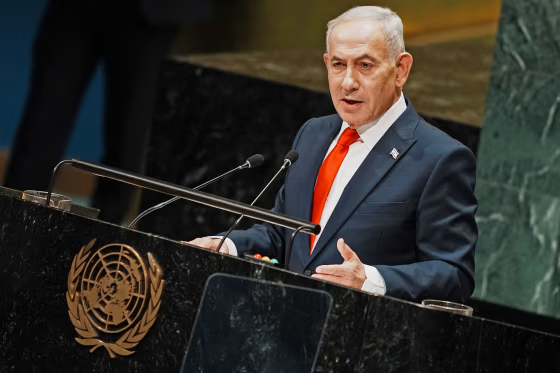
Israel is heading toward a closely contested election in which Prime Minister Benjamin Netanyahu could face one of the most uncertain political battles of his career, but the opposition still lacks a clear route to forming a government.
On the streets of Jerusalem, the divisions are visible. Secular and ultra-Orthodox Jews, religious nationalists, settlers, Palestinians and soldiers returning from deployments are preparing to vote in a country profoundly changed by the Hamas attacks of 7 October 2023 and the conflicts that followed in Gaza, Lebanon and Iran.
The election is scheduled for 27 October, and recent polling shows neither of the main political blocs comfortably reaching the 61 seats required to control the 120-member Knesset. A Channel 13 poll published in September gave Gadi Eisenkot’s Yashar party 22 seats and Netanyahu’s Likud 18, while the broader bloc picture remained inconclusive.
Other recent polls have also shown a fragmented political landscape, with the exact balance shifting between surveys. The common feature has been the absence of a straightforward majority for either side.
Netanyahu still has a loyal political base
Netanyahu’s political strength has repeatedly survived periods of intense criticism, protests and political uncertainty. His supporters continue to see him as the leader best positioned to deal with Israel’s security challenges and argue that the wars on several fronts must be brought to a conclusion on terms that protect the country.
Among those supporters are voters who want the current coalition and its rightwing partners to remain in power. Some say the government should continue its military campaign and what they describe as its effort to “finish the job” in Gaza, Iran, Lebanon and the West Bank.
That view remains particularly visible in parts of Jerusalem and among voters who regard security as the defining issue of the election.
“There is only one prime minister – Bibi!” an elderly passerby called out near Jerusalem’s central bus station, a reminder that Netanyahu’s personal political base remains significant despite the uncertainty surrounding the election.
Avraham Levy, 76, a Likud supporter and fruit seller at Jerusalem’s Mahane Yehuda market, said he expected Netanyahu to retain a majority and argued that Israel needed him to complete the country’s ongoing military objectives.
Opposition voters want a change of direction
On the other side of the political divide are voters who believe Israel needs a different approach after nearly three years of war and growing international criticism.
Gadi Eisenkot, a former chief of staff of the Israel Defense Forces, has emerged as one of Netanyahu’s principal challengers. His Yashar party has performed strongly in several recent polls, although the party’s position does not by itself provide a path to the 61-seat threshold.
Supporters of Eisenkot argue that the government should devote greater attention to education, social policy and the Economy alongside security. For some voters, the cost of living has become increasingly difficult to separate from the consequences of the prolonged regional conflict.
“I’ll vote for anyone but the prime minister of 7 October,” said Turgeman, a voter interviewed in Jaffa. He said he planned to support Eisenkot because he wanted a government that would pay greater attention to prices and economic conditions.
For other voters, however, the issue is broader than Netanyahu personally. They question whether changing prime ministers would produce a meaningful change when the political system remains divided between competing parties with very different priorities.
Public trust has fallen sharply
The uncertainty surrounding the election is occurring against a wider crisis of confidence in Israeli public institutions.
The Israel Democracy Institute’s surveys have recorded a substantial decline in average public trust across the eight institutions it has measured consistently. Average trust stood at 34% in 2025, compared with 61% in 2012.
That decline helps explain why some voters say they are disengaged from the election altogether.
Rachel, 42, an Israeli citizen living in West Jerusalem, said she was considering not voting because she no longer trusted the political system. She had previously voted for Yair Lapid’s centrist Yesh Atid party but said she no longer saw the same sense of possibility in Israeli Politics.
The mood is particularly complicated in Jerusalem, where political, religious and national identities overlap in a way that can make the divisions surrounding the election especially visible.
October 7 remains central to the election
The Hamas attack of 7 October 2023 is expected to remain one of the defining issues for voters.
The attack exposed major failures in Israel’s security system and was followed by an extended war in Gaza and a wider regional conflict. The consequences have affected security policy, military service, the economy, relations with other countries and the political debate over Netanyahu’s leadership.
A recent Israel Democracy Institute poll found that 68% of Jewish respondents said the events of 7 October would be a central factor in determining how they vote.
For some voters, the attack has reinforced support for Netanyahu and his security-focused approach. For others, it has become a reason to demand political accountability and a change of leadership.
Ilda, who owns a clothing shop on Jaffa Street in Jerusalem, said she believed the government should accept responsibility for the failures surrounding the attack. She also criticised the response to journalists who reported allegations that warnings about the possibility of a major Hamas assault had been received before the attack. Netanyahu has denied those allegations.
The economy is becoming another election issue
Security may dominate Israel’s political debate, but economic pressure is also influencing voters.
Food prices have risen sharply during the regional conflict, with supply disruptions contributing to higher costs. Food prices, including fresh produce, have risen by 9.5% over the past two years, according to the figures cited in the election debate.
For households already dealing with the consequences of war, higher food and living costs have created another source of frustration.
Turgeman said politicians were concentrating heavily on military conflicts while failing to address the economic problems facing ordinary Israelis. He also criticised government financial support for the Haredi, or ultra-Orthodox, community.
The issue connects the economic debate with one of the most contentious questions in Israeli politics: military conscription.
Ultra-Orthodox voters face a difficult choice
Israel’s ultra-Orthodox community has traditionally played an important role in Netanyahu’s governing coalitions. Its political parties have generally relied heavily on religious leadership when determining electoral strategy.
But the war has intensified a long-running dispute over military service.
Most Jewish Israelis are expected to serve in the military, while ultra-Orthodox men studying in religious seminaries have historically benefited from broad exemptions. In 2024, Israel’s Supreme Court ruled that there was no legal basis for continuing the exemption, increasing pressure on the government to change the system.
The dispute has triggered protests, roadblocks and clashes between some ultra-Orthodox demonstrators and police. Haredi political parties have also blamed Netanyahu for failing to secure Legislation protecting the exemption.
That has created a political problem within a community that has traditionally been an important part of Netanyahu’s coalition.
Pinchas, 24, an ultra-Orthodox student who recently completed military service, said he intended to vote for Eisenkot despite describing the available political options negatively. He said younger Haredim could be less willing to follow the voting preferences of their rabbis because of anger over the conscription dispute and the policing of protests.
Naftali Bennett remains another force on the right
Netanyahu’s opponents are not united behind a single political vision.
Naftali Bennett, a former prime minister and rightwing politician who now leads the B’Yachad alliance, is another major figure competing for voters who identify with the right but want a change from Netanyahu.
Yosef, 26, a religious Israeli voter, said he wanted what he described as “radical change” and was considering voting for Bennett.
The competition between Eisenkot, Bennett and other opposition parties makes the anti-Netanyahu camp more complicated than a straightforward contest between two leaders.
Recent polling has repeatedly shown that the opposition parties can collectively approach or exceed the governing bloc, but the distribution of seats among individual parties and the question of coalition partners remain decisive.
Arab parties could become crucial
One of the most difficult questions for Eisenkot is whether an anti-Netanyahu coalition could rely on parties representing Palestinian citizens of Israel.
Arab-majority parties have the potential to hold a critical group of seats in the Knesset. Yet Eisenkot has ruled out forming a government coalition with parties led by Palestinian citizens of Israel, limiting the possible combinations available to his side.
They could potentially support a minority government from outside a coalition, but that would create another complex parliamentary arrangement.
The political situation became even more uncertain after the Central Elections Committee voted to bar Ra’am and the Joint List from participating in the election following petitions from political opponents. The decision is being challenged in the Supreme Court, which has overturned similar election bans in previous contests.
The outcome of that legal challenge could therefore have consequences for the parliamentary arithmetic after election day.
Palestinian citizens remain divided over their political strategy
Palestinian citizens of Israel face a separate set of concerns. Many are focused on equality, discrimination, public safety and the Palestinian issue, while others favour practical cooperation with Israeli governments in order to secure funding and services for their communities.
Political tensions have increased since 7 October, including arrests, interrogations and legal action involving Arab citizens over protests and Social Media activity. That atmosphere has contributed to reluctance among some Palestinian citizens to discuss their political preferences openly.
The 2025 Israeli Democracy Index survey found that 70% of Palestinian citizens said they preferred to remain silent about their political views around strangers, compared with 53% of Jewish respondents.
Yet Arab voters are not politically unified.
Amir, 34, from Mashhad in northern Israel, said he planned to vote for the Joint List because he wanted stronger Arab political representation on equality, discrimination and the Palestinian cause.
Others favour Ra’am’s more pragmatic approach. The party, led by Mansour Abbas, became the first independent Arab party to join an Israeli governing coalition in 2021, seeking budgets, public services and greater political influence for Palestinian citizens.
Abu Mahmoud, 33, from Kafr Kanna, said he planned to vote for Ra’am because he wanted political cooperation that could address Crime, violence and economic problems in Arab communities.
A fragmented election with no obvious governing formula
The central problem facing both major camps is arithmetic.
Israel’s electoral system allows multiple parties to enter the Knesset, meaning that winning the largest number of seats does not automatically produce a government. A prime minister needs the support of at least 61 members of the 120-seat Parliament to establish a governing majority.
Recent polling illustrates how difficult that task could be. The Channel 13 survey that gave Yashar 22 seats and Likud 18 also showed the broader blocs falling short of the 61-seat threshold. Other surveys have produced different balances, underlining how volatile the contest remains.
For Netanyahu, retaining power could require maintaining the support of his existing partners while finding additional parliamentary backing if the current coalition falls short.
For Eisenkot, the challenge is different. Even if Yashar emerges as the largest individual party, he would still need to assemble a coalition from parties with competing ideological positions, while his refusal to join with Arab-led parties narrows the available options.
A country divided over what comes next
The election is therefore about more than whether Netanyahu remains prime minister.
Voters are being asked to weigh security after 7 October, the continuing regional conflict, the cost of living, military conscription, relations between Jewish and Palestinian citizens, the role of ultra-Orthodox parties and Israel’s position internationally.
Those questions cut across traditional political boundaries. Some voters who support a rightwing security agenda are unhappy with Netanyahu personally. Some ultra-Orthodox voters are questioning traditional political loyalties. Palestinian citizens are divided between political opposition and pragmatic cooperation. And opposition voters remain split among several parties and leaders.
That makes the coming election difficult to reduce to a simple contest between Netanyahu and Eisenkot.
For many Israelis, the deeper question is whether the election can produce a government capable of addressing the security, economic and social pressures that have intensified since 7 October 2023. With the 61-seat threshold still out of reach for the principal blocs in recent polling, the answer may depend as much on coalition negotiations and the final distribution of Knesset seats as on which party finishes first.
For breaking news and live news updates, like us on Facebook or follow us on Twitter and Instagram. Read more on Latest World on thefoxdaily.com.



COMMENTS 0