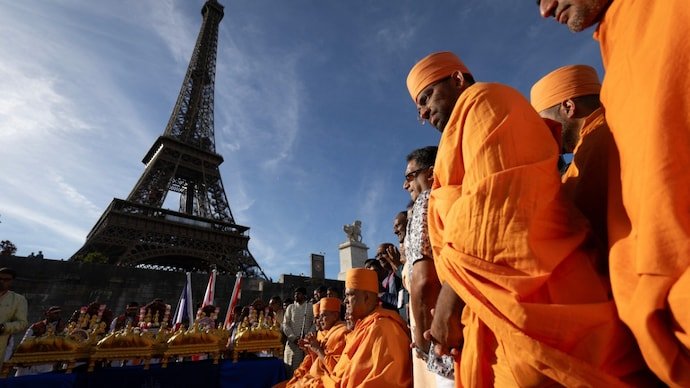
The Eiffel Tower was temporarily closed in Paris on September 7 after employees staged a protest over allegations that female staff were asked to step away from their workstations during a private visit by members of the Hindu organisation Bochasanwasi Akshar Purushottam Swaminarayan Sanstha (BAPS).
The incident occurred during a private visit by around 100 members of the organisation on Saturday, September 5, as BAPS representatives were in France for events surrounding the inauguration of a major Hindu temple near Paris.
According to union representatives, female employees at the Eiffel Tower were instructed to leave certain work areas or otherwise stay out of sight as the delegation passed through, with male employees taking their places.
The allegations triggered anger among workers and culminated in a staff meeting and walkout on Monday. The dispute also drew strong reactions from senior French politicians, while Paris authorities announced an investigation into the circumstances surrounding the visit.
The Eiffel Tower’s operating company, Société d’Exploitation de la Tour Eiffel (SETE), acknowledged that the delegation had requested arrangements intended to limit interactions with women and said such conditions should not have been accepted.
Why the Eiffel Tower was closed
The monument did not open to visitors as scheduled on Monday after employees gathered to discuss the incident and their concerns about how female colleagues had allegedly been treated.
Visitors were initially informed that the opening had been delayed for “operational reasons.” The delay ultimately became a closure for the day as employees protested the handling of the private visit.
Union representatives said the meeting had two immediate objectives: opening a dialogue with management and securing assurances that women would not again be treated differently because of their gender.
The closure turned what might otherwise have remained an internal workplace dispute into a highly visible international controversy involving one of France’s most recognisable landmarks.
What female Eiffel Tower employees allegedly experienced
Diane Davoine, a representative of the CGT union, said female workers were asked to leave their regular positions when members of the BAPS delegation passed through the tower.
According to her account, women were replaced by male colleagues in some areas so that the delegation would have fewer interactions with female employees.
The allegations have not been presented as a general policy at the Eiffel Tower. Instead, the dispute centres on arrangements made specifically for the private visit.
That distinction is important because the controversy is about whether management agreed to conditions that effectively changed how employees could perform their jobs based on gender.
SETE has acknowledged that the delegation requested arrangements limiting interactions with women, making the company’s own response a key part of the investigation.
SETE admits the conditions should not have been accepted
The Eiffel Tower’s operating company has accepted that the circumstances surrounding the visit were inappropriate.
SETE said representatives of the delegation had asked for the visit to be organised in a way that limited “interactions with women.” The company acknowledged that these conditions should not have been accepted.
SETE President Ariel Weil said the company would investigate the events and draw the necessary conclusions from what happened.
The statement is significant because it shifts the focus away from speculation over the exact intentions of individual visitors and toward the decision-making by the organisation responsible for operating the monument.
The central question for investigators is therefore likely to be how the request was handled, who authorised the arrangements and why female employees were allegedly instructed to change their normal working positions.
BAPS says the visit was coordinated with Eiffel Tower authorities
BAPS has offered a different perspective on the controversy.
The organisation said its visit had been arranged in consultation with Eiffel Tower management and was scheduled at the beginning of regular opening hours in an effort to minimise disruption to other visitors.
BAPS also said it was not aware of any instance in which members of the public were denied access to the monument during the visit.
The organisation expressed regret over the controversy and apologised to anyone who felt hurt or inconvenienced by the situation.
BAPS said it remains committed to mutual respect and service to others and takes the concerns raised over the incident seriously.
The organisation’s statement does not remove the questions being raised by Eiffel Tower employees, but it does provide important context regarding how BAPS understood the arrangements for the visit.
Paris mayor orders investigation
Paris Mayor Emmanuel Grégoire said an investigation would be launched as quickly as possible to establish what happened.
Grégoire said he had taken note of the anger among Eiffel Tower workers and described their concerns as legitimate.
He also said it was unacceptable for such conditions to be tolerated and argued that they were inconsistent with both his values and those that the Eiffel Tower should represent.
According to the mayor, everyone should be able to work and move freely without discrimination based on gender.
He stressed that equality between women and men must apply throughout Paris, including at major public landmarks such as the Eiffel Tower.
The investigation is expected to examine the circumstances of the private visit and the instructions given to employees before and during the delegation’s movement through the monument.
French political leaders react strongly
The controversy quickly moved beyond the Eiffel Tower’s workforce and into national political debate.
Yaël Braun-Pivet, president of France’s National Assembly, strongly criticised the reported treatment of female employees.
She argued that welcoming foreign visitors should not require France to compromise on its principles regarding Gender Equality and women’s participation in public life.
Her comments reflected a broader concern among French political figures that cultural hospitality should not come at the expense of domestic workplace rules or equality standards.
The reaction also highlights why the incident has generated such strong interest in France. The Eiffel Tower is not merely a tourist attraction; it is one of the country’s most visible national symbols.
Why the gender-equality issue has become central
At the heart of the controversy is a basic workplace question: can employees be instructed to step away from their normal duties because a visiting group prefers not to interact with them based on gender?
For the workers and unions protesting the incident, the answer is clearly no.
The CGT described the reported instructions as workplace measures that resulted in female employees being sidelined, replaced and made “invisible” because they were women.
The criticism goes beyond the specific religious identity of the visitors. The broader concern is whether any private group should be allowed to impose conditions that affect employees’ participation in a workplace on the basis of sex.
That is why the French political reaction has focused primarily on equality and labour practices rather than on the religious background of the delegation.
The private visit took place ahead of a major BAPS temple inauguration
The BAPS delegation was in France as part of events surrounding the inauguration of a major Hindu temple at Bussy-Saint-Georges, a suburb in the Paris region.
The temple inauguration represented a major event for the Hindu community in France and drew international attention.
Indian Prime Minister Narendra Modi attended the inauguration ceremony and highlighted the cultural relationship between India and France.
Modi said the temple would carry India’s ancient ideas and human values to France while helping strengthen cultural ties between the two countries.
The timing of the Eiffel Tower visit therefore placed the staff dispute within a wider set of cultural and diplomatic events involving an important Indian religious organisation and Indian-French relations.
Why the Eiffel Tower visit was arranged privately
BAPS said its visit was scheduled in coordination with Eiffel Tower management and timed around the beginning of the attraction’s operating hours.
Private or specially organised visits can allow large groups to move through major attractions with greater coordination and less disruption to ordinary visitors.
The BAPS delegation reportedly included around 100 people, making advance planning particularly relevant for crowd management and access.
However, the dispute shows that operational arrangements can create separate workplace questions. Even when a private visit is properly scheduled, the conditions attached to it may still need to comply with employment rules and institutional values.
Management’s apology did not end the dispute
According to union representatives, Eiffel Tower management apologised to staff after the controversy emerged.
That apology, however, did not prevent employees from organising a protest on Monday.
Workers were seeking not only an acknowledgement of what had happened but also assurances that similar instructions would not be repeated.
The distinction is important because workplace Protests often continue after an apology when employees believe the underlying management process has not been adequately addressed.
The investigation announced by Paris authorities and the separate review by SETE are therefore expected to play an important role in determining what corrective steps may follow.
What exactly is being investigated?
The investigation is likely to focus on the chain of decisions that resulted in female employees allegedly being moved away from their regular positions.
Questions include whether the request originated directly from members of the delegation, how the request was communicated to Eiffel Tower management, who approved it and whether the employees were formally instructed to comply.
Investigators may also examine whether workers from outside contractors were affected by the arrangements, since the union has referred to both Eiffel Tower employees and staff working for service companies.
Another important question is whether the reported measures were limited to a small number of locations or applied more broadly during the delegation’s movement through the monument.
Establishing those facts will be essential to distinguish between an isolated operational error and a more systemic failure in workplace oversight.
Why the BAPS apology matters
BAPS has not accepted the characterisation that it deliberately sought to discriminate against Eiffel Tower employees.
Instead, the organisation focused on the operational nature of its visit and said it had coordinated the arrangements with tower authorities. Its expression of regret suggests that it recognises the controversy created by the incident even while the exact circumstances remain under investigation.
The organisation’s statement also stressed its commitment to mutual respect.
This distinction could become important as the investigation proceeds. Determining what the delegation requested and what the Eiffel Tower management ultimately chose to do are separate questions.
Religious customs versus workplace equality
The incident has raised a broader cultural question about how institutions should respond when private religious or cultural groups request special arrangements.
Public venues regularly accommodate religious practices, dietary requirements, security needs and other reasonable requests from visitors. But those accommodations still operate within the rules governing the workplace and the rights of employees.
The difficulty arises when a request affects which employees can perform their normal duties or requires staff to be separated according to gender.
France places a particularly strong emphasis on gender equality in public life, making such a dispute especially sensitive at a major public-facing institution.
The investigation will therefore have significance beyond the individual visit because it could clarify where the boundary lies between reasonable cultural accommodation and inappropriate workplace discrimination.
The Eiffel Tower is a symbol of French public life
The location of the dispute has amplified its significance.
The Eiffel Tower is one of the world’s most recognisable landmarks and a major symbol of Paris and France. Millions of visitors from different countries and religious backgrounds pass through it every year.
Its staff regularly interact with an exceptionally diverse international public.
That makes questions about equal treatment particularly visible. Any workplace policy affecting who can interact with visitors has the potential to become a public issue when applied at such a prominent institution.
The tower’s management is therefore under pressure to ensure that future private visits are handled in ways consistent with both operational requirements and employee rights.
The controversy is not a judgment on all BAPS visitors
The allegations concern arrangements made around one private delegation and should not automatically be generalised to BAPS members or Hindu visitors as a whole.
The organisation has said it regrets the controversy and was not aware of any deliberate exclusion of women from normal public access to the monument.
Similarly, the investigation should focus on specific actions and decisions rather than broad assumptions about a religious community.
This distinction is particularly important because the dispute involves questions of workplace conduct and institutional responsibility, not a general assessment of Hindu practices or beliefs.
What happened to regular visitors?
The staff protest affected the Eiffel Tower’s opening on Monday, meaning ordinary visitors were caught in the consequences of the workplace dispute.
The monument remained closed for the day, disrupting tourists who had planned visits and creating operational difficulties for businesses and services connected to one of Paris’s busiest attractions.
The incident illustrates how labour disputes at major tourism sites can quickly affect the wider public.
However, the closure also gave workers a way to draw attention to an issue they considered serious enough to warrant immediate discussion with management.
Why management decisions matter in private events
Private events at public attractions often require complicated logistical planning. Groups may request dedicated routes, specific timings, controlled access and other arrangements.
But the Eiffel Tower case demonstrates that operational flexibility has limits.
Once a visitor request begins influencing the composition of the workforce visible to guests, management has to consider whether the accommodation conflicts with workplace equality principles.
SETE’s acknowledgement that the conditions should not have been accepted suggests that the company now recognises that the mistake was not simply in communication but in allowing the request to influence employee deployment.
French authorities face pressure to clarify responsibility
Paris authorities now have to determine how responsibility should be assigned.
If the investigation confirms that employees were instructed to leave their workstations specifically because they were women, officials will need to examine why those instructions were given and whether the existing management procedures were adequate.
The findings could also lead to changes in how private delegations are handled, particularly where visitors request gender-specific interactions with staff.
For the Eiffel Tower’s management, the issue is not simply about avoiding another controversy. It is also about establishing clear rules so that frontline employees do not have to decide on their own how to respond to potentially discriminatory requests.
What happened during the BAPS visit?
| Event | Details |
|---|---|
| BAPS visit | Around 100 members of the Hindu organisation visited the Eiffel Tower privately on September 5 |
| Reported workplace issue | Female staff were allegedly asked to move away from certain work areas as the delegation passed |
| Male staff | Union representatives said male employees took the affected positions |
| Management response | SETE acknowledged that the delegation requested arrangements limiting interactions with women and said they should not have been accepted |
| Staff reaction | Employees held a meeting and protested on September 7 |
| Eiffel Tower status | The monument remained closed to visitors on Monday |
| Paris authorities | Mayor Emmanuel Grégoire ordered an investigation |
| BAPS response | The organisation said the visit was coordinated with management, expressed regret and apologised to anyone hurt or inconvenienced |
What could happen next?
The immediate next step is the investigation announced by Paris authorities, alongside SETE’s internal review.
The findings could determine whether new procedures are needed for private visits involving religious or cultural groups.
The Eiffel Tower may also need to establish clearer rules concerning requests that affect employee interactions based on gender. Such rules could help prevent individual managers from accepting arrangements that later trigger workplace disputes.
For BAPS, the controversy could remain linked to an otherwise significant period for the organisation in France following the inauguration of its new temple near Paris.
For the French authorities, the priority will be to establish the facts and make sure workplace equality standards are consistently applied.
Why the controversy has become an international story
The dispute combines several highly sensitive issues: gender equality, religious accommodation, workplace rights, cultural diplomacy and the responsibilities of a major public institution.
That combination has attracted attention far beyond the Eiffel Tower itself.
The controversy is also unfolding at a moment when India and France are highlighting cultural ties, making the dispute particularly delicate diplomatically. Yet the central issue remains a workplace one, and the responses from Paris authorities have focused on equality and employee treatment rather than questioning the religious nature of the visiting delegation.
The investigation will be important because it can separate the facts of the incident from the competing interpretations that have emerged since Monday.
Eiffel Tower row puts workplace equality in spotlight
The Eiffel Tower’s temporary closure was triggered not by a technical fault or security threat but by employees protesting what they say was discriminatory treatment of female workers during a private BAPS visit.
SETE has acknowledged that the delegation requested measures to limit interactions with women and conceded that such conditions should never have been accepted. BAPS, meanwhile, said the visit had been coordinated with tower management, expressed regret over the controversy and apologised to anyone who felt hurt or inconvenienced.
Paris Mayor Emmanuel Grégoire has ordered an investigation, while other French political leaders have stressed that gender equality cannot be compromised when France welcomes foreign visitors.
The episode now raises a broader question for public institutions around the world: how far should they go in accommodating cultural or religious requests when those requests affect employees’ rights and workplace equality?
For the Eiffel Tower, the answer is likely to emerge from the investigation. Whatever the final findings, the incident has already highlighted the need for clear rules governing private events and reinforced the principle that workplace arrangements cannot simply be changed to make female employees invisible because of a visitor’s preferences.
For breaking news and live news updates, like us on Facebook or follow us on Twitter and Instagram. Read more on Latest World on thefoxdaily.com.






COMMENTS 0