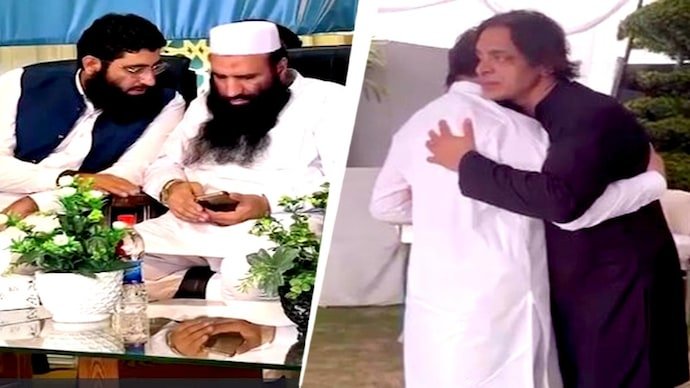
A funeral ceremony in Islamabad for Shahid Akhtar, the elder brother of former Pakistan fast bowler Shoaib Akhtar, has become the focus of intense scrutiny after videos circulating online appeared to show several individuals linked to Lashkar-e-Taiba (LeT), including Saifullah Kasuri, attending the gathering. The development has attracted widespread attention because Kasuri has been identified by Indian authorities as one of the key masterminds behind the April 2025 Pahalgam terror attack that claimed the lives of 25 civilians.
The incident has moved beyond being a social event involving a former sports star. Instead, it has evolved into a geopolitical issue, raising renewed debate about Pakistan’s efforts to curb internationally designated terrorist organizations, the visibility of extremist figures inside the country, and the wider implications for India-Pakistan relations at a time when tensions remain elevated.
As both countries continue navigating one of their most strained periods in recent years, the public appearance of alleged terror operatives has added another layer of complexity to regional security discussions.
What Happened at the Funeral?
Shahid Akhtar, elder brother of former Pakistani cricketer Shoaib Akhtar, passed away on June 24. His funeral was held at Islamabad’s H-8 graveyard and attended by family members, friends, public figures, and numerous mourners.
However, videos that later circulated across Social Media platforms appeared to show Saifullah Kasuri, along with other individuals reportedly linked to Lashkar-e-Taiba and the Pakistan Markazi Muslim League (PMML), present during the funeral proceedings.
The visuals quickly became the subject of political debate because of the identities of those allegedly attending rather than the funeral itself.
Why the Incident Has Drawn International Attention
The controversy stems from the fact that Saifullah Kasuri is regarded by Indian security agencies as one of the principal planners behind the April 2025 Pahalgam terrorist attack.
The attack targeted tourists in Jammu and Kashmir, resulting in multiple civilian casualties and triggering one of the sharpest escalations in India-Pakistan relations in recent years.
The public visibility of an individual accused of involvement in such an attack has inevitably generated questions regarding enforcement against banned extremist organizations.
For policymakers and security analysts, the issue is not merely WHO attended a funeral, but whether individuals linked to internationally scrutinized organizations are able to appear openly without fear of legal consequences.
Who Is Saifullah Kasuri?
Saifullah Kasuri is widely identified as a senior figure associated with Lashkar-e-Taiba, an organization designated as a terrorist group by multiple countries and international bodies.
Indian authorities allege that Kasuri played a leading operational and strategic role in planning the Pahalgam attack.
Over recent years, he has frequently appeared in videos making inflammatory statements directed toward India, further increasing his prominence within regional Counterterrorism discussions.
His reported attendance at a public funeral has therefore become politically significant because it suggests a level of visibility rarely associated with individuals accused of involvement in major terrorist attacks.
Understanding Lashkar-e-Taiba
Lashkar-e-Taiba has long remained one of South Asia’s most closely monitored militant organizations.
Founded during the late twentieth century, the group has been blamed for numerous attacks, including the 2008 Mumbai terror attacks, which resulted in the deaths of more than 160 people and drew widespread international condemnation.
Over the years, several countries have designated LeT as a terrorist organization, while international Sanctions have targeted many of its leaders and affiliated entities.
Despite these measures, security experts have repeatedly argued that elements connected to the organization have continued to operate through various social, charitable, religious, and political platforms.
The Pakistan Markazi Muslim League and Its Role
Among the organizations attracting attention is the Pakistan Markazi Muslim League (PMML), which has been described by critics and security observers as a political platform linked to individuals previously associated with banned organizations.
Reports have suggested that the PMML emerged following restrictions imposed on earlier groups connected with Hafiz Saeed.
The organization’s participation in Pakistani Politics has generated debate over whether former extremist networks have continued to maintain influence through alternative institutional structures.
These allegations remain central to ongoing regional security discussions.
The Pahalgam Terror Attack: A Turning Point
The April 2025 attack in Pahalgam marked one of the deadliest terrorist incidents targeting civilians in Jammu and Kashmir in recent years.
The assault shocked the country because the victims included tourists visiting one of Kashmir’s most popular destinations.
Beyond the immediate human tragedy, the attack dramatically altered the diplomatic atmosphere between India and Pakistan.
It prompted heightened military preparedness, intensified diplomatic engagement, and renewed global attention on cross-border terrorism.
| Key Event | Impact |
|---|---|
| Pahalgam terror attack | 25 civilians killed, triggering regional security concerns. |
| India’s response | Diplomatic, military, and strategic measures intensified. |
| International attention | Renewed focus on counterterrorism cooperation in South Asia. |
| Current controversy | Public appearance of alleged LeT leaders raises fresh questions. |
India’s Response After the Attack
Following the Pahalgam attack, India implemented a series of significant diplomatic and security measures.
Among the most notable decisions was the suspension of the Indus Waters Treaty framework, alongside expanded counterterrorism operations targeting militant infrastructure.
Indian authorities also announced military operations aimed at dismantling facilities allegedly connected to terrorist organizations operating across the border.
These developments represented one of the strongest responses to cross-border terrorism in recent years.
Why the Viral Video Matters Beyond Social Media
Videos circulating online increasingly play an important role in shaping public perception, diplomatic discourse, and intelligence assessments.
In this case, the footage has become significant because it appears to document alleged extremist figures participating openly in a public gathering rather than operating clandestinely.
Even if attendance at a funeral itself is not unlawful, the visibility of individuals accused of involvement in terrorism naturally attracts international attention.
Security analysts often examine such appearances for indications of organizational confidence, political protection, or shifts in operational behaviour.
Counterterrorism and Pakistan’s International Commitments
Pakistan has repeatedly stated that it remains committed to combating terrorism and dismantling extremist organizations operating within its territory.
The country has introduced legislative reforms, undertaken security operations, and implemented measures in response to international pressure over terrorist financing and extremist activity.
However, incidents involving alleged public appearances of individuals associated with banned groups continue to fuel debate over the effectiveness and consistency of those efforts.
These developments frequently become subjects of discussion among international policymakers, security institutions, and regional partners.
How the Incident Could Affect India-Pakistan Relations
Relations between India and Pakistan have remained fragile for years, influenced by terrorism, border tensions, diplomatic disputes, and unresolved political issues.
Any incident involving alleged extremist organizations carries the potential to complicate diplomatic engagement further.
Public perception also plays an important role.
Events interpreted as demonstrating insufficient action against terrorism can reduce political space for dialogue while strengthening calls for tougher security measures.
The Security Implications for South Asia
South Asia remains one of the world’s most strategically sensitive regions, with two nuclear-armed neighbours sharing a long History of conflict and cooperation.
Counterterrorism therefore extends beyond bilateral relations.
Regional stability affects trade, investment, tourism, infrastructure development, and international diplomatic engagement across the broader Indo-Pacific region.
Consequently, developments involving organizations accused of terrorism receive attention from governments well beyond South Asia.
The Role of Intelligence and Open-Source Evidence
Modern counterterrorism increasingly relies on a combination of classified intelligence and publicly available information.
Videos, photographs, satellite imagery, and digital communications now frequently contribute to broader security assessments.
While open-source material alone rarely establishes legal responsibility, it often provides valuable context when analysed alongside official intelligence.
The viral funeral footage is therefore likely to be examined carefully by analysts monitoring regional security trends.
Public Figures and Unintended Political Controversies
The incident also illustrates how prominent public personalities can become connected to broader political debates through events entirely unrelated to their professional careers.
Shoaib Akhtar remains one of Pakistan’s most celebrated fast bowlers and continues to enjoy significant recognition as a cricket commentator.
The controversy surrounding the funeral has focused on the identities of certain attendees rather than on the Akhtar family itself.
Nevertheless, the widespread attention demonstrates how high-profile public events can quickly become subjects of geopolitical discussion.
Expert Insight: Why Symbolism Matters in Counterterrorism
One aspect often overlooked in news coverage is symbolism.
Counterterrorism is not solely about arrests or military operations. Public symbolism also matters because it influences recruitment narratives, propaganda, diplomatic credibility, and public confidence.
When individuals accused of involvement in terrorism are seen participating openly in public events, the images themselves may become politically significant regardless of whether new operational activity has occurred.
This explains why governments closely monitor both actions and public messaging associated with extremist organizations.
Comparison With Previous Regional Security Incidents
| Issue | Earlier Cases | Current Situation |
|---|---|---|
| Extremist visibility | Occasional public appearances reported. | Viral video has renewed international scrutiny. |
| Diplomatic impact | Triggered bilateral criticism. | Likely to influence future security discussions. |
| Public perception | Concern over enforcement. | Questions raised about continued operational freedom. |
What Happens Next?
Several developments are likely to follow.
- Security agencies may continue analysing the available footage.
- Diplomatic discussions on counterterrorism cooperation could intensify.
- Regional intelligence monitoring of extremist organizations is expected to continue.
- Public debate over Pakistan’s enforcement against banned groups is likely to remain active.
- India may continue emphasizing cross-border terrorism in international forums.
Future Outlook
The reported appearance of alleged Lashkar-e-Taiba figures, including Saifullah Kasuri, at the funeral of Shahid Akhtar has transformed a private event into an issue with wider geopolitical implications. Beyond the immediate controversy, the incident has revived longstanding concerns about the visibility of individuals accused of terrorism, the effectiveness of counterterrorism enforcement, and the broader security dynamics between India and Pakistan.
Whether the episode leads to diplomatic consequences or renewed international scrutiny remains to be seen. What is clear, however, is that counterterrorism continues to be one of the defining issues shaping South Asian security. As both countries navigate an increasingly complex strategic environment, actions perceived as signalling tolerance or weakness toward extremist networks are likely to remain under intense domestic and international observation.
For breaking news and live news updates, like us on Facebook or follow us on Twitter and Instagram. Read more on Latest World on thefoxdaily.com.





COMMENTS 0