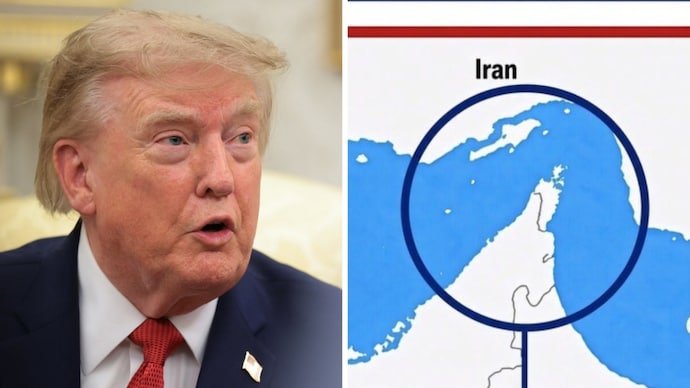
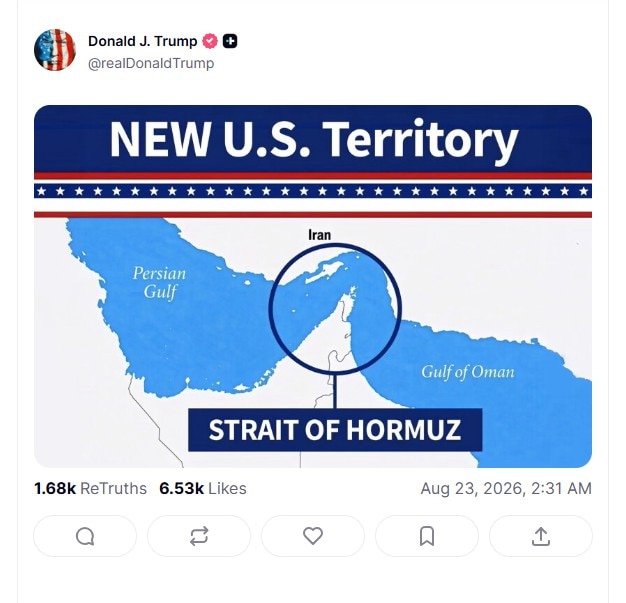
US President Donald Trump has again shared an image on Truth Social describing the strategically vital Strait of Hormuz as “NEW US Territory”, intensifying an already tense confrontation with Iran over control of the waterway and the movement of energy shipments.
The latest post comes as Washington prepares a new round of sanctions that Treasury Secretary Scott Bessent has described as the “toughest sanctions in history”. Iran has rejected the US pressure and warned countries in the region against helping Washington enforce its economic campaign.
The dispute is no longer limited to sanctions or military rhetoric. The Strait of Hormuz has become a central pressure point in the conflict because it is one of the world’s most important energy shipping routes. The disruption of tanker traffic has already reduced oil flows, while uncertainty over the waterway is adding another layer of risk to global energy markets.
Trump’s description of Hormuz as US territory is a political statement rather than a demonstrated change in the waterway’s legal status. The strait lies between Iran and Oman and has long been governed by international maritime arrangements. Nevertheless, the repeated use of the “US territory” label signals how aggressively Washington is framing its effort to restore unrestricted shipping.
Trump again targets the Strait of Hormuz
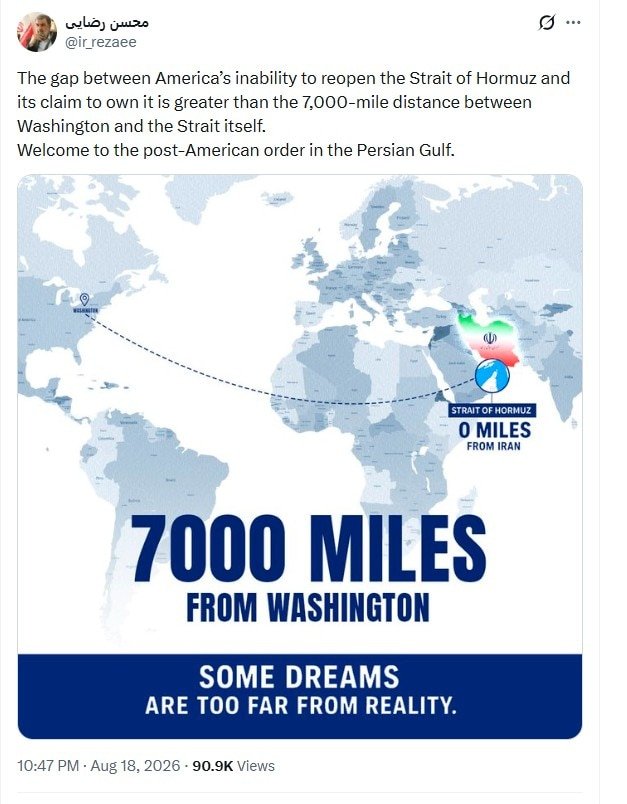
Trump first shared the same image on August 18, shortly after saying that he could declare the Strait of Hormuz a US territory. During remarks at a police academy on Long Island on August 14, Trump said he would soon make such a declaration.
His latest post repeats that message at a particularly sensitive moment. The United States is simultaneously increasing economic pressure on Iran while seeking to reopen the strategic waterway.
Iran has rejected Trump’s characterization of the strait and maintains that the waterway will remain closed unless Washington changes its approach.
That leaves the two sides with fundamentally different descriptions of the same strategic problem. Washington presents the reopening of Hormuz as a key objective of its pressure campaign. Tehran treats control over passage through the waterway as a major bargaining tool in its confrontation with the United States.
The result is a dispute in which economic pressure, military power, maritime access and diplomatic negotiations have become closely connected.
Why the Strait of Hormuz matters so much
The Strait of Hormuz is one of the world’s most strategically important maritime chokepoints. It connects the Persian Gulf with the Gulf of Oman and the wider Arabian Sea, making it a critical route for energy exports from several Gulf producers.
Before the current crisis, more than 20 million barrels of oil a day were moving through the waterway, according to the figures cited in the supplied material. The scale of that traffic explains why even a partial disruption can have consequences far beyond the Middle East.
The strait also matters because energy markets depend not only on actual supply but on expectations about future supply. If traders believe that shipping could remain restricted, oil prices can respond to the possibility of shortages before a physical shortage actually develops.
That makes Hormuz an unusually powerful economic pressure point. A prolonged disruption can affect crude oil, refined fuels, shipping costs, insurance and eventually consumer prices in countries far from the Gulf.
Oil traffic has fallen sharply
The current crisis has significantly reduced the amount of energy moving through Hormuz.
US Energy Secretary Chris Wright said the US military had helped move an average of about 8 million barrels of oil a day through the strait over a seven-day period. That is substantially below the more than 20 million barrels a day that passed through the waterway before the war.
The difference illustrates the scale of the disruption.
| Oil traffic through the Strait of Hormuz | Reported volume |
|---|---|
| Before the war | More than 20 million barrels per day |
| Recent seven-day average cited by US officials | About 8 million barrels per day |
These figures should not be interpreted as meaning that all energy exports through the region have stopped. Some vessels continue to move, and Iran has granted permission for certain Iraqi oil tankers to pass following requests from Baghdad.
But the sharp reduction in overall traffic demonstrates why the strait has become one of the most important economic battlegrounds in the conflict.
Iran warns countries against joining the US economic campaign
Tehran has responded to Washington’s pressure with increasingly forceful warnings aimed not only at the United States but also at countries that continue to trade with Iran.
Mohsen Rezaei, secretary of Iran’s Supreme National Security Council, warned neighbouring countries against supporting what Tehran describes as an American economic war.
Rezaei said countries that joined Washington’s campaign could be treated as enemies. The warning increases pressure on governments across the Gulf that have economic relationships with Iran while maintaining security partnerships with the United States.
The message also has wider implications because the US sanctions campaign is expected to focus heavily on Iran’s oil exports. Countries that buy, transport, finance or facilitate Iranian oil shipments could potentially face pressure from Washington.
That creates a difficult choice for businesses and governments. Continuing to trade with Iran may preserve access to energy or commercial opportunities, but it can also expose them to US financial and sanctions risks.
Washington prepares what Bessent calls the toughest sanctions yet
US Treasury Secretary Scott Bessent has said Washington will impose what he calls the “toughest sanctions in history” on Iran.
Bessent has described the strategy as a “one-two punch” involving economic pressure alongside the US blockade. He has said the measures are intended to put maximum pressure on Tehran and force a change in its position.
Further details are expected to determine how extensive the new measures will be and which companies, countries or parts of Iran’s economy could be affected.
The focus on sanctions is significant because Washington is attempting to increase pressure without necessarily relying on another major military escalation. Bessent has suggested that stronger economic measures could reduce the need for a renewed large-scale military operation.
But sanctions also carry risks for the countries imposing them. If they significantly restrict Iranian oil exports while Hormuz remains disrupted, global energy markets could face additional uncertainty.
China is at the centre of the sanctions strategy
china is likely to be one of the most important tests of Washington’s new approach.
China remains a major buyer of Iranian oil, with data cited by Reuters showing that it purchased more than 80% of Iran’s shipped oil in 2025. That makes Beijing central to any US attempt to restrict Tehran’s ability to sell crude.
Bessent has urged China to cooperate with Washington, pointing to China’s dependence on energy supplies from the Gulf. But Beijing has rejected the idea that sanctions and economic pressure are the answer to the crisis and has called for diplomatic efforts instead.
This creates a major challenge for Washington. Applying secondary sanctions to Chinese companies involved in Iranian oil trade could increase pressure on Tehran, but it could also create a confrontation with China, which is itself a major economic power and an important trading partner of the United States.
The effectiveness of the new sanctions will therefore depend not only on what Washington announces but also on how aggressively other countries comply.
Iran rejects the legal basis for secondary sanctions
Iranian Foreign Ministry spokesperson Esmaeil Baghaei has criticised the proposed secondary sanctions, arguing that Washington cannot legitimately impose its authority on other countries simply because they trade with Iran.
Baghaei said the secondary sanctions had no foundation in international law.
The dispute highlights a long-running conflict between US sanctions policy and the position of countries that reject Washington’s ability to regulate transactions beyond US jurisdiction. Secondary sanctions are particularly controversial because they can pressure foreign businesses to choose between access to the US financial system and continued dealings with a sanctioned country.
For Iran, the issue is therefore not simply whether Washington can restrict American companies from doing Business with Tehran. It is also whether the United States can persuade or force foreign companies and governments to follow the same restrictions.
Trump’s Hormuz claim is about pressure as much as territory
The repeated reference to the Strait of Hormuz as “NEW US Territory” should be understood in the broader context of Trump’s pressure campaign.
The statement does not itself establish US sovereignty over the waterway. Instead, it reinforces Trump’s claim that the United States should have decisive control over access through one of the world’s most important shipping routes.
That distinction matters because the strait is not simply an empty stretch of ocean that one country can claim through a political declaration. Its waters and navigation rights have long been subject to international maritime law and the interests of the surrounding states.
The political message, however, is unmistakable. Trump is signalling that Washington intends to challenge Iran’s ability to use the waterway as leverage.
Iran’s response is equally significant. Tehran’s refusal to reopen the strait without changes in US policy indicates that it views maritime access as part of the broader bargaining process.
Iran’s military capabilities remain a concern
The crisis is particularly difficult for the United States and its allies because Iran retains the ability to threaten shipping even after suffering substantial damage to its military infrastructure.
Iran possesses missile and drone capabilities that can create risks for commercial shipping and military forces operating in the region. The possibility of further attacks or disruption means that simply declaring the waterway open does not guarantee that normal shipping will immediately return.
Shipping companies must also consider insurance, crew safety, vessel security and the possibility of renewed attacks. Even if some vessels are permitted to pass, major crude carriers and LNG tankers may remain reluctant to return in large numbers until they believe the security situation has stabilised.
The Iraqi exception shows how complicated the situation has become
Iran has allowed some Iraqi oil tankers to pass through the Strait of Hormuz after requests from Baghdad.
The exception is important because it shows that the current restrictions are not necessarily identical for every vessel or every country. Tehran appears capable of making selective decisions about which shipments receive permission to transit.
For Iraq, this is especially important because the country’s oil exports are heavily dependent on routes through the Gulf. The disruption has encouraged Baghdad to consider alternative export routes, including increased use of pipelines and ports outside the traditional Gulf route.
For the wider market, selective passage also creates uncertainty. Traders cannot simply assume that every vessel will be treated in the same way, making the security and political assessment of each shipment more complicated.
Oil markets face a difficult combination of risks
The Hormuz crisis creates several potential sources of pressure on energy markets at the same time.
First, the physical volume of oil moving through the strait has fallen sharply. Second, shipping companies face security risks that can increase transportation and insurance costs. Third, sanctions could further restrict Iran’s ability to export oil. Finally, the possibility of further military escalation makes future supply difficult to predict.
These factors can reinforce one another.
If sanctions reduce Iranian exports while shipping through Hormuz remains restricted, available supplies could become tighter. If tensions increase further, additional vessels could avoid the waterway even if passage is technically possible.
That is why the economic consequences of the confrontation extend beyond Iran and the United States. Major energy-importing economies in Asia and elsewhere have a direct interest in keeping the waterway open and shipping predictable.
Iran signals it is not closing the door to diplomacy
Despite its aggressive response to Washington’s sanctions campaign, Tehran has also indicated that it remains interested in a diplomatic solution.
Iranian President Masoud Pezeshkian has called for diplomacy to end the conflict while arguing that Iran should preserve its strength and dignity.
This creates a complicated picture. Iran is simultaneously resisting US pressure, threatening countries that cooperate with Washington and maintaining that diplomacy remains possible.
For the United States, the challenge is determining whether greater economic pressure will bring Tehran back to negotiations or instead make compromise more difficult.
What happens next could depend on the sanctions package
The next major development is expected to come from Washington’s announcement of the new sanctions package.
The practical effect will depend on which sectors and transactions are targeted, how aggressively secondary sanctions are enforced and whether major buyers such as China alter their dealings with Iran.
If large parts of Iran’s oil trade are successfully restricted, Tehran could face additional economic pressure. But if major buyers continue purchasing Iranian crude through alternative channels, the impact may be less severe than Washington hopes.
The Strait of Hormuz will remain equally important. Sanctions can target Iran’s revenues, but they cannot by themselves guarantee the safe movement of ships through a contested maritime corridor.
The outcome could therefore depend on whether economic pressure and diplomacy move in the same direction or whether the two sides continue escalating their demands.
Why the Hormuz dispute matters beyond the US and Iran
The confrontation over Hormuz is ultimately about much more than a disputed map shared on social media.
The waterway sits at the intersection of global energy security, international maritime law, military power and economic diplomacy. A prolonged disruption can affect oil exporters, importers, shipping companies and consumers across the world.
For Washington, reopening the strait is both a strategic and economic objective. For Tehran, maintaining leverage over access gives it an important bargaining tool while it faces an increasingly aggressive sanctions campaign.
That makes Hormuz one of the most dangerous pressure points in the wider conflict. A political dispute over sanctions can quickly become a shipping crisis, while a shipping crisis can feed back into global energy prices and increase pressure on governments to intervene.
The road ahead remains uncertain
Trump’s latest “NEW US Territory” post underscores how far the confrontation has moved from conventional sanctions policy. The United States is combining economic pressure with a demand for control over maritime access, while Iran is using the Strait of Hormuz as leverage against Washington.
The next stage will depend heavily on the details of the US sanctions package, China’s response and whether Iran continues allowing selected tankers to pass.
For global energy markets, the central question is simpler: how much oil can reliably move through Hormuz, and for how long?
Until there is a clearer answer, the strait will remain a major source of geopolitical and economic uncertainty. Trump’s latest post may be symbolic, but the underlying dispute is very real. Control over the waterway, access to Iranian oil and the future of US-Iran diplomacy are now tightly connected, making the Strait of Hormuz one of the most consequential flashpoints in the current Middle East crisis.
For breaking news and live news updates, like us on Facebook or follow us on Twitter and Instagram. Read more on Latest World on thefoxdaily.com.



COMMENTS 0