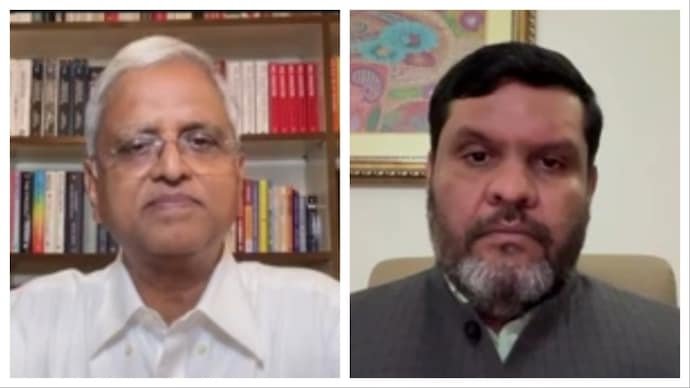
India’s latest 7.8% GDP growth estimate has triggered a fresh debate over how the country measures economic activity, after a large revision in the previous year’s current-price GDP figures became the centre of a televised exchange between former Finance Secretary Subhash Chandra Garg and Economic Advisory Council to the Prime Minister member Gaurav Vallabh.
The disagreement is not primarily about whether India’s Economy expanded in the April-June quarter. The official estimate puts real GDP growth at 7.8%. The sharper dispute concerns the figures used to compare the latest quarter with the previous year and the effect of the government’s new GDP series, which uses 2022-23 as its base year instead of 2011-12.
Garg has argued that the most important issue is the change in the current-price GDP estimate for the previous year’s first quarter, which was initially around Rs 86 lakh crore and is now around Rs 80 lakh crore under the revised series. He says a revision of roughly Rs 6 lakh crore is large enough to require a detailed explanation.
Vallabh, however, has rejected the suggestion that the difference can be understood simply as a downward revision designed to make the latest growth rate appear stronger. His argument is that the new series incorporates updated data sources, broader coverage of economic activity and methodological changes, making direct comparisons between figures from the old and new series misleading.
The clash illustrates a larger issue in economic reporting: GDP growth depends not only on arithmetic but also on the data, definitions and statistical framework used to calculate it.
Why the Rs 6 lakh crore GDP revision is at the heart of the dispute
Garg’s central criticism is focused on current-price GDP, not the use of a deflator to calculate real growth.
Under the earlier GDP series, India’s current-price GDP for the first quarter of 2025-26 had initially been estimated at about Rs 86.05 lakh crore. Under the revised 2022-23 base-year series, the corresponding figure was subsequently estimated at around Rs 80.32 lakh crore, later revised to Rs 80.44 lakh crore and then to roughly Rs 80 lakh crore as updated data were incorporated.
That difference of roughly Rs 6 lakh crore has become the focal point of the criticism.
Garg has argued that this is too large a revision to be treated as a routine statistical adjustment without a clear explanation of what changed. He has also pointed to revisions in earlier years, including what he described as a substantial upward revision to current-price GDP for 2023-24.
During the India Today TV discussion, Garg said that if the current-price estimate falls from around Rs 86 lakh crore to Rs 80 lakh crore, the government owes an explanation for such a change.
His broader argument is about transparency. Large revisions can influence how the public interprets the pace of economic expansion, especially when headline growth rates are calculated by comparing one period with another.
The government’s case: this is a new statistical series
Vallabh’s response rests on a different premise: the old and new estimates are products of different statistical frameworks.
India introduced a new GDP series with 2022-23 as the base year, replacing the previous 2011-12 base year. The government has said the new series uses improved data sources and incorporates information that was either unavailable or less comprehensive in the earlier framework.
These include additional corporate financial information, GST-related data, government records and newer surveys. Changes in sectoral coverage and the treatment of economic activities can also affect the estimated size of the economy.
That means the revision of a previous year’s figure is not necessarily equivalent to the government simply correcting an arithmetic mistake in the old series.
Vallabh used the example of economic units entering or leaving the measured coverage of an activity to explain why the size of GDP can change when the statistical framework is updated. A revised series may capture parts of the economy more comprehensively than the earlier one.
The government has similarly argued that GDP estimates are revised in stages as additional information becomes available. The first estimate is therefore not necessarily the final figure, and successive updates are a normal part of national-accounts statistics.
Why the 2.6% growth argument has become controversial
The dispute became more complicated after Garg questioned the interpretation of the 7.8% real GDP growth figure.
Critics have argued that if the previous year’s current-price GDP estimate of roughly Rs 86 lakh crore had remained unchanged, the nominal increase implied by the latest figure would have been much smaller. Garg’s calculations were interpreted by some as suggesting that growth on the basis of current-price figures could have been around 2.6% rather than the officially reported 7.8% real growth.
Garg, however, has stressed that his argument is not based on changing the GDP deflator. He has said the specific issue is the revision to the current-price starting point itself.
That distinction is important because nominal GDP and real GDP are not the same measure.
Nominal GDP measures the value of goods and services at current prices. Real GDP attempts to measure changes in the volume of economic activity after accounting for price effects. The official real growth rate is therefore calculated using comparable constant-price estimates within the same statistical series.
The government has rejected attempts to compare the latest real GDP figure with a previous-year current-price estimate from an older GDP series. Officials have described such comparisons as effectively mixing two different datasets.
That is the core of the “apples and oranges” argument made by government representatives. A mathematically correct calculation can still be economically misleading if the underlying figures are not comparable.
What a base-year change actually does
The phrase “base-year change” can sound technical, but it has a direct impact on how national income statistics are constructed.
A GDP series uses a reference year for its price and production calculations. As an economy changes, an older base year may no longer adequately represent its structure. Consumers buy different products, industries gain or lose importance and new forms of economic activity emerge.
Updating the base year allows statisticians to reflect those changes more accurately.
India’s new series uses 2022-23 rather than 2011-12. The update also incorporates changes in data sources and methodology.
That means the new GDP series does more than change the year printed next to the calculation. It can alter how sectors are weighted, which sources are used and how certain types of production are estimated.
As a result, earlier GDP figures can be revised to create a consistent historical series under the new methodology.
This is why the latest revision should not automatically be interpreted as evidence that the economy “lost” Rs 6 lakh crore in the conventional sense. The change reflects a re-estimation of economic activity under a different statistical framework.
Why the revision still deserves scrutiny
That explanation does not necessarily eliminate the questions raised by Garg.
National accounts are among the most important economic statistics published by a government. They influence monetary policy, fiscal planning, corporate decisions, investor expectations and international comparisons.
When a major revision changes the estimated size of the economy by several lakh crore rupees, economists naturally want to know exactly what drove the change.
The key questions include which sectors were most affected, how newly incorporated datasets changed estimates, how revisions differ across earlier years and whether the new methodology produces more stable estimates over time.
This is particularly important because GDP statistics are revised repeatedly. The first estimate provides an early picture, while later estimates can change as more complete information becomes available.
Transparency about the revision process therefore matters almost as much as the headline growth number itself.
The employment debate adds another layer
The Television discussion moved beyond GDP into the state of India’s labour market, revealing another disagreement over how the economy should be judged.
Vallabh pointed to several indicators as evidence that economic activity remained strong. These included 7.1% growth in private consumption, 11.9% growth in gross fixed capital formation and 12% growth in real exports. He also referred to official labour-market data showing a decline in unemployment.
The argument is that economic expansion should be evaluated through a range of indicators rather than GDP alone. Higher consumption can indicate stronger household demand, while an increase in gross fixed capital formation can signal continued investment in productive assets.
Garg took a more cautious view of the employment picture.
He argued that the headline increase in employment needs to be examined more closely to determine what types of jobs are being created. In particular, he raised concerns about the role of unpaid work in family enterprises and agriculture and questioned whether such increases necessarily represent improvements in job quality.
He also highlighted concerns involving educated young people and those who remain outside the labour force.
The disagreement reflects a longstanding challenge in interpreting employment data: having more people counted as employed does not automatically tell us whether the economy is creating stable, productive and adequately paid jobs.
Growth can be strong while the jobs picture remains uneven
The employment argument points to a broader distinction between economic growth and economic well-being.
A country can register strong GDP growth while different parts of the population experience very different outcomes. Businesses may invest more, services may expand and exports may rise without every region or household benefiting equally from those developments.
That is why economists often examine GDP alongside consumption, investment, exports, productivity, wages, unemployment and labour-force participation.
Vallabh acknowledged that improving the quality of employment remains an important challenge, while maintaining that the broader economic indicators point toward continued expansion.
Garg similarly did not present the employment situation as entirely negative. His “glass full” and “glass half empty” comparison reflected a more mixed assessment in which positive aggregate numbers coexist with unresolved structural problems.
Why revised GDP numbers can change the economic narrative
The dispute illustrates how much influence statistical revisions can have on the political and economic narrative.
A growth rate of 7.8% conveys a strong expansion. But when observers discover that the comparison point from the previous year has been substantially revised, questions naturally arise about how much of the apparent change reflects underlying economic activity and how much reflects a change in measurement.
In reality, both can matter.
Statistical improvements can produce a more accurate picture of the economy, even when they alter historical figures. But that also means analysts must avoid combining figures produced under incompatible methodologies simply because they refer to the same calendar or financial quarter.
The correct comparison for measuring growth is generally between comparable observations within the same statistical framework.
This is why the government’s defence focuses heavily on the new series rather than the standalone Rs 80 lakh crore or Rs 86 lakh crore numbers.
Why the latest 7.8% figure is still important
Despite the controversy over the historical revision, the latest official growth number remains economically significant.
India recorded 7.8% real GDP growth in the April-June quarter of 2026-27. The figure indicates that economic activity remained strong at the start of the financial year and was supported by a combination of consumption, investment, services, manufacturing and exports.
The government has used the result to reinforce its assessment that India remains one of the fastest-growing major economies.
However, a single quarterly number should not be treated as a complete assessment of the economy. Quarterly growth can be affected by base effects, temporary sectoral movements, Weather conditions, investment cycles and external demand.
The durability of the performance will become clearer as subsequent quarters provide more evidence.
What economists should watch next
The most useful way to assess the GDP debate is to look beyond the headline percentage and monitor whether the supporting indicators remain strong.
Private consumption will show whether households continue to generate strong domestic demand. Investment growth will indicate whether businesses and the public sector are expanding productive capacity. Export performance will reveal how effectively Indian producers are responding to global demand.
Employment will remain another major test. The quality, productivity and stability of newly created jobs are likely to matter more than the headline number of people employed.
At the statistical level, future GDP revisions will also be important. As more data enter the system, economists will gain a better understanding of whether the new 2022-23-based series produces substantial revisions similar to those currently being debated.
The real issue: growth versus measurement
The Subhash Garg-Gaurav Vallabh exchange ultimately exposes two different questions that are often mixed together.
The first is whether India’s economy is growing rapidly. The official data say yes, with real GDP growth of 7.8% in the April-June quarter.
The second is whether the data series used to calculate that growth deserve scrutiny. Garg argues that the scale of the revision in previous-year current-price GDP is unusual enough to demand a detailed explanation. Vallabh and government officials contend that the difference is a predictable consequence of replacing the old GDP framework with one that incorporates newer information, wider coverage and revised methodology.
Both sides are therefore addressing different parts of the same statistical question.
A GDP estimate is not simply a single number produced by a calculator. It is the result of thousands of data points, classifications, surveys, administrative records, price measures and methodological decisions. When those inputs improve or change, historical estimates can change too.
The challenge is to explain those changes clearly enough that economists, investors and the public can understand what has actually changed in the economy and what has changed only in the way the economy is measured.
That is why the Rs 6 lakh crore revision has become politically and economically significant. The debate is not just over whether India grew by 7.8%. It is about how confidently that growth can be interpreted, how earlier estimates should be compared with the new series and how transparent the statistical revision process needs to be.
As more data are released and the new GDP series develops through subsequent revisions, the most important test will be whether the numbers continue to tell a consistent story: one of sustained economic expansion, rising investment and consumption, and stronger productivity and employment alongside the headline growth rate.
For breaking news and live news updates, like us on Facebook or follow us on Twitter and Instagram. Read more on Latest Business on thefoxdaily.com.






COMMENTS 0