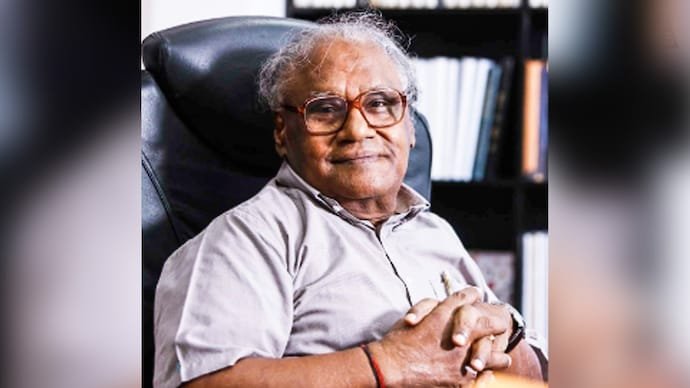
Bharat Ratna scientist Professor C N R Rao has been issued a notice under Karnataka’s Special Intensive Revision (SIR) of Electoral Rolls after a minor spelling discrepancy in his name triggered a formal identity verification process.
The 92-year-old scientist, one of India’s most prominent figures in chemistry and materials Science, has been asked to appear for a hearing in Malleshwaram, Bengaluru, following what the notice describes as a “self-name mismatch”. The reported discrepancy involves an extra letter “f” in the word “Prof”.
Older electoral records reportedly list him as “Prof CNR Rao”, while the current roll records his name as “Proff CNR Rao”. The difference of a single letter has consequently placed one of India’s most recognisable scientists in the same electoral verification process being carried out for millions of voters across Karnataka.
The episode has attracted attention not because of any question surrounding Rao’s identity in public life, but because it illustrates how even a small inconsistency between historical and current electoral records can trigger a requirement for individual verification during an intensive roll revision.
Why did CNR Rao receive an SIR notice?
The notice reportedly cites “self-name mismatch” as the reason for calling Rao for a hearing.
In the context of the Karnataka SIR exercise, such a mismatch can arise when information from an earlier electoral roll does not correspond exactly with information in the current electoral records. Differences may involve names, spelling, addresses or other identifying details.
In Rao’s case, the issue appears unusually minor: the earlier record reportedly uses “Prof”, while the current entry contains an additional “f”. That has resulted in a discrepancy between “Prof CNR Rao” and “Proff CNR Rao”.
The hearing is intended to establish that the person named in the records is the same elector appearing in the earlier roll and the current database.
It is important to distinguish an identity-verification notice from an allegation of wrongdoing. Receiving an SIR notice does not by itself mean that a voter has been accused of fraud, has lost voting rights or has been removed from the electoral roll.
What does “self-name mismatch” mean?
A “self-name mismatch” refers to a discrepancy between the elector’s own name as it appears in an earlier roll and the details appearing in the current electoral record.
The SIR exercise uses older electoral rolls as an important reference point for verifying voters. When a current entry does not precisely correspond with the historical information provided during the enumeration process, an elector may be required to establish the connection between the records.
That can happen even when the underlying identity is not genuinely in doubt. Names may have been transliterated differently between languages, spellings may have changed, initials may have been expanded or shortened, or clerical errors may have entered official databases over time.
The CNR Rao case offers an unusually clear example of how such a mechanism can capture a person whose public identity is otherwise beyond dispute.
Why one extra “f” matters in an electoral database
To a casual reader, changing “Prof” to “Proff” appears to be nothing more than a typographical error. Electoral databases, however, depend on consistency in identifying individual records.
A voter’s name is only one element used for identification, but discrepancies can create problems when records from different years or databases are compared.
That is especially relevant during an intensive revision, where officials are attempting to verify whether existing voters are properly represented in the electoral register and whether the records correspond with earlier documentation.
The purpose is not necessarily to decide whether a spelling is aesthetically correct. It is to establish whether two records refer to the same individual.
In practical terms, the case shows why database accuracy matters in electoral administration. A small data-entry mistake may be harmless in everyday life but can become significant when automated or manual verification compares current information with historical records.
CNR Rao is one of India’s most decorated scientists
The person at the centre of the notice is not an ordinary public figure.
C N R Rao is internationally recognised for his work in solid-state and structural chemistry and has played a major role in the development of materials and solid-state research in India.
The Indian Institute of Science describes him as a leading solid-state chemist and notes that he served as its director from 1984 to 1994. He is also associated with the institution’s Solid State and Structural Chemistry Unit, which he founded in 1976.
In 2013, Rao was awarded the Bharat Ratna, India’s highest civilian honour, in recognition of his contributions to science. He became the third scientist to receive the award, after C V Raman and former President A P J Abdul Kalam.
His career has extended far beyond laboratory research. He has helped shape scientific institutions, mentored researchers and advised successive Indian governments on science and Technology policy.
Rao’s connection with Bengaluru runs deep
The notice has a particular local resonance because Bengaluru has been central to Rao’s professional life.
Rao was born in Bengaluru and later became one of the most influential figures in the city’s scientific community. His career at the Indian Institute of Science helped strengthen Bengaluru’s position as one of India’s leading centres for advanced scientific research.
During his tenure as director of IISc from 1984 to 1994, Rao played a significant role in the institution’s scientific development. The institute continues to recognise him as one of its distinguished former leaders.
He also founded the Jawaharlal Nehru Centre for Advanced Scientific Research, or JNCASR, in Bengaluru. The institution became an important centre for interdisciplinary research spanning chemistry, physics, Materials Science and other fields.
That long association with Bengaluru makes the Malleshwaram hearing especially notable. A scientist whose name is closely associated with some of the city’s most prestigious scientific institutions must now attend an electoral hearing because of a small mismatch in an official record.
He has advised several Indian prime ministers
Rao’s influence has not been limited to academic science.
He has served on the Scientific Advisory Council to the Prime Minister and has headed or played leading roles in scientific advisory mechanisms for several prime ministers.
His public service has included engagement with the governments of Rajiv Gandhi, H D Deve Gowda, I K Gujral and Manmohan Singh, reflecting the unusually long span of his involvement in India’s science-policy ecosystem.
That experience has made Rao an important voice in discussions surrounding scientific research, higher Education, Innovation and the development of national research institutions.
His career therefore extends across several generations of Indian policymaking, making the electoral-roll notice stand out as an almost mundane administrative episode in an otherwise extraordinary public life.
Rao’s scientific legacy goes beyond a single field
Although he is widely identified with solid-state chemistry, Rao’s work has had implications across materials science and related disciplines.
The research associated with his career has covered areas including nanomaterials, electronic materials, oxides, carbon-based materials and other advanced substances. His scientific output has contributed to the broader development of modern materials research in India and internationally.
The Indian Institute of Science’s Solid State and Structural Chemistry Unit, which identifies Rao as its founder and professor for life, remains an example of the institutional legacy he helped establish.
His contribution is therefore measured not only through publications and awards but also through the research institutions and scientific communities built during his career.
Why the SIR exercise is producing such notices
The CNR Rao case comes amid a large-scale electoral-roll verification exercise in Karnataka.
The Special Intensive Revision is intended to review voter records and identify discrepancies that need to be resolved through supporting information and hearings where required.
According to recent reports, tens of lakhs of voters have been involved in the process, with millions of cases requiring further verification or action during the revision exercise.
Other well-known figures have also attracted attention after receiving notices related to discrepancies in their electoral records. That has turned what is normally a technical election-administration process into a wider public discussion about how historical voter data is maintained and verified.
The appearance of prominent names can make the process more visible, but the underlying mechanism applies much more broadly to ordinary voters whose records contain inconsistencies.
A spelling discrepancy can create a real administrative burden
For most people, correcting an additional letter in a title would be a simple matter. During an electoral roll revision, however, the process can require a voter to provide documents or appear before an election official.
That is because authorities must establish that a current record corresponds to a legitimate elector rather than simply correcting a spelling in isolation.
The requirement can be especially inconvenient for elderly voters, people living far from their polling locations or individuals whose records have accumulated several differences over decades.
In Rao’s case, reports have indicated that he does not regularly use email or a mobile phone himself, adding another practical complication to an otherwise straightforward administrative issue.
His case highlights a wider question about whether digital voter databases should be better integrated with authoritative identity records so that minor clerical differences can be resolved without unnecessary burdens on citizens.
The notice does not diminish Rao’s public identity
The irony of the situation is obvious: the electoral authorities are asking one of India’s most recognisable scientists to establish that “Prof CNR Rao” and “Proff CNR Rao” refer to the same person.
Yet identity verification systems are designed around records rather than reputations. Public recognition, professional honours or national awards do not automatically eliminate the need to reconcile discrepancies between voter databases.
That is why even a Bharat Ratna recipient can receive the same kind of procedural notice that could be sent to any other elector whose details do not align across records.
From an administrative perspective, the important issue is not whether Rao is famous enough to be recognized. It is whether the electoral record correctly identifies the individual entitled to remain on the roll.
Rao’s awards underline the contrast
The contrast between the administrative notice and Rao’s scientific stature has made the story especially striking.
His honours include the Bharat Ratna, Padma Vibhushan, Padma Shri and Karnataka Ratna, along with a long list of national and international scientific awards.
He has also received extensive recognition for his contributions to chemistry, materials science and scientific institution building.
Despite that extraordinary record, the electoral system ultimately reduces the matter to something very simple: whether the person listed under two slightly different versions of a name is the same elector.
That may sound almost absurd, but it illustrates an important principle of public administration. Complex systems often operate through very ordinary pieces of information, and even minor inconsistencies can cause larger procedures to begin.
What happens at the Malleshwaram hearing?
The hearing will provide an opportunity for the electoral authorities to verify Rao’s identity and reconcile the name discrepancy in the relevant records.
The purpose is expected to be documentary and administrative rather than a substantive examination of his citizenship or professional identity.
Once the authorities are satisfied that the records relate to the same elector, the discrepancy can be addressed through the applicable electoral-roll process.
The broader lesson for voters is that receiving an SIR notice should not automatically be interpreted as evidence that their registration has already been cancelled. Such notices can arise from data mismatches that require clarification.
The issue raises questions about electoral data quality
The CNR Rao case also points to a larger technological challenge facing electoral administrations.
India’s electoral rolls have evolved over many decades, moving from predominantly paper-based records to increasingly digitised systems. During that transition, inconsistencies can arise because names are entered in different scripts, translated or transliterated, abbreviated in different ways or manually re-entered from older documents.
Cleaning such databases is important because accurate voter records form the foundation of a reliable election process.
At the same time, verification systems need to distinguish between meaningful discrepancies and harmless clerical variations. A spelling difference of one character should ideally be resolvable through efficient cross-checking rather than becoming an unnecessarily complicated process for the voter.
Modern data-matching technologies can potentially help identify likely duplicate or matching records, but human verification remains important when databases contain historical inconsistencies.
Why the episode has attracted wider attention
The story has resonated because it combines two completely different worlds: the precision of India’s electoral machinery and the extraordinary public stature of one of the country’s most celebrated scientists.
Rao has spent decades associated with scientific accuracy, institutional building and research excellence. Yet his electoral record reportedly contains an extra letter that has been enough to trigger an official hearing.
The episode is also a reminder that government databases do not automatically become flawless simply because the people recorded in them are famous.
For ordinary citizens, the lesson may be even more relevant. A small difference in spelling, address or other personal details can potentially create complications during large-scale verification exercises, making it important to check voter records and respond to legitimate notices.
CNR Rao’s legacy remains far bigger than the paperwork
Whatever the outcome of the Malleshwaram hearing, the SIR notice has little bearing on Rao’s scientific legacy.
His influence on Indian science stretches across research, institution building and policy. He helped establish major centres of scientific research, led the Indian Institute of Science and advised governments on national science priorities.
The Indian Institute of Science continues to list him among its distinguished scientific figures, while the institution he founded in Bengaluru remains a major centre for advanced research.
His Bharat Ratna recognition further reflects the extraordinary national importance attached to his contribution.
The present controversy is therefore best understood as a small electoral-record discrepancy involving a very prominent individual, rather than as a question about Rao’s standing, achievements or public identity.
A tiny spelling error exposes a much bigger administrative challenge
Professor CNR Rao’s SIR notice may have begun with just one extra “f”, but the episode highlights a much larger issue surrounding modern electoral administration: keeping historical records accurate while ensuring that genuine voters are not unnecessarily burdened by technical discrepancies.
The reported difference between “Prof CNR Rao” and “Proff CNR Rao” is minor in everyday language. In a voter database undergoing intensive verification, however, it becomes a mismatch that officials are required to resolve.
For Rao, that means appearing for a hearing in Malleshwaram. For the electoral system, it means reconciling two records belonging to the same person. And for the wider public, the episode offers a striking example of how even a single typographical error can trigger a formal government process.
Rao’s decades-long scientific achievements remain unchanged. He remains one of India’s most decorated scientists, a Bharat Ratna recipient and an influential architect of the country’s modern scientific institutions. The unusual SIR notice simply adds another, far less scientific footnote to an extraordinary career.
For breaking news and live news updates, like us on Facebook or follow us on Twitter and Instagram. Read more on Latest India on thefoxdaily.com.






COMMENTS 0