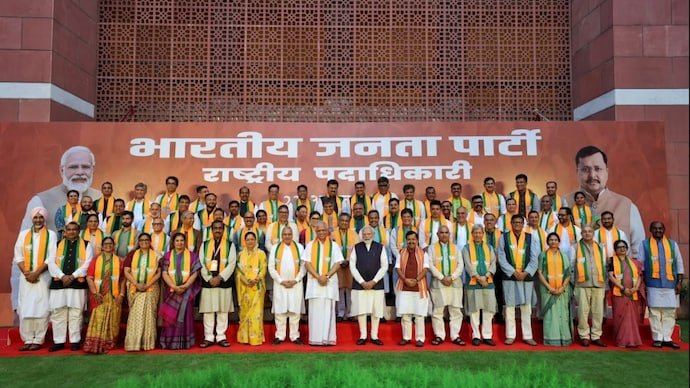
Prime Minister Narendra Modi has urged the Bharatiya Janata Party’s newly appointed national office-bearers to strengthen the organisation from the grassroots up and maintain a more active connection with the public, including through social Media.
Modi met all 65 members of the BJP‘s new national organisational team at the party headquarters in New Delhi on Saturday. The interaction lasted roughly four-and-a-quarter hours and was the Prime Minister’s first meeting with the newly appointed office-bearers since BJP president Nitin Nabin announced the team on August 17.
The meeting comes as the BJP prepares for upcoming Assembly elections and looks to expand its outreach among young voters and other demographic groups. Alongside organisational mobilisation, the party is also placing greater emphasis on communication, including sustained engagement with younger audiences through its Yuva Samvad initiative.
Rather than limiting the session to a conventional political briefing, Modi personally interacted with each of the new office-bearers, asking about their backgrounds, experiences and previous organisational responsibilities. The format offered the Prime Minister an opportunity to understand the new team while also sharing lessons from his own years working within the BJP organisation.
Modi spends more than four hours with the new BJP team
The length and format of the meeting stood out within the BJP’s latest organisational exercise. Modi interacted individually with all 65 office-bearers WHO were present, according to people familiar with the meeting.
He asked each participant about their name and their best experience in life. The office-bearers then discussed their previous organisational work and shared experiences from their political careers.
The interaction allowed the new team to present its background directly to the Prime Minister rather than simply receiving instructions from the party leadership.
People present at the meeting said Modi appeared to draw heavily on his own experience as a BJP Sangathan Mantri, a role associated with organisational work and cadre-building. His approach reportedly resembled that of an organisation functionary, with discussions centred on how the party could expand its reach and improve its internal functioning.
For the BJP, that organisational emphasis is significant because the party’s political strength has historically been closely linked to its network of workers and its ability to mobilise supporters beyond election periods.
Why grassroots organisation remains central to the BJP
Political campaigns are increasingly dominated by television debates, digital platforms and social media, but the BJP continues to place substantial emphasis on its organisational structure at the local level.
Grassroots workers are responsible for maintaining contact with voters, communicating party programmes and government initiatives, identifying local issues and mobilising supporters during elections.
Modi’s message to the new office-bearers therefore appears to combine two approaches that are sometimes treated separately: strengthening the traditional party organisation while adapting it to newer forms of political communication.
The emphasis on fresh ideas is particularly relevant as voter behaviour changes. Younger voters consume political information through a much wider range of platforms than earlier generations, and political parties increasingly have to communicate through short-form video, social networks and direct digital engagement.
For the BJP, the challenge is not simply to increase its social media presence. It is to connect digital communication with the party’s wider organisational network so that online outreach translates into sustained engagement at the local level.
Social media becomes an important part of the BJP’s outreach strategy
The emphasis on social media comes at a time when political communication in India has become increasingly digital.
Social platforms allow political organisations to communicate directly with supporters without depending entirely on traditional media. They also allow national messages to be adapted for regional and local audiences.
For the newly appointed office-bearers, staying active on social media can serve several purposes. It can help them communicate party positions, explain government initiatives, respond quickly to political developments and maintain visibility between elections.
But effective digital outreach requires more than frequent posting. The Prime Minister’s broader message about fresh ideas and deeper public engagement suggests that the BJP wants its communication to remain connected to issues that matter to different sections of society.
That distinction could become important as the party attempts to reach voters who may not have a longstanding connection with its traditional political networks.
Youth outreach is a major focus
One of the clearest priorities discussed during the meeting was the need to strengthen the BJP’s connection with young people.
The party is preparing to intensify its Yuva Samvad initiative, which is aimed at sustained engagement with youth.
Younger voters represent an important audience for every major political organisation because their political preferences can evolve quickly and because they are among the most active users of digital platforms.
For the BJP, youth outreach also provides an opportunity to introduce a new generation to the party’s political messaging and organisational activities.
Modi’s instruction to connect with young people and new demographic groups suggests that the party does not want its outreach to remain confined to established voter constituencies. Instead, the new office-bearers are being asked to look for groups that may require different forms of communication and engagement.
New BJP office-bearers asked to bring fresh perspectives
Another theme running through the meeting was the need for new ideas.
Modi told the new team that the organisation should move forward with new perspectives while maintaining its connection with the public. That creates a dual responsibility for the office-bearers: preserve the BJP’s organisational strengths while finding new ways to engage with voters.
This is particularly relevant for a national party operating across regions with very different political, social and economic concerns. A single national message may not be equally effective in every state or among every demographic group.
A stronger emphasis on local experience could allow national leaders to better understand issues emerging at the grassroots level. The personal interaction between Modi and the office-bearers appears to have been designed partly around that exchange of experience.
The 65-member team marks a new organisational phase
The meeting followed BJP president Nitin Nabin’s announcement of the party’s new 65-member national office-bearer team on August 17.
The team includes several prominent political figures, including former Union minister Smriti Irani and RSS national executive member Ram Madhav, both of whom have returned to important organisational positions.
The composition of the team gives the BJP a combination of experienced political figures and organisational leaders as it prepares for the next phase of its political activity.
National office-bearers have an important role in coordinating the party’s work across states, supporting election preparations and implementing organisational programmes. Their responsibilities can range from political communication and youth outreach to coordination with state units and grassroots workers.
For that reason, the first detailed interaction with the Prime Minister carries significance beyond a routine introductory meeting.
Nitin Nabin also reviews the party’s strategy
The Prime Minister’s meeting was part of a broader organisational programme at the BJP headquarters.
Earlier in the day, Nabin chaired a meeting of the newly appointed office-bearers. The discussions covered organisational strategy, preparations for upcoming Assembly elections, grassroots mobilisation and communication of government initiatives.
The sequence of meetings indicates that the BJP is using the new organisational team to begin work on several priorities at the same time.
Election preparation is one of them, but the party is also looking beyond individual electoral contests by focusing on organisational strengthening and public outreach.
That distinction matters because political organisations typically need to maintain their networks between elections. Regular engagement can help parties identify public concerns before campaigns formally begin.
Assembly elections add urgency to the organisational push
The BJP is simultaneously reviewing preparations for upcoming Assembly elections. That gives the new office-bearers an immediate political task alongside their longer-term organisational responsibilities.
Election preparation requires coordination between national leaders, state units and local workers. It also involves understanding regional political conditions and communicating government initiatives to voters.
The new team’s emphasis on grassroots mobilisation could therefore become particularly important as the party moves closer to upcoming state contests.
However, the meeting itself does not establish specific electoral strategies or predict the outcome of any upcoming election. It shows instead that the BJP’s national leadership is beginning to organise its resources and communication strategy around the next phase of political activity.
Modi also meets key BJP leaders separately
During his visit to the BJP headquarters, Modi also held separate meetings with Nabin, BJP organisation general secretary B. L. Santosh and Shivkumar.
These discussions took place alongside the larger meeting with the 65 office-bearers.
The combination of individual leadership meetings and the larger interaction suggests that the party is coordinating its political and organisational leadership as the new team takes charge.
For a party with a large nationwide structure, coordination between the national president, senior organisational leadership and national office-bearers is essential to ensuring that programmes decided at the top are implemented consistently across states.
What the social media push could mean for BJP communication
The BJP’s emphasis on social media is likely to have an impact beyond the party’s formal organisational structure.
National office-bearers can become important communication channels between the central leadership and voters. Their individual social media activity can help amplify political messages while also giving the party a larger number of public-facing representatives.
There is another potential advantage: rapid feedback.
Digital platforms allow political leaders to observe which issues attract attention and how different groups respond to particular messages. That information can complement traditional organisational feedback from party workers.
But digital visibility also creates challenges. Social media is highly competitive, and political communication can quickly become dominated by controversy rather than policy. Maintaining credibility therefore requires consistent, clear and relevant communication rather than simply increasing the number of posts.
Modi’s simultaneous emphasis on public connection and new ideas suggests that the BJP’s objective is broader than digital activity alone. The party appears to be seeking a communication network that remains connected to its grassroots organisation.
Why the youth focus matters politically
The BJP’s planned expansion of Yuva Samvad highlights a broader reality of electoral Politics: parties must continually build relationships with voters who are entering the political system for the first time.
Youth engagement can involve more than election campaigning. It can include discussions around Education, employment, Entrepreneurship, technology, skills and opportunities, depending on the priorities of different communities.
The effectiveness of such outreach will ultimately depend on whether young people view it as meaningful engagement rather than one-way political messaging.
That makes the Prime Minister’s instruction to develop fresh perspectives particularly relevant. A party seeking long-term youth support has to understand how younger voters’ concerns differ from those of established voter groups.
The bigger organisational challenge for the BJP
The BJP’s new national team is taking charge at a time when political communication is becoming more decentralised.
National leaders remain important, but voters increasingly receive information from local leaders, influencers, community networks and social media accounts. This makes the role of national office-bearers more complicated.
They must communicate the party’s national position while remaining responsive to local political realities.
Modi’s emphasis on grassroots organisation addresses that challenge directly. The party’s central leadership can set broad priorities, but implementation depends on state and local units understanding the concerns of their respective communities.
The new office-bearers will therefore have to perform both organisational and communication roles. Their effectiveness will be measured not simply by how visible they are online, but by whether they can strengthen the party’s connection with people outside its established support base.
What happens next for the BJP
The immediate focus will be on turning the new team’s organisational priorities into programmes on the ground.
The BJP is expected to continue preparations for upcoming Assembly elections while expanding youth engagement and grassroots mobilisation. The Yuva Samvad initiative is likely to be an important part of that effort.
Social media will also remain a major communication channel, particularly as the party seeks to connect with younger voters and new demographic groups.
The key test will be whether the new organisational team can combine the BJP’s established grassroots network with newer forms of political outreach. A strong digital presence can amplify a party’s message, but sustained political engagement ultimately depends on what happens beyond the screen.
Modi’s message signals a broader BJP organisational push
Prime Minister Narendra Modi’s extended interaction with the BJP’s new national office-bearers was more than an introductory meeting. It offered a clear set of priorities for the organisation: strengthen the grassroots network, engage the public more deeply, reach younger voters, communicate more effectively and bring fresh ideas into the party’s work.
The timing is also significant. With the BJP reviewing preparations for upcoming Assembly elections and beginning a new phase under its 65-member national team, the party is seeking to combine electoral readiness with longer-term organisational expansion.
The emphasis on social media shows that the BJP recognises the changing Nature of political communication. But the continued focus on grassroots mobilisation suggests that the party does not see digital outreach as a substitute for its organisational machinery.
Instead, the emerging strategy appears to be about connecting the two: a stronger ground network supported by faster and broader digital communication. How effectively the new office-bearers execute that approach will become clearer as the party’s youth programmes, organisational initiatives and election preparations gather pace.
For breaking news and live news updates, like us on Facebook or follow us on Twitter and Instagram. Read more on Latest India on thefoxdaily.com.






COMMENTS 0