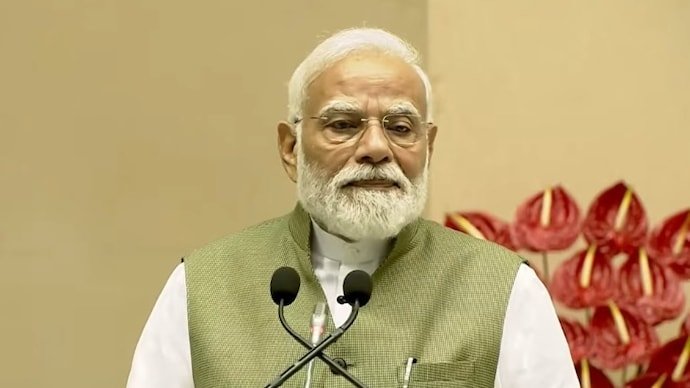
Prime Minister Narendra Modi is travelling to Uzbekistan and the Kyrgyz Republic from August 29 to September 1 for a visit that puts Security, connectivity and economic opportunity at the centre of India‘s engagement with Central Asia.
The four-day trip will combine a State Visit to Uzbekistan with participation in the 26th Shanghai Cooperation Organisation (SCO) Summit in Bishkek, giving New Delhi an opportunity to pursue bilateral priorities while also shaping discussions within the wider regional grouping.
Before departing, Modi said India would work with fellow SCO members toward a region free from terrorism, separatism and extremism. He also described security, connectivity and opportunity as the three pillars of India’s approach to the organisation.
The visit comes at a time when Central Asia remains strategically important to India for several reasons, including trade routes, energy interests, regional security and historical links. For New Delhi, strengthening relationships with Central Asian states is also closely connected to the challenge of improving India’s physical and economic access to a region separated from India by geography and complex transit routes.
PM Modi’s Central Asia visit begins in Uzbekistan
Modi will begin the trip in Tashkent on August 29 at the invitation of Uzbek President Shavkat Mirziyoyev.
The two leaders are expected to discuss ways to expand the India-Uzbekistan strategic partnership, with trade and investment, digital connectivity, defence and energy among the areas highlighted by the Indian prime minister.
Modi has described the relationship as one that has advanced significantly in recent years. His discussions with Mirziyoyev are expected to focus on translating that growing political relationship into deeper practical cooperation.
Trade and investment will be particularly important because stronger economic ties require reliable business channels, financial cooperation and transport links. Digital connectivity is another increasingly important area, as both countries seek to expand Technology-driven economic activity.
Defence cooperation adds a strategic dimension to the relationship. Uzbekistan occupies an important position in Central Asia, bordering Afghanistan and other regional states, making security issues an unavoidable part of India’s engagement with Tashkent.
Energy is another area where cooperation could become increasingly relevant. Central Asia possesses significant energy resources, while India remains a major energy-consuming economy. The practical challenge is creating commercially and logistically viable routes for greater cooperation.
From Tashkent to Bishkek for the SCO summit
After his Uzbekistan visit, Modi will travel to Bishkek, the capital of the Kyrgyz Republic, to attend the 26th SCO Summit at the invitation of Kyrgyz President Sadyr Zhaparov.
The summit is particularly significant because it marks 25 years of the organisation. Modi is expected to address fellow SCO leaders and outline India’s priorities for the regional grouping.
India has been an SCO member since 2017. Since joining, New Delhi has used the organisation as one of several platforms for engaging with major Eurasian powers and Central Asian countries.
The SCO brings together countries with very different political systems, economic interests and strategic priorities. That makes consensus difficult, but it also gives the organisation importance as a forum for dialogue on security, regional stability, connectivity and economic cooperation.
For India, the organisation provides direct access to Central Asian partners while also creating a forum in which New Delhi can engage with other major powers on issues affecting the wider Eurasian region.
Security remains India’s central SCO priority
Modi’s departure statement placed security at the top of India’s agenda.
He said India wanted to work with SCO members toward a region free from terrorism, separatism and extremism, which he described as continuing threats to peace and stability in the neighbourhood and beyond.
The emphasis reflects India’s longstanding concern about terrorism and instability in its wider neighbourhood. Central Asia’s proximity to Afghanistan makes developments there particularly relevant to regional security discussions.
For India, the security conversation is not limited to conventional military threats. Terrorist networks, radicalisation, cross-border crime and instability can affect trade routes, investment and regional development.
That is why New Delhi has consistently argued that economic connectivity and regional development cannot be separated from security.
At the SCO summit, India’s challenge will be to advance its security priorities while working within a group whose members do not always share identical views on regional conflicts or strategic issues.
Connectivity is a strategic priority for India
Connectivity is the second major pillar of Modi’s stated approach to the SCO.
For India, stronger links with Central Asia have always faced a basic geographical problem: the country does not have a simple, uninterrupted land route into the region.
Improving connectivity therefore requires cooperation with multiple countries and the development of alternative transport corridors.
Transport infrastructure can influence much more than the movement of goods. Reliable routes can make trade more predictable, reduce logistical costs and create opportunities for businesses that currently find Central Asian markets difficult to reach.
Digital connectivity provides another route for cooperation. As economies become more dependent on digital payments, information services and technology platforms, physical distance becomes less of a barrier in some sectors.
Modi’s decision to highlight both connectivity and opportunity suggests that India’s Central Asia strategy is intended to move beyond traditional diplomatic engagement and toward more practical economic integration.
Why Central Asia matters to India
Central Asia occupies a strategically important position between Europe, Russia, china, South Asia and the Middle East. Its location gives the region significance far beyond its individual national markets.
For India, the five Central Asian republics of Kazakhstan, Kyrgyzstan, Tajikistan, Turkmenistan and Uzbekistan offer potential partnerships in areas including energy, minerals, trade, transport, education, pharmaceuticals, information technology and security.
India also has longstanding historical and cultural links with Central Asia. Trade, travel, Buddhism, language and the movement of people have connected the Indian subcontinent with parts of Central Asia for centuries.
Those links remain an important element of New Delhi’s diplomatic approach. However, cultural goodwill alone cannot create sustained economic relationships. Modern connectivity, investment and institutional cooperation are necessary to convert historical ties into contemporary partnerships.
Modi to highlight India’s “Security, Connectivity and Opportunity” vision
Modi has framed India’s SCO approach around three closely connected objectives: security, connectivity and opportunity.
Security is intended to address terrorism, extremism and regional instability. Connectivity focuses on improving transport and digital links between economies. Opportunity covers the trade, investment and development potential that can emerge when countries are better connected and more secure.
The three priorities reinforce one another.
Trade routes require stability to function effectively. Investment is easier when transport and digital infrastructure are reliable. Regional security becomes more valuable when countries have stronger economic incentives to cooperate.
India’s approach therefore attempts to present the SCO not simply as a security grouping but as a platform for broader regional cooperation.
India-Uzbekistan ties extend beyond trade
The Uzbekistan leg of Modi’s trip is expected to give particular attention to the bilateral relationship.
India and Uzbekistan have developed cooperation across several areas, and Modi has specifically identified trade and investment, digital connectivity, defence and energy as priorities for discussion with President Mirziyoyev.
The two countries also share an interest in strengthening people-to-people relations. Modi’s planned visits to the Shastri Memorial and the Mahatma Gandhi Centre at Tashkent State University of Oriental Studies are intended to highlight that cultural connection.
The Shastri Memorial is associated with former Indian prime minister Lal Bahadur Shastri, who died in Tashkent in 1966 while attending talks following the India-Pakistan conflict.
The Mahatma Gandhi Centre, meanwhile, reflects the wider cultural interest in India’s history and philosophy in Uzbekistan.
By including these sites in the itinerary, the visit places cultural Diplomacy alongside discussions on trade, defence and energy.
The Kyrgyz Republic adds another strategic dimension
In Bishkek, Modi will meet President Sadyr Zhaparov and other SCO leaders.
Kyrgyzstan’s location makes it relevant to India’s broader Central Asian strategy. The country sits within a mountainous part of the region and maintains relationships with neighbouring Central Asian states as well as larger powers active in Eurasia.
India has maintained diplomatic and defence engagement with Kyrgyzstan, and the SCO provides another channel through which the two countries can coordinate on regional issues.
Modi’s bilateral meeting with Zhaparov will therefore complement his multilateral participation at the SCO summit.
World Nomad Games highlight Central Asian heritage
Modi is also scheduled to attend the opening ceremony of the 6th World Nomad Games in Kyrgyzstan.
The event provides a cultural dimension to a visit otherwise dominated by security, diplomacy and economic discussions.
The World Nomad Games celebrate traditional sports, cultural practices and the heritage of nomadic communities. Modi’s planned participation allows India to demonstrate respect for Central Asia’s cultural traditions while strengthening people-to-people diplomacy.
For Central Asian countries, cultural identity is an important part of their modern nation-building. India’s engagement with that heritage can complement its political and economic outreach.
Why connectivity is harder than it sounds
One of the biggest challenges for India’s Central Asia policy is that geographical proximity does not necessarily translate into easy access.
Central Asia is relatively close to India in straight-line terms, but the region is separated from India by difficult terrain and political borders. This has historically complicated direct trade.
India has therefore supported efforts to develop alternative routes connecting it with Central Asian markets.
The challenge is not simply building roads, railways or ports. Successful corridors require customs coordination, predictable regulations, efficient border crossings and political stability along the entire route.
A transport corridor is only as strong as its weakest link. If goods can move quickly through one section but face delays at another border, the overall economic benefit can be reduced.
That makes Modi’s emphasis on connectivity a long-term strategic objective rather than a goal that can be achieved through a single infrastructure project.
Security and economic interests are increasingly connected
India’s emphasis on terrorism and regional stability also has a direct economic component.
Businesses are more likely to invest in markets where political and security conditions are predictable. Transport networks are also more useful when countries can protect them from disruption.
For Central Asian states, deeper economic links with India can potentially diversify their international partnerships. For India, stronger relationships with Central Asian countries can create additional avenues for trade, energy cooperation and diplomatic engagement.
This creates an incentive for both sides to maintain stable relations even when broader geopolitical tensions complicate the region.
India’s cultural connection with Central Asia
Modi’s comments about India’s “civilisational connect” with Central Asia point to another part of the country’s regional strategy.
The relationship between India and Central Asia is older than the modern borders of either region. Historical trade routes connected merchants, scholars and travellers across the subcontinent and Central Asia.
Indian cultural influence has also travelled into Central Asia through different religious and intellectual traditions over the centuries.
Modern diplomacy cannot simply reproduce those historical networks, but cultural familiarity can provide a foundation for stronger people-to-people relations.
Educational exchanges, tourism, cultural institutions and academic cooperation can help make those links relevant to younger generations.
What the SCO summit means for India
India’s participation in the SCO summit gives New Delhi a platform to discuss regional issues with countries that it may not engage with through the same combination of institutions elsewhere.
The grouping’s agenda extends across security, economic cooperation and regional development. For India, the challenge is to use the organisation where common interests exist while continuing to pursue its own bilateral relationships independently.
That is particularly important because India’s relationships with individual SCO members can differ significantly. New Delhi has deep partnerships with some countries while having complicated strategic relationships with others.
The SCO therefore requires diplomatic flexibility.
India’s emphasis on security, connectivity and opportunity offers a relatively broad framework for cooperation because all three issues affect the region collectively, even when individual governments disagree on other matters.
What could come from Modi’s visit
The most immediate outcomes of the visit are likely to come through bilateral discussions and the SCO summit’s joint agenda.
In Uzbekistan, attention will focus on whether the two governments can identify new areas for cooperation in trade, investment, defence, energy and digital connectivity.
In Kyrgyzstan, Modi’s discussions with President Zhaparov will provide an opportunity to strengthen bilateral ties while his participation in the SCO summit will put India directly into wider regional discussions.
The longer-term significance will depend on whether political commitments translate into actual projects, investment and institutional cooperation.
Connectivity agreements, for example, have greater value when they eventually lead to functioning transport links and increased trade. Similarly, strategic partnerships become more meaningful when businesses, universities and government institutions develop sustained cooperation.
A broader push for a secure and connected Central Asia
Modi’s four-day visit brings together the major elements of India’s current Central Asia strategy.
Security remains essential because terrorism, extremism and instability can undermine regional development. Connectivity is necessary to overcome the geographical barriers that limit trade between India and Central Asia. Economic opportunity provides an incentive for countries to deepen cooperation.
The visit also demonstrates that India’s engagement with Central Asia is not limited to one country or one institution. The Uzbekistan discussions, Kyrgyzstan partnership and SCO summit participation form parts of a broader diplomatic effort.
Modi’s planned cultural engagements add another layer, emphasizing that India’s relationship with the region is based not only on contemporary strategic interests but also on longstanding historical connections.
The difficult task now is converting that diplomatic vision into measurable outcomes. Stronger trade, better connectivity, greater investment and more effective security cooperation will determine how far India’s ambitions in Central Asia can progress.
As Modi heads to Tashkent and Bishkek, the message from New Delhi is clear: India wants a Central Asia that is more secure, better connected and capable of creating greater opportunities for regional cooperation. The SCO summit provides one platform for advancing that objective, while the bilateral meetings in Uzbekistan and Kyrgyzstan will test how effectively India’s broader vision can be translated into practical partnerships.
For breaking news and live news updates, like us on Facebook or follow us on Twitter and Instagram. Read more on Latest India on thefoxdaily.com.





COMMENTS 0