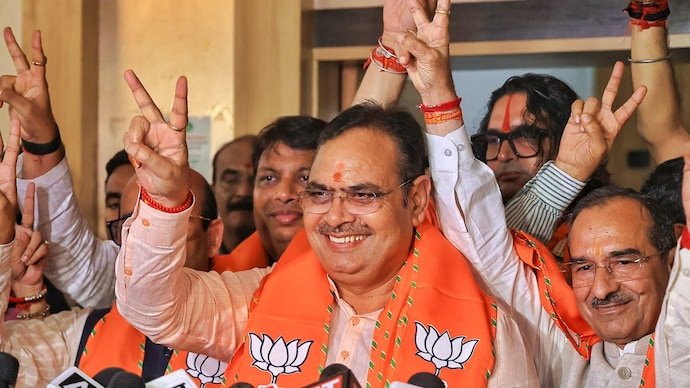
The Rajasthan urban local body election results 2026 gave the Bharatiya Janata Party (BJP) the largest overall tally, but the numbers also show why the contest cannot be reduced to a straightforward sweep for the ruling party.
The BJP won 4,179 of the 10,235 wards for which results had been declared, compared with 3,613 for the Congress. Independents won another 2,273 wards, making them an important force in several municipalities where neither major party secured a majority.
The distinction between seat share and vote share is particularly important. The BJP’s share of the declared wards was about 40.8%, compared with 35.3% for Congress. But the two parties were separated by less than one percentage point in overall vote share, according to reported election data: about 35.18% for the BJP and 34.24% for Congress. That narrow gap helps explain how a relatively small difference in votes translated into a much larger difference in ward victories.
The results therefore present two realities at the same time. The BJP remains a powerful urban electoral organisation in Rajasthan, but its performance was uneven across some of the state’s most politically significant urban centres. In places such as Bharatpur, Ajmer, Pali, Bikaner and Jodhpur, the results were far more complicated than a simple BJP-Congress contest.
BJP won the statewide ward contest, but the map was fragmented
The elections covered 309 urban local bodies, with polling conducted in two phases on September 9 and 11. Counting followed on September 14. The BJP emerged as the leading party across the state, but the distribution of victories varied sharply from city to city.
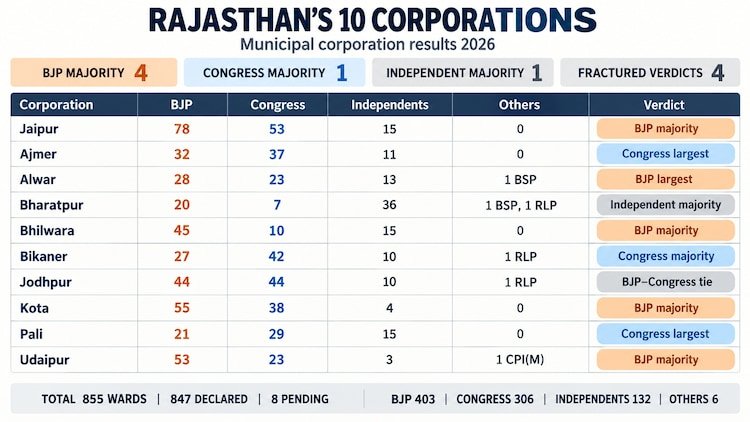
Of Rajasthan’s 10 municipal corporations, the BJP secured clear majorities in Udaipur and Bhilwara and emerged as the largest party in Jaipur, Kota and Alwar. Congress secured a clear majority in Bikaner and emerged as the largest party in Ajmer and Pali. Jodhpur produced an almost even BJP-Congress contest, while Bharatpur became the most striking example of Independent candidates reshaping the result.
At the wider urban-local-body level, the BJP secured clear majorities in 86 bodies, while Congress secured clear majorities in 46. In many of the remaining bodies, neither party crossed the majority mark, leaving Independents and smaller parties with greater influence over board formation.
This is significant because municipal elections work differently from Assembly or lok Sabha elections. A party can finish first statewide while still struggling to control individual civic bodies. Ward-level contests are heavily influenced by candidates, local factions, civic services, ticket distribution and personal networks.
The ward numbers look stronger than the vote-share gap
The BJP’s 4,179 ward victories represent a substantial improvement over its previous urban local-body performance. Its share of the total ward pool increased from roughly 35.7% in the 2019-21 cycle to 40.8% in the current contest.
Congress moved in the opposite direction, falling from about 40.7% to 35.3% of wards.
However, comparisons between the two election cycles require caution. Delimitation before the 2026 election increased the number of wards significantly, adding roughly 2,770 seats to the pool. The previous election cycle was also conducted in several rounds between 2019 and 2021 rather than in a single two-phase exercise.
The more revealing figure is therefore the narrow vote-share difference between the two major parties. The BJP’s roughly 0.94-percentage-point advantage over Congress shows that the larger ward tally was not accompanied by an overwhelming statewide vote lead.
That difference also illustrates how India‘s first-past-the-post electoral system can convert relatively small differences in support into much larger differences in seats. A party that wins narrowly in many individual wards can accumulate considerably more seats than a rival whose votes are concentrated in fewer constituencies.
| Indicator | BJP | Congress |
|---|---|---|
| Declared wards won | 4,179 | 3,613 |
| Approximate share of declared wards | 40.8% | 35.3% |
| Reported statewide vote share | 35.18% | 34.24% |
| Difference in reported vote share | About 0.94 percentage points |
Bharatpur shows the importance of local rebellions
The result in Bharatpur was one of the most notable outcomes of the election. Independents won 36 of the 65 wards, giving them an outright majority. The BJP won 20 and Congress seven, while smaller parties secured the remaining seats.
Bharatpur is particularly politically significant because it is associated with Chief Minister Bhajan Lal Sharma. The scale of the Independent victory therefore attracted attention beyond the municipal contest itself.
But the result should not automatically be interpreted as 36 wards shifting from BJP to an anti-BJP camp. Bharatpur has a history of candidates contesting outside the two major party structures. Congress, for example, won only 18 wards in the 2019 election but subsequently formed the civic board with support from Independents and BSP councillors.
There were also reports before the election of dissatisfaction within both BJP and Congress over ticket distribution. Candidates denied nominations by major parties entered the contest independently in several areas.
This creates an important distinction. An Independent victory can represent opposition to an official party candidate without necessarily representing a permanent change in the voter’s preference between BJP and Congress.
Ajmer, Pali and Jhalawar add to the picture
Several other politically important urban centres produced results that were difficult for the BJP to translate into straightforward control.
In Ajmer, Congress won 37 of 80 wards, compared with 32 for BJP and 11 for Independents. The result was particularly notable because Ajmer has historically been an important BJP-RSS centre. Congress’s performance therefore demonstrated that local political organisation and candidate-level dynamics could overcome the BJP’s broader urban strength.
Pali produced another setback for the BJP. Congress won 29 of 65 wards, while BJP won 21 and Independents 15. Pali is associated with BJP state president Madan Rathore, making the result politically prominent even though municipal outcomes are not direct referendums on individual leaders.
In Jhalawar, Congress won 29 of 45 municipal council wards, while BJP secured 13. Jhalawar is closely associated with former Rajasthan chief minister Vasundhara Raje. At the same time, BJP retained the separate Jhalrapatan municipality, illustrating why individual municipal results need to be assessed separately rather than treated as a uniform regional verdict.
These results can reasonably prompt questions about candidate selection, local factionalism and the effectiveness of party organisations. They do not, by themselves, establish a statewide collapse in BJP support.
Jodhpur and Alwar produced another kind of challenge
Jodhpur delivered one of the closest contests among the major corporations. BJP and Congress each won 44 wards, leaving Independents and other candidates in a position to influence the formation of the civic administration.
The result is noteworthy because Jodhpur is associated with Union minister Gajendra Singh Shekhawat. Yet a tied municipal contest cannot be treated as a direct assessment of an individual national or state leader. Local candidates, ward-level alliances and civic concerns all influence such elections.
In Alwar, BJP emerged as the largest party with 28 wards, compared with 23 for Congress and 14 for Independents. The BJP therefore had an advantage but did not cross the majority threshold.
Alwar’s result, like Jodhpur’s, demonstrates the difference between being the largest party and having enough seats to govern without outside support.
Bikaner shows that BJP’s urban strength was not uniform
Bikaner produced one of the clearest Congress victories among the major corporations. Congress won 42 of 80 wards, while BJP secured 27 and Independents 11.
Bikaner is associated with Union minister Arjun Ram Meghwal and has previously been an important BJP-controlled urban centre. The result therefore attracted attention to local political issues as well as broader social mobilisation.
One factor raised in reporting around the election was the campaign by Shri Rajput Karni Sena against the University Grants Commission‘s 2026 caste-equity regulations. Karni Sena president Mahipal Singh Makrana subsequently claimed that the organisation supported large numbers of Independent candidates and that the campaign contributed to the BJP’s setback.
That interpretation remains a claim by the organisation rather than an independently established explanation for the entire Bikaner result. The BJP has disputed the suggestion that the Independent performance can be attributed primarily to the Karni Sena campaign.
The episode nevertheless illustrates how a policy dispute can intersect with local elections, particularly when community organisations encourage voters to support candidates outside established party structures.
Civic issues can matter more in municipal elections
Urban local-body elections also expose political parties to a different kind of accountability. Voters encounter municipal governance through roads, drainage, garbage collection, water supply, street lighting and other everyday services.
Reports of damaged roads, waterlogging, overflowing drains and other civic problems had featured prominently in Rajasthan’s public debate before the election. The Monsoon timing of the polls made some Infrastructure problems especially visible.
A municipal voter does not necessarily need to assess a party’s national economic or foreign policy record before deciding whether the councillor responsible for a neighbourhood deserves another term. The condition of a nearby road or drainage system can become an immediate electoral issue.
This helps explain why a voter who generally supports BJP at the Assembly or Lok Sabha level might still vote for an Independent or opposition candidate in a ward election.
Independents were important, but there was no statewide Independent surge
The Independent tally is one of the most striking features of the 2026 results. Independents won 2,273 of the 10,235 declared wards, or about 22.2%.
Yet their proportion was remarkably close to the previous cycle, when Independents accounted for roughly 22.4% of wards. That means the headline figure does not necessarily demonstrate a statewide explosion in Independent support.
What changed was the importance of Independents in particular urban centres. In a corporation where BJP and Congress are separated by only a few wards, a relatively stable Independent vote can suddenly become decisive.
This is precisely what happened in several fragmented civic bodies. The electoral importance of Independents therefore came less from a dramatic statewide increase and more from their ability to prevent either major party from securing a majority in closely contested municipalities.
Smaller parties also occupied political space
The BJP’s setbacks did not automatically translate into equivalent gains for Congress. Smaller parties captured some of the political space created by dissatisfaction with the major parties.
The Aam Aadmi Party won 42 wards, including 31 of the 60 wards in Baran Municipal Council, ending Congress’s long control of the body.
The CPI(M) also performed strongly in Nokha, while the Rashtriya Loktantrik Party led by Nagaur MP Hanuman Beniwal increased its ward tally from around 14 in the previous cycle to 63 in the current election.
The RLP’s performance is particularly relevant in parts of central and western Rajasthan where Beniwal has established a political base among sections of the Jat electorate. A regional party gaining support in these areas can affect the distribution of votes between the BJP and Congress without necessarily transferring that support wholesale to the other national party.
The result is therefore better understood as a fragmented urban contest than as a simple BJP-versus-Congress swing.
Caste representation and local leadership remain unresolved factors
Questions surrounding political representation also featured in the campaign. Reports pointed to dissatisfaction among sections of OBC communities and disputes surrounding the Rajasthan OBC Commission’s survey and political representation.
Some candidates from communities such as Kumawats also contested successfully as Independents. Such outcomes can indicate dissatisfaction with candidate selection or expectations about representation, but ward-level results alone cannot establish how an entire caste group voted.
This distinction is important. There is no caste-wise post-poll survey establishing that a particular community collectively moved away from BJP in these elections. The available results instead show that local candidate identities, community representation and organisational disputes interacted differently from one municipality to another.
What the Rajasthan urban results actually establish
The 2026 Rajasthan urban local body elections establish several clear facts. First, the BJP remains the largest party in the state’s urban electoral landscape. Its 4,179 ward victories were substantially ahead of Congress’s 3,613.
Second, the statewide vote contest was much closer than the ward tally suggests. A reported vote-share difference of less than one percentage point separates the two major parties.
Third, BJP’s performance was geographically uneven. The party secured strong majorities in several important cities but faced difficult contests or losses in Bharatpur, Ajmer, Pali, Bikaner, Jhalawar and Jodhpur.
Fourth, Independents and smaller parties remain capable of changing the outcome of individual municipal bodies. Their presence means dissatisfaction with a major party does not necessarily translate into a direct vote for its principal rival.
Finally, the results provide evidence of competitive urban Politics rather than a uniform realignment. The BJP’s traditional urban support remains substantial, but local factors appear to have mattered considerably in determining whether that support translated into municipal majorities.
Why the results matter for Rajasthan’s next political contests
The immediate significance of the election lies less in declaring a permanent shift in urban voting patterns and more in identifying the issues parties will have to manage.
For BJP, the results highlight the importance of maintaining local organisation, managing ticket distribution, addressing civic infrastructure and keeping different social groups represented within its urban political coalition.
For Congress, the results show that BJP’s weaker performances do not automatically create a transfer of votes to the opposition. In several places, Independents and smaller parties benefited instead. Converting local dissatisfaction into a broader electoral coalition would therefore require more than simply opposing the ruling party.
The 2026 municipal verdict is consequently best read as a detailed map of Rajasthan’s urban political competition. The BJP has retained the largest statewide position, but the narrow vote-share gap, fragmented municipal outcomes and strength of candidates outside the two major parties show that urban voters cannot be treated as a single, permanently aligned bloc.
For breaking news and live news updates, like us on Facebook or follow us on Twitter and Instagram. Read more on Latest India on thefoxdaily.com.





COMMENTS 0