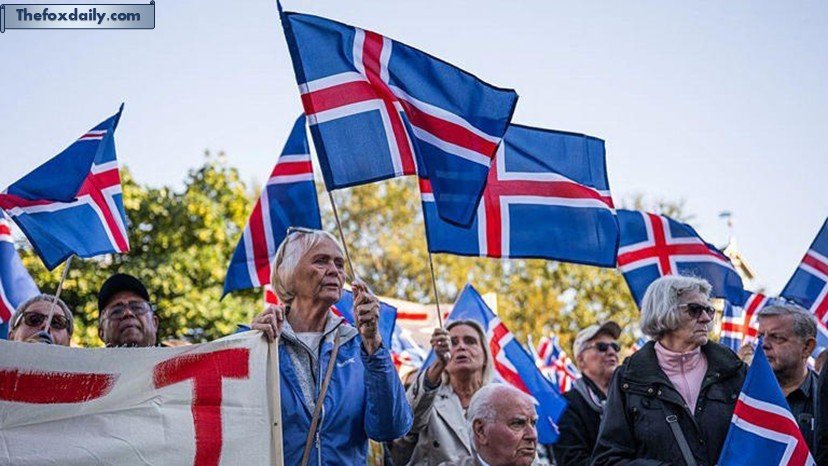
Iceland is holding a closely watched referendum on Saturday on whether the country should restart negotiations to join the European Union, reopening a question that has been largely frozen for more than a decade.
The vote is not a decision on whether Iceland will actually become an EU member. Instead, voters are being asked whether the government should resume accession negotiations with Brussels. A “yes” would reopen a process that began in 2010 and was suspended several years later. A separate referendum would be required if negotiators eventually produced an accession agreement.
What makes the vote particularly significant is the changed geopolitical Environment around Iceland. Concerns about Security in the North Atlantic have intensified following US President Donald Trump’s repeated interest in Greenland, the self-governing territory of Denmark located relatively close to Iceland. The debate has consequently moved beyond the traditional argument over fishing quotas and sovereignty to include a broader question: how should a small North Atlantic country position itself in an increasingly uncertain security environment?
For Iceland, however, closer integration with Europe comes with its own difficult questions. Fishing remains deeply connected to the country’s Economy, national identity and understanding of sovereignty. Joining the EU would require Iceland to participate in areas of EU policy that it currently controls independently, making fisheries one of the most politically sensitive parts of any future negotiations.
What Icelanders are voting on
The referendum is deliberately narrower than a vote on EU membership itself. If voters approve restarting negotiations, Iceland would return to the accession process and begin discussions with the European Union over the conditions under which it could eventually join the bloc.
That distinction is central to the government’s argument. Prime Minister Kristrún Frostadóttir has emphasized that a “yes” vote would not immediately change Iceland’s relationship with the EU. Instead, it would give the government a mandate to negotiate and allow voters to assess the eventual terms before making a final decision.
The European Union’s accession process covers 35 policy areas, ranging from economic and financial matters to environmental policy, justice, competition, agriculture, fisheries and foreign and security policy. Iceland had already made substantial progress in its earlier negotiations before the process was suspended.
European Commission records show that Iceland applied for EU membership in July 2009. The EU agreed to open accession negotiations in 2010, and 27 of the negotiating chapters had been opened before Iceland put the talks on hold in 2013. In March 2015, the Icelandic government formally asked that the country no longer be regarded as an EU candidate.
A successful vote therefore would not mean starting completely from zero. Much of the institutional groundwork from the previous process already exists, although the political and negotiating environment has changed considerably.
Why Greenland has changed the EU debate
Security has become one of the most important new dimensions of Iceland’s EU discussion.
Greenland’s strategic importance has grown as competition in the Arctic and North Atlantic has become more prominent. Trump’s interest in Greenland has unsettled parts of the Icelandic public and prompted questions about whether existing security arrangements can be relied upon in the same way they were in the past.
For some Icelanders, the issue is not that EU membership would provide a simple substitute for existing security arrangements. Rather, it is about whether closer political and economic integration with European countries could give Iceland additional strategic weight at a time when the traditional assumptions surrounding the North Atlantic are being questioned.
Iceland already has important international security relationships, so EU membership would not automatically transform its defence position. The European Union itself is not a replacement for every existing security institution or alliance. But the referendum has nevertheless brought European cooperation into a much wider discussion about Iceland’s place in the region.
That helps explain why an issue that once centred overwhelmingly on fishing and sovereignty is now also being debated through the lens of geopolitical uncertainty.
Iceland already has unusually close ties with the EU
One of the most important facts about the referendum is that Iceland is not choosing between complete independence from Europe and EU membership.
Iceland is already deeply integrated with the European economy. It has been part of the European Economic Area since 1994 and therefore participates in the EU single market despite not being an EU member. It is also part of the Schengen Area and the European Free trade Association.
The European Commission says a significant proportion of EU legislation already applies in Iceland through the EEA framework. Iceland also participates in a range of EU programmes and agencies, although it does not have the voting rights of an EU member state in those institutions. The EU is also an important trading partner, with the European Commission noting that roughly two-thirds of Iceland’s foreign trade is with EU member states.
That arrangement is at the heart of the argument made by opponents of membership. They say Iceland already receives many of the economic benefits of close European integration without transferring additional powers to Brussels.
Supporters see the same relationship differently. They argue that Iceland already follows many European rules but has limited influence over the decisions behind them. Full membership, they say, could give Iceland a formal seat in the EU institutions that shape policies affecting the country.
Fishing remains the biggest obstacle
If security has given the referendum new urgency, fishing remains the issue most likely to determine how difficult actual accession negotiations would become.
Iceland’s fishing industry is much more than an ordinary economic sector. Fishing has shaped the country’s modern history, its relationship with neighbouring states and its conception of national sovereignty.
The memory of the Cod Wars with Britain remains particularly important. During the disputes, Iceland expanded its claimed fishing jurisdiction and confronted British opposition. The conflicts eventually ended with Iceland establishing control over fishing grounds around the country.
That history helps explain why many Icelanders are cautious about transferring control over fisheries policy to a larger political bloc.
The European Union operates a Common Fisheries Policy, while Iceland currently manages its fisheries under its own national system. The European Economic Area agreement does not include the EU’s common agricultural and fisheries policies, making these areas different from many other aspects of Iceland’s relationship with Europe.
Any future accession negotiations would therefore have to address how Iceland’s fisheries would fit within the EU framework. The question is especially sensitive because access to Icelandic waters and management of fish stocks have implications for both domestic fishing communities and other European fishing interests.
The issue is not simply whether Iceland would lose control overnight. The practical details would have to be negotiated, and the final terms would depend on the accession process. But the fishing question is likely to be among the hardest political tests if talks resume.
The fishing dispute is also about sovereignty
The fisheries argument reflects a broader concern about national independence.
Iceland became a sovereign republic in 1944 after ending its union with Denmark. Since then, the ability of the Icelandic state to control its natural resources has become closely associated with national identity.
For opponents of EU membership, maintaining control over fisheries is therefore not simply an economic calculation. It is part of the wider principle that decisions affecting Iceland’s most important natural resources should ultimately remain under Icelandic authority.
Former Prime Minister Katrín Jakobsdóttir has argued that Iceland can remain closely connected to Europe without becoming an EU member. That position reflects a longstanding Icelandic approach: cooperate extensively with European institutions while retaining political independence.
Supporters of reopening talks counter that sovereignty can also mean having a meaningful voice in the institutions that influence a country’s interests. From this perspective, negotiating membership does not necessarily mean abandoning Icelandic independence. Instead, it gives the country an opportunity to determine whether the benefits of membership would outweigh the concessions required.
The economic argument has gained new importance
Economic considerations have also entered the renewed EU debate.
Iceland has its own currency, the króna, rather than the euro. Supporters of closer European integration point to the potential economic advantages of deeper integration and argue that EU membership could eventually create a pathway toward adopting the euro if all required conditions were met.
That argument is particularly relevant because Iceland has experienced periods of financial instability and significant economic pressure in the past. The country’s small, open economy can be sensitive to developments in global markets, exchange rates and domestic interest rates.
Recent reporting has highlighted the gap between Icelandic interest rates and those in the euro area as one factor influencing the domestic debate. But EU membership would not provide an instant solution to Iceland’s economic challenges, and adopting the euro would involve additional conditions and a separate process.
The more immediate economic reality is that Iceland already benefits from access to the European single market through the EEA. The question for voters is therefore whether the additional political influence and potential economic benefits of membership justify the additional obligations that would come with it.
What would happen after a “yes” vote?
A “yes” vote would be the beginning of a process, not the end of one.
Iceland and the EU would have to determine how the accession negotiations should be reopened and which issues require fresh examination. The country’s previous negotiations could provide useful institutional experience, but the talks would still have to reflect current EU rules and Iceland’s present circumstances.
The most difficult areas would likely include fisheries, agriculture, economic and monetary policy, and other fields that are not already fully covered by Iceland’s existing EEA relationship.
There would also be political negotiations over the precise terms of membership. The EU has previously assessed Iceland as highly prepared in many areas because of its extensive integration with the European single market. At the same time, earlier EU assessments identified fisheries, agriculture, environmental matters, financial services and other areas as requiring particular attention during accession.
Eventually, if an accession agreement were reached, Icelandic voters would have another opportunity to decide whether to accept it. That makes Saturday’s referendum an important but preliminary step.
What would a “no” vote mean?
A rejection would preserve Iceland’s current relationship with the European Union and keep the country outside the membership process.
Iceland would remain part of the EEA and Schengen arrangements while continuing to manage fisheries and other areas of national policy outside the EU framework.
Politically, however, a “no” vote would likely send a strong message about the importance Icelanders place on sovereignty and control over natural resources. It could also indicate that recent security concerns have not been strong enough to overcome resistance to EU membership.
Because the referendum concerns restarting negotiations rather than final membership, its political significance could be larger than its immediate legal effect. A rejection could push the EU question back into the background for years, while an approval would place it at the centre of Icelandic Politics again.
Iceland’s relationship with Europe is more complicated than “in or out”
The referendum is sometimes presented as a straightforward choice between the EU and independence. Iceland’s existing arrangements show why that description is incomplete.
The country already participates in the European single market, cooperates with the EU in numerous policy areas and shares the Schengen travel area. At the same time, it remains outside the EU’s political institutions and retains control over important national policies, particularly fisheries.
That makes Saturday’s decision less about whether Iceland should cooperate with Europe and more about how far that cooperation should go.
The distinction matters because either outcome leaves Iceland closely connected to Europe. A “yes” would begin a debate over whether those existing ties should evolve into full political membership. A “no” would preserve the current model, in which Iceland accepts extensive European economic integration while maintaining greater formal independence from EU decision-making.
Why the result matters beyond Iceland
The outcome will be watched beyond Reykjavik because Iceland occupies a strategically important position between North America and Europe.
For the European Union, renewed Icelandic accession talks would add another layer to its relationship with the North Atlantic and Arctic regions. The European Commission has previously highlighted Iceland’s geographical importance for the EU’s Arctic policy and its role in regional fisheries management.
For Iceland, the question is more immediate. The country must balance several interests that do not always point in the same direction: economic access to Europe, control over natural resources, national sovereignty and security cooperation in a changing North Atlantic.
The Greenland issue has made that balancing act more visible. What was once largely an argument about fishing policy has become a broader conversation about how a small state should respond when assumptions about the international order begin to change.
What to watch after the referendum
The most important point for voters and observers is that Saturday’s result will not settle the EU membership question by itself.
If negotiations are approved, the next stage will be to establish the framework for talks and identify the issues requiring agreement. Fisheries will almost certainly remain one of the most closely watched subjects. The government would also have to manage domestic expectations, because agreeing to negotiate does not guarantee that Iceland will ultimately accept the conditions offered.
If voters reject the proposal, the government will instead have to continue working within Iceland’s existing European arrangements while addressing the security and economic concerns that helped bring the referendum forward.
Either way, the vote represents a significant change from the political environment of the mid-2010s, when Iceland formally stepped away from its EU candidacy.
The central question is no longer simply whether Iceland wants to join Europe. Iceland is already deeply connected to Europe. The harder question is whether, in an era of greater geopolitical uncertainty, Icelanders believe those existing ties are enough, or whether they want to take the next step toward full European Union membership while protecting the interests they consider uniquely Icelandic.
For breaking news and live news updates, like us on Facebook or follow us on Twitter and Instagram. Read more on Latest World on thefoxdaily.com.






COMMENTS 0