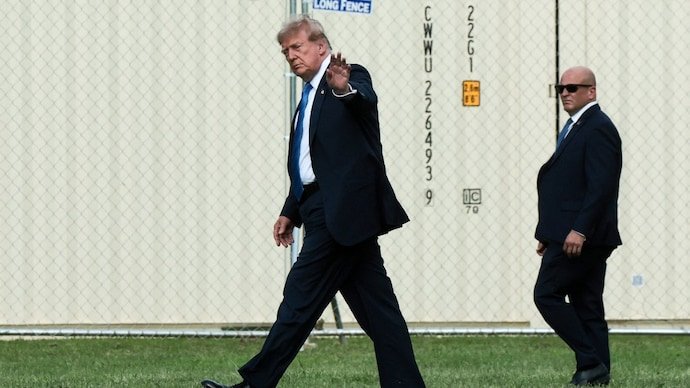
US President Donald Trump has announced what he described as an unprecedented agreement aimed at giving American interests greater control over a substantial portion of Venezuela’s enormous oil reserves, potentially reshaping the relationship between Washington and Caracas and the future of Venezuela’s Energy industry.
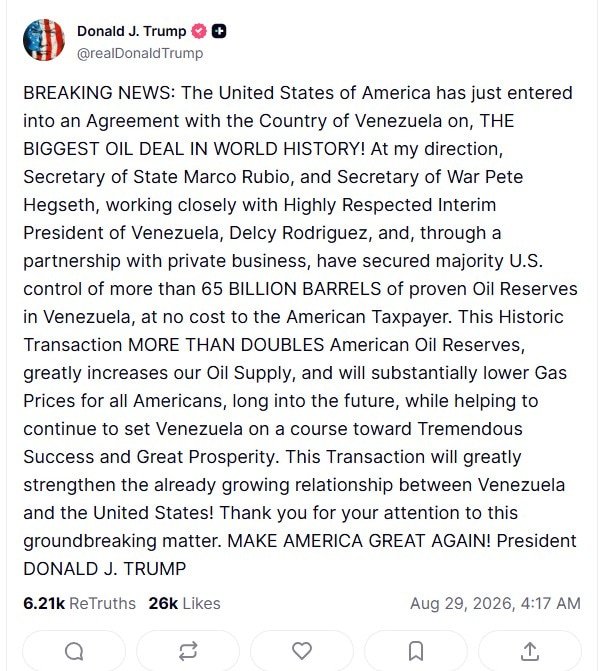
Trump said on Friday that the arrangement would give the United States access to a majority share of more than 65 billion barrels of Venezuela’s proven oil reserves through partnerships with private companies. He said the agreement had been negotiated over several weeks between Washington, Venezuelan officials and businesses and would not require direct spending by American taxpayers.
The announcement comes as Venezuela prepares to sign new agreements granting exploration and production rights to oil companies, with US firms expected to play a prominent role. If implemented, the plan could represent one of the most significant attempts yet to bring American capital and expertise back into Venezuela’s oil industry after years of declining production, underinvestment and sanctions.
But major questions remain unanswered. Trump has not publicly explained exactly how the United States would exercise “majority control” over the reserves, which oilfields would be included, which companies would participate or how the arrangement would comply with Venezuelan law.
Those details are critical because Venezuela’s constitution and hydrocarbons legislation give the state a central role in the country’s petroleum resources. A proposed leasing or auction system could therefore face legal and political challenges before it becomes operational.
What Trump says the Venezuela oil deal will do
Trump described the agreement as a partnership involving the US government, Venezuela and private companies. He credited Secretary of State Marco Rubio and Secretary of War Pete Hegseth with helping negotiate the arrangement alongside Venezuelan interim President Delcy Rodriguez and private-sector participants.
In his announcement, Trump presented the deal primarily as an energy and economic opportunity. The United States would gain access to Venezuela’s huge reserves, while American companies would receive opportunities to invest in oil exploration, production and related infrastructure.
The announcement did not provide a complete contractual framework. There was no detailed public explanation of whether “control” refers to production rights, operating rights, ownership interests, long-term leases or another arrangement.
That distinction matters enormously in the oil industry. Having access to reserves is not the same as owning the reserves, and controlling production from an oilfield is different from having legal ownership of the underlying resource.
For now, the precise economic and legal meaning of the proposed US role remains uncertain.
Why Venezuela’s oil reserves matter
Venezuela possesses the world’s largest proven crude oil reserves, giving it an energy resource base that is potentially transformative for the country’s economy.
Yet the size of those reserves has not translated into comparable levels of production.
Venezuelan oil output has fallen dramatically from historical levels because of years of underinvestment, operational problems, economic mismanagement, infrastructure deterioration and international sanctions. The country’s crude is also generally heavy and requires specialized processing and transportation infrastructure.
The result is an unusual situation: Venezuela has enormous quantities of oil underground but lacks the production capacity needed to fully exploit them.
That gap is one of the main reasons the proposed agreement could be attractive to US energy companies. American producers and service companies could potentially provide capital, Technology, equipment and operational expertise while gaining access to one of the world’s largest hydrocarbon resource bases.
The proposed agreements could give US oil companies a larger role
Venezuelan officials are preparing to sign agreements that would grant new exploration and production rights to several companies, particularly firms from the United States.
Earlier discussions had reportedly considered a lease-based model under which Venezuelan oilfields could be offered to US producers. Such a system could allow private companies to invest directly in fields while providing Venezuela with revenue through contractual arrangements.
However, the legal structure is likely to be one of the most sensitive parts of the plan.
Venezuela’s hydrocarbons framework places important petroleum activities under state control. Any agreement that appears to transfer extensive control over oilfields to foreign companies would therefore need to fit within existing laws or be supported by appropriate legal changes.
That is why the difference between a production contract and a transfer of ownership is crucial. A foreign company can potentially operate or invest in a field without receiving ownership of the country’s underlying natural resources.
Until the contracts are published, it is difficult to determine how the proposed US control would work in practice.
Why Venezuela needs massive oil investment
Venezuela’s oil industry has suffered from years of inadequate investment and declining infrastructure.
Producing crude at scale requires much more than access to underground reserves. Oilfields need drilling equipment, pipelines, storage facilities, processing plants, electricity, maintenance and skilled workers. Venezuela’s heavy crude also requires suitable refineries and blending systems.
Restoring production capacity can therefore take years and require billions of dollars in investment.
That is one reason the proposed agreement should not be interpreted as meaning that tens of billions of barrels will suddenly enter global markets.
The reserves already exist, but extracting them economically is a separate challenge. Production depends on the condition of individual fields, the availability of equipment, investment terms, infrastructure and the ability of companies to operate reliably over long periods.
Venezuela’s current production is estimated at around 1.25 million barrels per day, substantially below what the country’s resource base might support under different investment and operating conditions.
Increasing output could eventually make Venezuela a more important supplier to global markets, but rebuilding the industry would be a gradual process rather than an immediate supply shock.
Could the deal lower US gasoline prices?
Trump administration officials have linked greater access to Venezuelan crude with the possibility of lower energy costs for American consumers.
Secretary of State Marco Rubio has argued that the arrangement could provide the United States with a stable source of relatively low-cost oil while encouraging investment in Venezuela.
Rubio has also said Venezuela could receive close to $100 billion in private investment, potentially creating thousands of jobs and helping rebuild the country’s economy.
Those potential benefits are significant, but the relationship between Venezuelan production and US gasoline prices is not straightforward.
Gasoline prices are influenced by global crude oil prices, refinery capacity, transportation costs, seasonal demand, inventories, taxes and geopolitical developments. Increasing Venezuelan production would add supply to the market, but the effect on prices would depend on how much additional crude actually reaches consumers and how quickly production rises.
There is another complication: much of Venezuela’s crude is heavy and requires refineries capable of processing it efficiently. Some US Gulf Coast refineries have historically been configured to handle heavier grades of crude, which could make Venezuelan supplies particularly relevant to the US refining system.
Even so, rebuilding Venezuelan production capacity would take time. Any significant impact on gasoline prices would therefore depend on sustained increases in production rather than the announcement of a new investment agreement alone.
Why the legal questions could determine the deal’s future
The biggest uncertainty surrounding the proposed arrangement may not be the amount of oil involved but the legal structure behind it.
Venezuela’s legal system treats hydrocarbons as a strategic national resource, with the state retaining substantial control over the sector. A lease or auction system that gives foreign companies extensive authority over oilfields could therefore face scrutiny under the country’s constitution and petroleum laws.
The question is particularly important because a long-term investment agreement needs legal stability. Oil companies can spend billions of dollars developing a field, building infrastructure and maintaining production facilities. Investors therefore need confidence that contracts will remain valid through political and economic changes.
For the US government, the issue is equally important. If Washington is supporting or facilitating a major energy agreement, the legal basis for the arrangement must be clear enough to withstand challenges from Venezuelan institutions, political opponents or future governments.
Without the final contracts, it is impossible to determine whether those concerns have been resolved.
Trump’s strategy goes beyond oil production
The proposed deal also reflects a broader US effort to reshape Venezuela’s economic relationship with Washington.
For years, American policy toward Venezuela has combined sanctions, political pressure and restrictions on investment. The new approach places greater emphasis on bringing private capital into the country’s energy sector and using oil production as a foundation for economic recovery.
Oil is central to that strategy because it is Venezuela’s most valuable natural resource and one of the few sectors capable of generating large-scale foreign investment relatively quickly if operating conditions improve.
For Washington, increased Venezuelan production could also diversify crude supplies available to US refiners. For Caracas, American investment could provide access to financing, equipment and expertise that have been difficult to obtain in sufficient quantities.
The two sides therefore have potentially overlapping economic interests, even though political and legal disagreements remain.
The role of American oil companies will be crucial
The success of the plan will ultimately depend heavily on private companies.
Oil producers will have to determine whether individual Venezuelan fields are commercially viable under the proposed contracts. That assessment would include expected production costs, infrastructure requirements, crude quality, Security risks, taxation, contract terms and the ability to repatriate profits.
Companies may also need to invest in facilities that are not directly related to drilling. Pipelines, storage terminals, power systems and upgrading infrastructure could all require substantial capital.
That means the headline figure associated with Venezuela’s reserves should not be confused with the amount of money that can immediately be invested or earned.
A reserve becomes economically valuable only when companies can extract it at a competitive cost and transport it to a market.
Venezuela could gain economically, but rebuilding will take time
For Venezuela, increased foreign investment could offer a pathway toward higher oil production and greater government revenues.
Higher production could support employment, infrastructure spending and broader economic activity. Rubio’s projection of nearly $100 billion in private investment illustrates the scale of economic transformation the administration hopes to encourage.
But Venezuela would also need to manage the risks associated with renewed dependence on oil.
The country has historically relied heavily on petroleum revenues, making the economy vulnerable to fluctuations in global oil prices. A sustainable recovery would therefore require not only rebuilding production but also strengthening institutions and creating conditions for investment beyond the oil sector.
There is also the question of how oil revenues would be distributed and used. Increased production can generate substantial income, but the economic impact depends on government fiscal policy, investment decisions and the terms negotiated with private companies.
Why the deal may not immediately change global oil markets
The scale of Venezuela’s reserves can make the announcement sound like an immediate transformation of global energy supply. The reality is more complicated.
Oil reserves are measured over long periods, while production is measured in barrels per day. A country can possess enormous reserves without being able to produce them quickly.
Venezuela’s current infrastructure limitations mean that increasing output would require significant investment. Heavy crude also presents additional technical and refining challenges.
Even if US companies receive new production rights, they would still need to assess fields individually, repair infrastructure, drill new wells where necessary and establish reliable export routes.
As a result, the most immediate impact of the agreement could be financial and strategic rather than a sudden increase in global oil supply.
What could happen next?
The next major development will be the signing and publication of the proposed oil agreements.
Those documents should clarify which companies receive exploration and production rights, what fields are involved, how long the agreements will last and what obligations Venezuela and the companies will assume.
They could also reveal whether the US role described by Trump means operational control, investment control, production rights or another contractual arrangement.
The legal response inside Venezuela will also be important. If opponents argue that the agreements violate constitutional or hydrocarbons provisions, the issue could move into a broader political or judicial dispute.
For investors, the critical question will be whether Venezuela can provide a sufficiently stable Environment for long-term capital investment. For the US government, the test will be whether the agreement can simultaneously increase oil supply, support American companies and advance Washington’s wider strategic goals.
The biggest issue is not the oil underground, but the ability to produce it
Trump’s announcement puts Venezuela’s extraordinary oil reserves back at the centre of international energy Politics.
The figure of more than 65 billion barrels highlights the enormous resource potential involved, but reserves alone cannot guarantee cheaper gasoline, higher production or immediate economic recovery.
The real test will come when contracts are signed, investments begin and companies attempt to restore production in an industry weakened by years of underinvestment and operational problems.
If the proposed agreements survive legal scrutiny and attract large-scale private investment, Venezuela could gradually become a more significant crude supplier while US companies gain a substantial presence in the country’s energy sector.
If the legal framework proves uncertain or the investment environment remains difficult, the ambitious plans could take much longer to deliver results.
For now, the announcement marks a potentially major shift in US-Venezuela energy relations. The size of the reserves makes the opportunity enormous, but turning that underground resource into reliable production will depend on contracts, capital, infrastructure and political stability. The details of those agreements, rather than the headline number of barrels, will ultimately determine whether Trump’s “biggest oil deal” becomes a lasting transformation of Venezuela’s petroleum industry.
For breaking news and live news updates, like us on Facebook or follow us on Twitter and Instagram. Read more on Latest World on thefoxdaily.com.





COMMENTS 0