Iran may have been offered an unexpected place inside a defence framework created by three countries with very different relationships with Tehran.
An Iranian official has reportedly said that Iran received an invitation to join the Mecca Joint Defence Agreement, the security pact signed by Saudi Arabia, Pakistan and Türkiye on August 7. The claim has not been officially confirmed by Iran, Saudi Arabia, Pakistan or Türkiye, making the reported invitation a development to watch rather than an established change in the region’s security architecture.
The report, carried by Al Mayadeen, cited Mehdi Rahimi, head of Iran’s parliamentary Khaneh Mellat news agency. Rahimi reportedly said the invitation was under review and described the emergence of a regional security framework as consistent with Iran’s longstanding call for regional countries to take greater responsibility for their own security.
The timing makes the report particularly significant. The Mecca Pact was signed as the Middle East faces an unusually volatile security environment, while Yemen’s Iran-aligned Houthi movement has continued to threaten Saudi interests. On August 20, the Houthis claimed drone attacks targeting sites in Saudi Arabia’s Najran region, including an Aramco facility and the airport, although Saudi authorities had not confirmed the claims at the time of the report.
If Iran were actually to join the framework, it would represent a remarkable shift. Saudi Arabia and Iran spent years competing for regional influence, including through opposing sides of the Yemen conflict. Yet the two countries also restored diplomatic relations in 2023, creating a channel that has survived despite subsequent crises.
What is the Mecca Joint Defence Agreement?
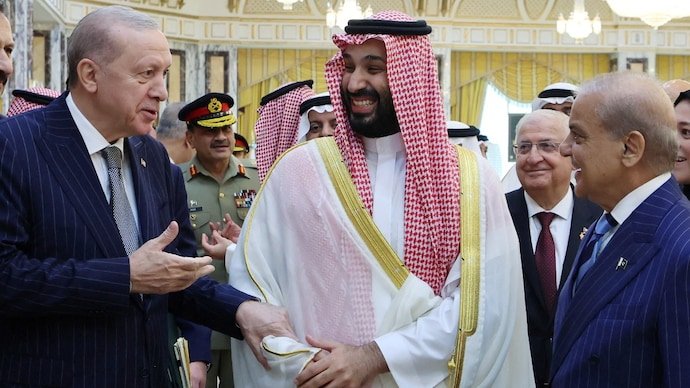
The Mecca Joint Defence Agreement was signed in Makkah on August 7 by Saudi Crown Prince and Prime Minister Mohammed bin Salman, Turkish President Recep Tayyip Erdoğan and Pakistani Prime Minister Shehbaz Sharif.
The central provision is straightforward: an armed attack against one of the three countries is to be regarded as an attack against all three. The agreement also calls for broader defence cooperation and stronger collective deterrence.
Saudi Arabia, Pakistan and Türkiye have presented the agreement as a defensive arrangement intended to strengthen regional security rather than as a pact directed against a named adversary. Pakistan’s Foreign Ministry has likewise described it as defensive in nature and linked it to the countries’ right to individual and collective self-defence.
That distinction matters because the pact does not publicly identify Iran as an enemy.
Yet the agreement was created against the backdrop of a wider regional confrontation involving Iran, Gulf states, Israel, the United States and Iran-aligned armed groups. Consequently, its strategic meaning cannot be separated entirely from the security environment in which it was signed.
Is the Mecca Pact an Arab or Sunni NATO?
The comparison with NATO has already entered the public discussion because of the agreement’s mutual-defence language. But the comparison should be treated cautiously.
NATO has decades of institutional development, an integrated military structure and extensive mechanisms for planning and coordinating collective defence. The Mecca agreement is a much newer framework involving three states with different strategic priorities and existing relationships with other military alliances.
Its immediate importance is therefore political and strategic as much as military. Saudi Arabia brings its economic weight and central position in the Gulf and Muslim world. Türkiye contributes a large military establishment and a significant defence industry. Pakistan brings longstanding military ties with Saudi Arabia and extensive experience in regional security affairs.
The agreement creates a mechanism through which those relationships can be deepened, but its ultimate strength will depend on how the three governments interpret and implement their mutual-defence commitment during an actual crisis.
Why would Iran’s possible invitation be so significant?
Iran joining the Mecca framework would turn the logic of the agreement on its head.
Instead of functioning primarily as a security grouping among countries concerned about regional instability, the framework could potentially become a broader platform that includes one of the region’s principal strategic powers.
Iran has traditionally argued that Gulf and Middle Eastern security should be managed by regional states rather than primarily by outside powers. That position has been consistent with Tehran’s broader criticism of American military involvement in the region.
Iranian Foreign Ministry spokesman Esmaeil Baghaei offered a notably restrained response to the Mecca Pact on August 10. He said Tehran had no reason to be concerned about the agreement and described it as evidence that regional countries were changing their approach to security and relying more on their own capabilities.
That statement does not confirm that Iran was invited to join. But it does show that Tehran has not publicly treated the new pact as an inherently hostile development.
That distinction is important. Iran can welcome the idea of regional security cooperation without agreeing with every strategic objective of Saudi Arabia, Türkiye or Pakistan.
The Saudi-Iran rivalry makes membership difficult to imagine
The biggest obstacle would be the relationship between Tehran and Riyadh.
Saudi Arabia and Iran have long been major competitors for political and strategic influence across the Middle East. Their rivalry has been particularly visible in Yemen, where Saudi Arabia has backed forces opposed to the Iran-aligned Houthi movement.
The relationship improved significantly in 2023, when Saudi Arabia and Iran agreed in Beijing to restore diplomatic relations and reopen their diplomatic missions. China brokered the agreement, which also reaffirmed principles including respect for sovereignty and non-interference.
The rapprochement was one of the region’s most important diplomatic developments in years. It did not eliminate the underlying strategic differences between the two governments, but it created a framework for managing them without direct diplomatic rupture.
Any Iranian role in the Mecca Pact would take that process much further.
It would require Saudi Arabia and Iran to treat at least some aspects of regional security as a shared interest rather than an arena for competition. That would be a much more ambitious step than restoring diplomatic relations.
Then there is the Houthi question
Yemen could become the hardest test of any attempt to bring Iran closer to a Saudi-led security arrangement.
The Houthis, formally known as Ansar Allah, are an Iran-aligned movement that has fought Saudi-backed forces during Yemen’s prolonged conflict. Their military capabilities have included missiles and drones, and attacks involving the group have repeatedly raised concerns about Saudi territory, energy infrastructure and shipping routes.
The latest reported escalation adds immediate relevance to the question. On August 20, the Houthis claimed drone strikes against targets in Saudi Arabia’s Najran region. The group said it targeted Najran airport and an Aramco facility. Saudi authorities had not confirmed the claims in the reporting available at the time.
This creates an obvious contradiction for the idea of Iranian participation in a pact with Saudi Arabia.
If the Mecca Agreement treats an attack on one member as an attack on all, what would happen if Saudi Arabia were attacked by a group aligned with Iran? Would Iran be expected to support Saudi Arabia’s defence? Would membership require Tehran to restrain or distance itself from the Houthis? Or could the pact establish a political framework that deliberately avoids such questions?
Those are not minor technicalities. They would go directly to the credibility of the agreement.
Iran’s relationship with the Houthis complicates everything
Tehran’s relationship with the Houthis is another reason an Iranian invitation would need to be interpreted carefully.
Iran has backed the Houthi movement, but describing the group simply as an Iranian proxy can obscure the complexity of Yemen’s internal Politics. The Houthis have their own leadership, interests and domestic political agenda, even as Iran provides important political and military support.
For Saudi Arabia, however, the distinction is less reassuring when missiles or drones linked to the Houthis threaten its territory.
A regional security pact involving both Saudi Arabia and Iran would therefore need to address not only direct state-to-state conflict but also the problem of armed groups operating across national borders.
This is where a potential Iranian membership would face its most difficult test: whether regional security cooperation can move beyond declarations and produce mechanisms for preventing escalation through partners and allied groups.
Why Saudi Arabia might see value in a wider framework
Saudi Arabia has strong reasons to diversify its security relationships.
The kingdom has historically relied heavily on security cooperation with the United States. But the region’s repeated conflicts have encouraged Gulf states to develop additional diplomatic and defence partnerships.
The Mecca Pact brings together Saudi Arabia with Türkiye and Pakistan, two states with significant military capabilities and established relationships with Riyadh.
Adding Iran, even in some limited form, could potentially give the arrangement a different purpose. Instead of becoming another bloc in a divided Middle East, it could evolve into a regional mechanism for managing disputes among major Muslim countries.
But this would also create serious strategic questions for Riyadh. Saudi Arabia would need confidence that Iranian participation strengthened rather than weakened its security commitments.
The credibility of collective defence depends on trust. That is precisely what remains limited between Saudi Arabia and Iran despite their diplomatic rapprochement.
Pakistan and Türkiye could become important bridges
The presence of Pakistan and Türkiye gives the Mecca framework another dimension.
Both countries maintain relationships with Iran as well as Saudi Arabia. That gives them potential diplomatic value if the three-member arrangement eventually seeks to expand.
Pakistan in particular has historically maintained close defence ties with Saudi Arabia while also sharing a border and longstanding diplomatic relationship with Iran. Türkiye, meanwhile, has repeatedly sought an independent regional role and maintains working relationships with both Tehran and Riyadh.
Neither country’s participation means that Iranian membership is inevitable. But both could theoretically provide channels through which regional security discussions become broader rather than more polarised.
What Iran’s reported invitation does not mean
The most important fact at this stage is that the invitation remains unconfirmed.
That means the report should not be treated as evidence that Iran has decided to join the Mecca Pact, that Saudi Arabia has formally offered membership, or that a four-country military alliance is already taking shape.
There is also a major difference between being invited to participate in a regional security dialogue and becoming a full member of a mutual-defence agreement.
Iran’s reported interest, if accurately described, could therefore point to several possibilities. It might involve exploratory discussions, political consultations, an invitation to a broader regional security mechanism or consideration of some future form of participation rather than immediate accession to the mutual-defence commitment.
Until the governments involved issue formal statements, the precise nature of the reported offer remains unclear.
Could the Mecca Pact become a broader Middle East security system?
That is perhaps the most interesting question behind the report.
The agreement was initially signed by three countries, but discussions about a wider framework have already generated speculation about additional participants. Egypt has been mentioned as a possible future participant, while Bangladesh has indicated openness to economic or defence cooperation involving the three founding states, depending on its own interests.
Expansion would change the character of the pact.
A small mutual-defence arrangement can concentrate on military coordination among a limited number of governments. A broader regional framework would have to accommodate countries with different relationships with Iran, Israel, the United States, China and Russia.
That could make the framework more politically inclusive, but also harder to operate.
The biggest test will be whether the pact can prevent escalation
The Mecca Agreement’s real significance will ultimately be determined by what happens during the next major regional crisis.
If the pact remains a mechanism for military coordination and deterrence among Saudi Arabia, Türkiye and Pakistan, its immediate role will be relatively clear. If it expands to include countries such as Iran, however, it could become something much more ambitious: an attempt by regional powers to construct a security system that does not depend entirely on external military guarantees.
Iran’s reported invitation, if confirmed, would be an extraordinary development in that process.
It would not erase the Saudi-Iran rivalry, resolve the Yemen war or settle disputes over regional influence. Nor would membership automatically mean that Tehran and Riyadh agree on Israel, the United States, Yemen or the future balance of power in the Gulf.
But it could create a channel for those disagreements to be managed inside a regional framework rather than through competing security blocs.
What happens next?
The next key development will be an official clarification from the governments involved. Confirmation of an Iranian invitation would be significant on its own. Details about the terms of any proposed participation would matter even more.
Several questions would then become central: Would Iran become a full member? Would the mutual-defence clause apply to Tehran? What obligations would Iran accept toward Saudi Arabia? How would the pact address the Houthis? And would the agreement remain defensive if new attacks occurred between Iran and Gulf states?
For now, the most defensible conclusion is narrower.
Iran has not publicly rejected the Mecca Pact. Saudi Arabia, Pakistan and Türkiye have created a new collective-defence framework without naming Iran as an enemy. At the same time, the security environment around the Gulf remains highly unstable, with Houthi attacks and the broader Iran-related conflict keeping regional governments on alert.
If the reported invitation is confirmed, it could signal that the Mecca Pact is being considered not merely as a military alliance, but as the foundation for a wider regional security architecture. Whether Saudi Arabia and Iran can turn their fragile diplomatic rapprochement into meaningful security cooperation would then become one of the most consequential questions in the Middle East.
For breaking news and live news updates, like us on Facebook or follow us on Twitter and Instagram. Read more on Latest World on thefoxdaily.com.



COMMENTS 0