The White House has unveiled a new US-backed arrangement aimed at rebuilding Venezuela’s Oil Industry, creating a private joint venture with North American Blue Energy Partners that would give the Pentagon a substantial ownership stake linked to some of the country’s largest proven petroleum reserves.
The agreement marks a significant expansion of President Donald Trump’s push to gain greater access to Venezuela’s oil resources following the US military operation that captured then-President Nicolás Maduro in January on federal narcoterrorism and drug-trafficking charges.
Under the arrangement, North American Blue Energy Partners, or NABEP, will receive long-term rights covering 17 Venezuelan oil fields. The White House said those fields contain about 65 billion barrels of proven reserves, while many were previously controlled by Russian or Chinese companies.
The administration has portrayed the agreement as a major opportunity to rebuild Venezuela’s position as an important oil producer in the Western Hemisphere. Trump has gone further, describing it as the biggest oil deal in history.
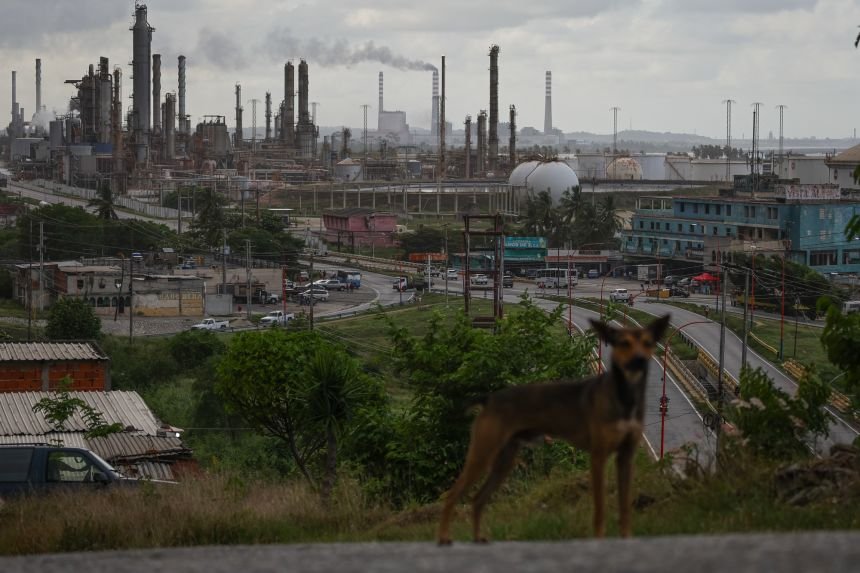
Yet the size of Venezuela’s reserves does not automatically translate into rapid increases in oil production. Years of underinvestment, deteriorating infrastructure and political instability have left the country’s petroleum sector facing substantial operational challenges.
The agreement therefore represents both an enormous commercial opportunity and a complicated political gamble.
What the new Venezuela oil deal actually does
The arrangement creates a US-backed private company through a joint venture between the American side and NABEP, which is owned by Venezuelan businessman Alejandro Betancourt.
NABEP already operates extensively in Venezuela and is described by the White House as the country’s second-largest oil operator after Chevron.
The company is being granted 100-year rights over 17 oil fields under an arrangement involving Venezuela’s acting President Delcy Rodríguez.
The fields reportedly contain 65 billion barrels of proven reserves. That figure is significant because Venezuela possesses the world’s largest proven crude oil reserves, although its ability to convert those resources into sustained production has historically been constrained by infrastructure, investment and political problems.
The deal is consequently not simply about ownership of oil underground. Its success will depend on whether the companies involved can restore wells, rebuild infrastructure, attract capital and establish reliable production and export operations.
Why the Pentagon is getting a 35% stake
One of the most unusual elements of the arrangement is the role assigned to the US Department of Defense.
The White House said the Pentagon will receive a 35 per cent ownership stake in the new company.
The State Department, meanwhile, will receive a guarantee to purchase 20 per cent of the venture’s oil output at cost.
This gives the US government a direct financial and strategic interest in the venture rather than leaving the project entirely in private hands.
The administration has said the arrangement will come at zero cost to the United States. It also said the government will have veto power over board members, with most directors expected to be US citizens.
The structure effectively combines private capital with significant US government oversight.
NABEP promises $100 billion in new infrastructure
The size of the proposed investment is another defining feature of the agreement.
According to the White House, Betancourt’s company has committed to investing $100 billion in new oil infrastructure.
Such spending would be aimed at rebuilding and expanding the physical infrastructure required to turn Venezuela’s enormous reserves into commercially viable production.
Oil production depends on far more than drilling wells. Producers require functioning pipelines, storage facilities, processing plants, electricity, transportation networks and export terminals.
Years of economic and political turmoil have damaged Venezuela’s energy infrastructure and reduced the country’s ability to maintain production at the levels once associated with its vast resource base.
That makes infrastructure investment central to the administration’s ambitions.
Why Venezuela’s huge oil reserves are difficult to exploit
Venezuela’s enormous reserves have long been viewed as one of its greatest economic advantages. But reserves are not the same as production.
A barrel of oil counted as a proven reserve can remain underground for years if the technical, financial or political conditions required to extract it are not in place.
Venezuela’s oil industry has faced prolonged difficulties, including deteriorating infrastructure and a shortage of sustained investment. The result has been a large gap between the country’s geological potential and its actual output.
That gap is the central challenge facing the new US-backed venture.
Even if billions of dollars become available, rebuilding a complex oil industry takes time. Equipment has to be repaired or replaced, fields have to be assessed, workers and contractors have to be mobilised, and transportation and export systems must operate reliably.
For that reason, analysts have expressed scepticism about how quickly Venezuela could return to significantly higher production.
Trump wants Venezuela to become a major oil producer again
Trump has made increased Venezuelan oil production a central element of his policy toward the country.
Since the January military operation that removed Maduro from power, the administration has sought to reshape Venezuela’s oil industry and bring greater US influence over its resources.
The White House sees the country’s petroleum reserves as an opportunity to strengthen energy production in the Western Hemisphere while reducing the influence previously exercised by Russian and Chinese interests in parts of Venezuela’s energy sector.
The new agreement is therefore broader than a conventional oil investment.
It links energy production to US foreign policy, national Security and Venezuela’s political transition.
Russia and China are part of the strategic equation
The White House said many of the 17 oil fields covered by the agreement were previously owned by Russian or Chinese firms.
That detail gives the arrangement a geopolitical dimension.
Venezuela has historically maintained close relationships with both Russia and china, including significant economic and energy ties. A restructuring of the oil industry that shifts ownership or operational control toward US-backed interests could therefore represent a major change in the country’s economic orientation.
For Washington, increasing US involvement could strengthen its influence over one of the largest oil-producing countries in the Americas.
For investors, however, the same political dimension introduces additional uncertainty. Oil projects with long investment horizons are particularly sensitive to changes in governments, laws and foreign-policy relationships.
Why the 100-year oil rights are significant
The proposed 100-year rights over the 17 oil fields stand out because of their extraordinary duration.
Long-term rights can give investors the confidence needed to commit large sums to infrastructure. Oil projects often require substantial upfront capital, and companies need a sufficiently long period over which to recover those investments and generate returns.
But a century-long arrangement also creates political questions.
Future Venezuelan governments may have different views about foreign ownership and resource policy. Future US administrations could also adopt different approaches to Venezuela.
That creates a fundamental tension within the agreement: the longer the contract, the greater the number of political changes that could occur during its lifetime.
Political risk could become the deal’s biggest challenge
Former US government energy advisers have warned that the agreement carries political risk.
Future administrations in Venezuela or the United States could attempt to challenge or renegotiate the arrangement.
That concern is particularly relevant because the agreement is being established during a period of major political upheaval in Venezuela.
The White House has attempted to address some of the uncertainty by specifying that the agreement with NABEP is governed by US law and subject to the jurisdiction of US courts.
The administration also said NABEP will use US auditors, lawyers and advisers.
Those provisions may strengthen the legal framework surrounding the venture, but they cannot entirely eliminate political risk. A future Venezuelan government could still challenge the underlying arrangements or seek changes to the country’s resource policy.
What “zero cost” to the US government means in practice
The White House has described the arrangement as coming at “zero cost” to the US.
That does not mean the venture requires no capital. Rather, the administration’s position is that the US government will not have to finance the project directly in the manner of a conventional taxpayer-funded infrastructure programme.
The proposed $100 billion investment is attributed to NABEP, while the US government receives an ownership position and other rights within the structure.
The distinction matters because the economic risk of rebuilding Venezuela’s oil sector will still need to be borne by the companies and investors providing the capital.
If production recovers strongly, the venture could generate substantial value. If redevelopment takes much longer or costs more than expected, investors could face significant financial exposure.
The State Department’s oil guarantee adds another layer
The State Department’s role also deserves attention.
Under the arrangement, it will receive a guarantee to purchase 20 per cent of the company’s output at cost.
Such an arrangement could provide an element of certainty around part of the venture’s future production. For an oil project undergoing redevelopment, having a guaranteed buyer can help reduce some of the uncertainty surrounding market access.
But the arrangement also highlights the strategic nature of the project. The US government is not simply regulating or supervising an oil company; it is taking a direct role in the commercial structure surrounding production.
Why Venezuela’s oil recovery could take years
The biggest gap between the political rhetoric surrounding the deal and its practical implementation is time.
Trump has presented Venezuela’s reserves as an enormous opportunity, but transforming reserves into production is a lengthy process.
Oil fields that have suffered years of inadequate maintenance cannot necessarily return to high production immediately. Existing wells need evaluation, damaged equipment needs replacement and supporting infrastructure must be restored.
Some fields may also require advanced recovery techniques and substantial investment before they can operate efficiently.
The result is that the headline figure of 65 billion barrels should not be interpreted as 65 billion barrels of immediately available production.
The reserves indicate the potential scale of the resource base. The actual economic outcome will depend on how efficiently the venture can develop it.
Venezuela’s oil sector is bigger than one company
The agreement also needs to be viewed within the broader structure of Venezuela’s energy industry.
Chevron has remained an important foreign operator in Venezuela, making the US-backed NABEP venture part of a wider landscape rather than a standalone project.
The emergence of another major US-linked operator could increase competition for labour, equipment, contractors and infrastructure.
It could also encourage additional investment if the project succeeds and demonstrates that large-scale operations can be conducted under the new political and legal framework.
On the other hand, rapid expansion could expose bottlenecks if Venezuela lacks sufficient infrastructure and skilled personnel to support multiple large projects simultaneously.
What the deal means for global oil markets
If the venture eventually succeeds in raising Venezuelan production substantially, the additional supply could become relevant to international oil markets.
More Venezuelan crude reaching global markets could increase the availability of heavy oil and strengthen the country’s role as a supplier to refiners capable of processing its grades of crude.
However, the effect would not be immediate.
The investment, infrastructure construction and field redevelopment required before production can increase substantially mean that the project is better understood as a long-term supply strategy than as a quick response to oil-market conditions.
That distinction is important because oil prices are influenced by many factors, including global demand, production decisions by major exporters, geopolitical disruptions and inventory levels.
A new model for US involvement in Venezuela’s oil industry
The most consequential aspect of the agreement may ultimately be its structure.
Instead of relying solely on conventional private-sector investment, the arrangement combines a US-backed corporate venture, government ownership, guaranteed access to a portion of production and extensive political oversight.
The Pentagon’s 35 per cent stake makes the model particularly unusual.
The White House is effectively linking energy development with US strategic interests, while NABEP is expected to provide the investment and operational capabilities needed to rebuild production.
That could become a template for deeper US economic involvement in Venezuela if the arrangement succeeds.
The questions that remain unanswered
Despite the scale of the announcement, several practical questions remain unresolved.
- How quickly can the 17 oil fields return to higher production?
- How will the proposed $100 billion infrastructure investment be financed and deployed?
- How much existing infrastructure can be repaired rather than replaced?
- How will the new venture work alongside existing operators such as Chevron?
- How will future Venezuelan governments treat the 100-year rights?
- What mechanisms will protect the agreement if US policy toward Venezuela changes?
These questions will matter more than the headline size of the reserves when investors and energy analysts assess the venture’s real potential.
What happens next for the Venezuela oil deal?
The next stage will be turning the political agreement into an operating oil business.
That means establishing the corporate structure, securing investment, assessing the fields, restoring infrastructure and determining how production will be marketed.
The timeline for meaningful increases in output will depend on how quickly those steps can be completed and whether the political environment remains stable enough to support long-term investment.
The most important test will therefore not be the announcement itself but the pace of capital deployment and production recovery that follows.
Venezuela’s oil wealth is an opportunity, but not a guarantee
The new US-backed venture gives Washington an unusually direct role in Venezuela’s oil industry and places the Pentagon at the centre of a major commercial arrangement involving some of the country’s largest proven reserves.
For the Trump administration, the deal offers the possibility of rebuilding Venezuelan production while strengthening US influence over a strategically important energy resource in the Western Hemisphere.
For NABEP, the opportunity comes with the prospect of controlling long-term rights over fields containing an enormous resource base.
But the size of the reserves alone does not guarantee success. Venezuela’s oil industry needs investment, infrastructure, technical capacity and political stability before those resources can translate into sustained production.
The 35 per cent Pentagon stake, the State Department’s production guarantee and the proposed $100 billion infrastructure commitment make the arrangement unlike a conventional oil deal. They also ensure that its success or failure will be closely connected to US policy in Venezuela.
The biggest question now is not whether Venezuela has enough oil. It clearly has enormous reserves.
The question is whether the new political and financial structure can turn those reserves into reliable production quickly enough to justify the extraordinary scale of the agreement while surviving the political changes that could emerge over the decades ahead.
For breaking news and live news updates, like us on Facebook or follow us on Twitter and Instagram. Read more on Latest World on thefoxdaily.com.





COMMENTS 0