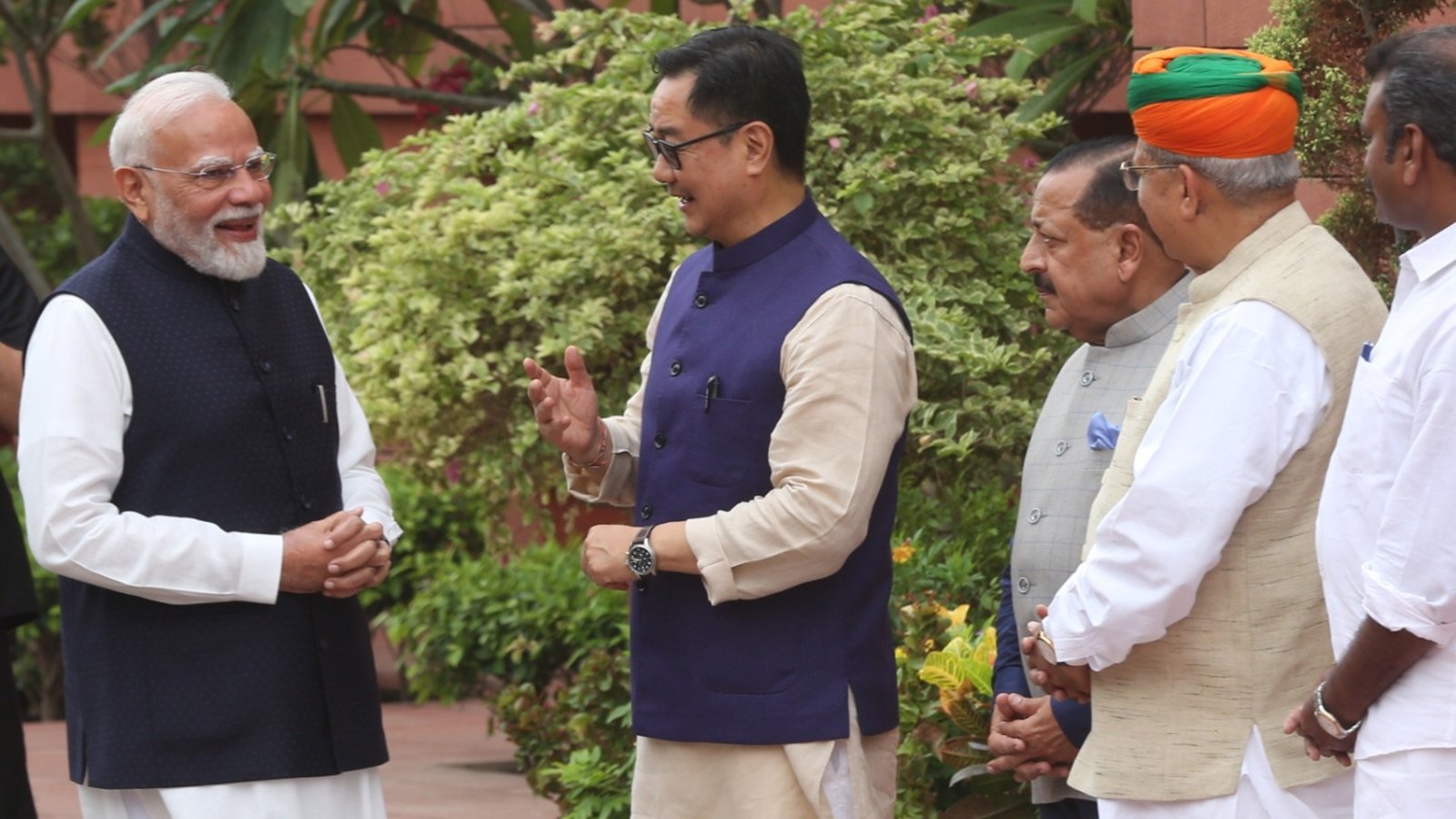
Prime Minister Narendra Modi on Monday appealed for meaningful and respectful parliamentary discussions as the Monsoon Session of Parliament commenced, stressing that facts, arguments and every voice deserve an opportunity to be heard. Addressing the media at the Parliament complex, the Prime Minister said the session comes at a crucial time when India is witnessing strong economic momentum, rapid technological progress and growing global recognition.
His remarks set the tone for what is expected to be a politically significant parliamentary session, with several major bills, economic reforms, Policy debates and opposition-led discussions likely to dominate proceedings. Modi emphasised that Parliament should function as a platform for constructive dialogue rather than disruption, arguing that informed debate is essential for achieving the country’s long-term development goals.
The Prime Minister also highlighted India’s recent achievements including robust GDP growth, the country’s first privately developed orbital rocket launch and advances in green hydrogen-powered rail transport as examples of the nation’s growing capabilities despite global economic uncertainty.
PM Modi’s Key Message: Let Facts and Arguments Lead Parliamentary Debate
Speaking before the start of the session, PM Modi expressed hope that parliamentary proceedings would remain focused on productive discussions rather than political confrontation.
“There is no need for a storm where arguments and facts exist. I hope facts, arguments and every voice receive an opportunity and respect.”
The statement underscored his call for a parliamentary culture based on dialogue, accountability and democratic debate. India’s Parliament serves as the country’s highest legislative institution, where laws are debated, government policies are scrutinised and issues affecting citizens are discussed. Constructive functioning of both Houses is widely regarded as essential for efficient governance.
The Prime Minister said the country’s rapid pace of development creates an opportunity for Parliament to contribute positively by facilitating informed policy discussions.
Why the Monsoon Session Matters
The Monsoon Session is traditionally one of Parliament’s most important sittings, often featuring significant legislation, discussions on the economy, national security, agriculture, social welfare and international affairs.
This year’s session assumes additional importance because India continues to navigate multiple domestic and international challenges, including Inflation management, Energy Security, employment generation, infrastructure expansion and geopolitical uncertainties affecting global trade.
Parliament also plays a critical role in approving financial proposals, debating government initiatives and ensuring executive accountability through questions, committee reviews and policy discussions.
Constructive Parliament Essential for a Developed India
PM Modi said India’s development journey requires cooperation across political parties. While acknowledging ideological differences, he noted that experienced Members of Parliament from every party possess valuable knowledge that should contribute to national policymaking.
According to the Prime Minister, Parliament functions most effectively when debates focus on solutions rather than prolonged disruptions. He stressed that citizens particularly younger generations expect elected representatives to discuss issues that directly affect employment, education, economic opportunities and national progress.
The appeal reflects a broader expectation that legislative institutions balance political competition with consensus-building on issues of national importance.
India’s Economic Performance Remains a Key Focus
One of the central themes of PM Modi’s address was India’s economic resilience despite global uncertainties. The Prime Minister pointed to the country’s strong GDP growth while several advanced economies continue to experience slower expansion, inflationary pressures and supply-chain disruptions.
According to official government estimates, India has remained among the world’s fastest-growing major economies in recent years. Economic expansion has been supported by public infrastructure investment, manufacturing incentives, digitalisation, services exports and domestic consumption.
The Prime Minister argued that India’s ability to sustain growth despite global shocks demonstrates the increasing strength of its economic fundamentals.
Factors Supporting India’s Growth
- Strong domestic consumer demand
- Rapid infrastructure development
- Growth in digital public infrastructure
- Expansion of manufacturing under production-linked incentive (PLI) schemes
- Rising startup ecosystem and innovation
- Continued investment in transport and logistics
Global Challenges Continue to Influence the Economy
PM Modi referred to the economic impact of tensions in West Asia, noting that disruptions in Global Energy Markets continue to affect countries worldwide.
India imports a significant share of its crude oil requirements, making international oil prices an important factor in inflation, transportation costs and industrial production. Similarly, fluctuations in fertiliser prices influence agricultural input costs and Food production.
Despite these challenges, the Prime Minister said India has managed to maintain relatively strong economic momentum through policy interventions, diversified energy sourcing and sustained domestic demand.
Economists generally agree that geopolitical events can influence inflation, exchange rates and commodity markets, making economic resilience an increasingly important policy objective.
Private Space Launch Marks a Milestone for India’s Space Sector
A major highlight of the Prime Minister’s address was India’s expanding private space industry following the successful launch of Skyroot Aerospace’s Vikram-1, an important milestone in the country’s commercial space journey.
The achievement reflects the transformation of India’s space ecosystem after policy reforms opened greater opportunities for private participation. Earlier, most launch activities were carried out exclusively through the Indian Space research Organisation (ISRO).
Private companies are now increasingly contributing to satellite Technology, launch vehicles, space manufacturing and downstream space applications.
Why Private Space Companies Matter
- Encourage technological innovation
- Create high-skilled employment
- Strengthen India’s commercial space industry
- Attract domestic and foreign investment
- Increase global competitiveness
- Support national strategic capabilities
India’s rapidly growing startup ecosystem has become one of the largest globally, with space technology emerging as a promising new sector.
Young Innovators Represent India’s Future
The Prime Minister highlighted the relatively young age of the team behind the successful private rocket launch, describing it as evidence of India’s growing innovation ecosystem.
India has witnessed a significant increase in entrepreneurship over the past decade, particularly in technology, fintech, healthcare, clean energy, defence manufacturing and deep-tech sectors.
Government initiatives supporting startups, digital infrastructure, simplified regulations and greater access to venture capital have contributed to the emergence of thousands of technology-driven enterprises.
The Prime Minister argued that the achievements of young innovators demonstrate India’s expanding scientific capabilities and entrepreneurial potential.
Green Hydrogen Train Reflects India’s Clean Energy Push
Another milestone highlighted by PM Modi was the operation of India’s first hydrogen-powered train, an initiative aligned with the country’s broader clean energy transition.
Hydrogen-powered rail systems are viewed globally as a promising alternative to diesel-powered transportation, particularly on routes where complete electrification may not be immediately feasible.
Green hydrogen, produced using renewable energy sources, has the potential to reduce carbon emissions across transportation, heavy industry and power generation.
India’s National Green Hydrogen Mission aims to position the country as a global hub for hydrogen production while reducing dependence on imported fossil fuels.
Innovation Becoming a New Growth Engine
Beyond individual achievements, India’s recent advances in space technology, renewable energy, semiconductor manufacturing, artificial intelligence and digital governance indicate a broader shift toward innovation-led economic growth.
Government policies increasingly focus on creating an ecosystem where research institutions, startups, industry and investors collaborate to commercialise emerging technologies.
This transition could play a crucial role in generating high-value employment while improving India’s competitiveness in advanced manufacturing and knowledge-intensive industries.
Parliament’s Role in India’s Development Journey
While highlighting economic achievements, PM Modi reiterated that Parliament remains central to India’s democratic framework.
Legislative discussions shape policies affecting taxation, healthcare, education, defence, technology, agriculture, environmental protection and social welfare. Constructive parliamentary debate also enables greater transparency by allowing opposition parties to question government decisions while providing opportunities for consensus-building on national priorities.
Political analysts often note that productive legislative sessions help accelerate reforms by ensuring timely discussion and passage of important bills.
Comparison: Political Debate vs Policy Outcomes
| Constructive Parliamentary Functioning | Frequent Disruptions |
|---|---|
| Detailed policy discussions | Reduced legislative productivity |
| Better scrutiny of government proposals | Delayed debates on public issues |
| Greater public accountability | Limited parliamentary oversight |
| Faster consideration of important bills | Backlog of legislative business |
| Improved democratic engagement | Reduced discussion time |
Expert Insight: Why Constructive Debate Matters for Investors and Citizens
Stable legislative functioning influences more than politics. Investors closely monitor parliamentary proceedings because major economic reforms, taxation changes, infrastructure initiatives and Business regulations often require legislative approval.
Efficient parliamentary sessions can improve policy certainty, encourage long-term investment and support economic confidence. Similarly, citizens benefit when discussions focus on practical issues such as employment, healthcare, education, inflation and public services.
In mature democracies, vigorous debate and accountability are considered strengths, provided they result in informed policymaking rather than prolonged institutional deadlock.
What to Watch During the Monsoon Session
The current parliamentary session is expected to feature discussions on several important issues, including:
- Economic reforms and fiscal policy
- Employment and skill development
- Infrastructure expansion
- National security and foreign affairs
- Technology and digital governance
- Agriculture and rural development
- Climate and clean energy initiatives
The quality of these debates will likely shape both policy outcomes and public perception of Parliament’s effectiveness.
Conclusion
Prime Minister Narendra Modi’s opening remarks for the Monsoon Session emphasised a message that extends beyond politics: democratic institutions function best when facts, reasoned arguments and constructive engagement take precedence over disruption. By highlighting India’s economic resilience, advances in space technology, clean energy initiatives and the growing contribution of young innovators, he framed the session as an opportunity to build consensus around the country’s long-term development goals.
As Parliament begins deliberations, the coming weeks will test how effectively lawmakers can balance political differences with legislative responsibility. For citizens, businesses and investors alike, productive parliamentary discussions remain essential for shaping policies that influence India’s economic growth, technological progress and global standing in the years ahead.
For breaking news and live news updates, like us on Facebook or follow us on Twitter and Instagram. Read more on Latest India on thefoxdaily.com.





COMMENTS 0