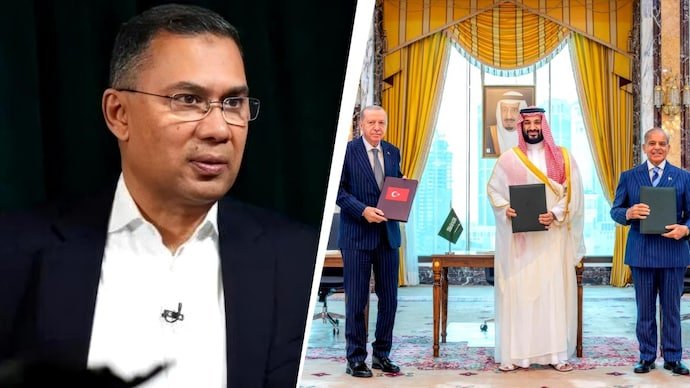
Bangladesh is keeping the door open to closer cooperation with the new Saudi Arabia–Pakistan-Türkiye defence framework, but the government is making clear that membership will not be automatic. Any decision, officials say, will depend on whether participation protects Bangladesh’s national interests and benefits its people.
The position comes as Prime Minister Tarique Rahman prepares for a possible visit to Riyadh after Saudi Crown Prince and Prime Minister Mohammed bin Salman invited him to Saudi Arabia. The proposed visit could give Dhaka and Riyadh an opportunity to discuss bilateral relations as well as broader regional and international issues.
Bangladesh’s position is significant because Saudi Arabia, Pakistan and Türkiye signed the Makkah Joint Defence Agreement on August 7. The agreement establishes a framework for stronger defence cooperation and says that an armed attack against any one of the three signatories will be regarded as an attack against all three.
For Dhaka, however, the question is not simply whether it shares close relations with the three countries. The government’s newly emphasised “Bangladesh First” foreign policy means that economic interests, sovereignty, security and the welfare of Bangladeshi citizens are expected to shape decisions on new international partnerships.
Bangladesh does not rule out joining the defence framework
State Minister for Foreign Affairs Humayun Kobir said Bangladesh has a positive approach toward the possibility of joining an economic or defence framework involving Saudi Arabia, Pakistan and Türkiye, while stressing that Dhaka will consider its own interests and the changing international environment.
His comments indicate that Bangladesh is not rejecting the possibility of joining the emerging arrangement. At the same time, they stop short of confirming that Dhaka has decided to become a participant.
Another State Minister for Foreign Affairs, Shama Obaed Islam, delivered a similar message. She said Bangladesh’s position on joining any pact or multilateral organisation would primarily be determined by whether Bangladesh and its people are protected.
The two statements establish an important distinction: Bangladesh is considering the possibility of participation, not announcing membership.
That distinction matters because joining a defence framework is fundamentally different from maintaining friendly diplomatic or economic relations with its members. A defence agreement can carry strategic, political and security implications that extend well beyond trade or bilateral cooperation.
What is the Saudi-Pakistan-Türkiye defence pact?
Saudi Arabia, Pakistan and Türkiye signed the Makkah Joint Defence Agreement in Makkah on August 7. Saudi Crown Prince Mohammed bin Salman, Turkish President Recep Tayyip Erdoğan and Pakistani Prime Minister Shehbaz Sharif signed the agreement during the Makkah Joint Defence Summit.
The central provision is a collective-deterrence principle: an armed attack against one of the three countries is to be regarded as an attack against all three. The agreement also calls for strengthening defence cooperation among the participating states.
The pact therefore creates a framework for closer security coordination among three countries that already maintain significant bilateral relationships in defence and strategic affairs.
Official statements from the countries involved have described the agreement as a mechanism intended to strengthen collective security and deterrence. Saudi officials have also stressed that the arrangement is not intended to create a military axis or sectarian bloc and is not linked to nuclear ambitions or an arms race.
That context is important when assessing what Bangladesh could potentially be considering. The agreement is more than a conventional diplomatic partnership because of its collective-defence language, but the precise practical consequences for future members would depend on how the framework develops and how its provisions are implemented.
Why Bangladesh is taking a cautious approach
Bangladesh’s cautious position reflects the difference between strategic cooperation and formal defence commitments.
Dhaka has strong reasons to maintain relationships with Saudi Arabia, Pakistan and Türkiye. Saudi Arabia is an important partner for Bangladesh, while Pakistan and Bangladesh have been seeking to strengthen bilateral relations after years in which ties remained complicated by historical and political issues.
Türkiye, meanwhile, is another important partner for Bangladesh in trade, diplomacy and broader international engagement. Closer relations with all three countries can potentially create opportunities for economic and diplomatic cooperation without necessarily requiring Bangladesh to become part of a formal defence arrangement.
This is where the government’s “Bangladesh First” approach becomes central. The policy, as described by the government’s finance and planning adviser Professor Rashed Al Mahmud Titumir, places national interest, sovereignty, mutual respect and regional harmony at the centre of Bangladesh’s international relations.
That approach gives Dhaka room to deepen cooperation with individual countries while assessing multilateral arrangements separately.
What “Bangladesh First” could mean for foreign policy
The government’s description of “Bangladesh First” suggests a shift toward evaluating foreign-policy decisions primarily through their practical impact on Bangladesh.
Titumir described the approach as a “paradigm shift” and said Bangladesh would seek constructive and mutually beneficial relations with all countries. The phrase used by the adviser, “Bangladesh for all,” is important because it indicates that prioritising national interests is not being presented as a rejection of other countries or international partnerships.
In practical terms, that could mean Bangladesh avoids treating foreign-policy relationships as fixed blocs. Instead, Dhaka may seek different forms of cooperation with different partners depending on the issue.
That distinction could become particularly relevant as international Politics becomes more competitive. Economic relationships, supply chains, trade access, security concerns and regional stability increasingly overlap, making it harder for governments to separate economic diplomacy from strategic calculations.
For Bangladesh, joining a defence pact would therefore need to be assessed against the country’s wider diplomatic and economic interests rather than viewed only through a military lens.
Tarique Rahman’s possible Riyadh visit adds another dimension
The discussion over the defence framework comes shortly after Saudi Arabia extended an invitation to Prime Minister Tarique Rahman.
Saudi Ambassador to Bangladesh Abdullah Zafar H bin Abiyah delivered the invitation to Tarique Rahman at the Prime Minister’s Office on August 17. The invitation from Crown Prince Mohammed bin Salman calls for discussions aimed at strengthening bilateral relations and exchanging views on regional and international issues.
The exact schedule has not been finalised. Bangladesh’s State Minister for Foreign Affairs Humayun Kobir said the tour schedule is expected to be settled after the summer.
The proposed visit is therefore important even if Bangladesh ultimately decides not to join the defence arrangement. Saudi-Bangladesh relations cover a much broader area than defence, and discussions between the two governments could include economic cooperation, investment, labour issues and regional developments.
The timing also means that the possible visit could provide a diplomatic setting for Bangladesh to better understand Riyadh’s expectations regarding the emerging security framework.
Bangladesh-Pakistan ties are also being recalibrated
Dhaka’s consideration of the Saudi-Pakistan-Türkiye framework comes alongside efforts to strengthen bilateral relations with Pakistan.
Kobir said Bangladesh intends to improve ties with Pakistan through normal diplomatic engagement, with particular attention to trade and people-to-people connectivity.
This does not necessarily mean that closer Bangladesh-Pakistan relations will automatically lead to a shared position on security matters. Bangladesh can expand trade, diplomatic exchanges and people-to-people links while maintaining an independent position on defence arrangements.
That flexibility is consistent with the government’s stated emphasis on national interests. It also gives Dhaka the ability to improve relations with Islamabad without allowing one bilateral relationship to determine the country’s entire foreign-policy direction.
Why Saudi Arabia matters to Bangladesh
Saudi Arabia occupies a particularly important place in Bangladesh’s international relations because the relationship extends well beyond government-to-government diplomacy.
Bangladesh has longstanding social and economic links with Saudi Arabia, including a large community of Bangladeshi workers in the kingdom. That makes the relationship relevant to employment, household incomes and economic ties as well as foreign policy.
Saudi Arabia is also seeking wider economic and strategic partnerships as it pursues its own long-term development ambitions. For Bangladesh, closer engagement with Riyadh could potentially create opportunities across areas such as investment, trade and economic cooperation.
This helps explain why a proposed visit by Tarique Rahman is significant even independently of the defence pact. The two countries have multiple interests that can be advanced without necessarily being tied to military cooperation.
Could Bangladesh actually join the pact?
At this stage, the available statements support only one clear conclusion: Bangladesh has not ruled out the possibility.
There has been no confirmed announcement in the supplied statements that Dhaka has decided to join the Makkah Joint Defence Agreement. Instead, senior officials have repeatedly emphasised that the decision will depend on Bangladesh’s interests and those of its people.
That leaves several possibilities open. Bangladesh could decide to remain outside the formal defence framework while expanding bilateral relations with Saudi Arabia, Pakistan and Türkiye. It could seek closer economic or security cooperation without becoming a signatory. Alternatively, if Dhaka concludes that participation would strengthen its strategic and national interests, it could pursue membership or another form of association.
The wording used by the ministers is therefore deliberately flexible. It keeps diplomatic options open while avoiding an immediate commitment.
The economic dimension may be as important as defence
One detail in Kobir’s statement deserves particular attention: he referred not only to an economic or defence framework but also to changing global economic and trade dynamics.
That suggests Bangladesh is looking at the issue through a broader strategic lens. For a country whose foreign-policy priorities include economic growth and international trade, a new regional partnership cannot be evaluated solely by military considerations.
An arrangement involving Saudi Arabia, Pakistan and Türkiye could have implications for trade and investment relationships, but the benefits and risks would need to be assessed on a case-by-case basis. Bangladesh would also need to consider how any new strategic alignment might affect its relationships with other major partners.
The “Bangladesh First” approach gives the government a framework for making that calculation: cooperation where it produces tangible benefits, while preserving room for independent decision-making.
What the defence pact means for South Asian diplomacy
The emergence of the Saudi-Pakistan-Türkiye framework adds another layer to the strategic environment surrounding South Asia and the wider Middle East.
Pakistan is already one of the three signatories, while Bangladesh has longstanding links with both Pakistan and the Gulf region. If Bangladesh were eventually to become involved, it could broaden the geographic reach of the framework. But that would also increase the diplomatic consequences of the decision.
For now, Dhaka appears to prefer keeping its options open rather than making a rapid strategic commitment.
That approach allows Bangladesh to watch how the agreement develops, assess its practical implications and determine whether closer involvement would actually advance national interests.
What to watch next
The next major development will likely be Prime Minister Tarique Rahman’s potential visit to Riyadh. The timing and agenda of that visit could provide more clues about the direction of Bangladesh-Saudi relations.
Several issues will be particularly important to watch:
- The Riyadh visit: Whether and when Tarique Rahman travels to Saudi Arabia, and what areas of cooperation are discussed.
- Bangladesh’s position on the pact: Whether Dhaka moves from expressing openness to formally exploring participation.
- Defence cooperation: Whether Bangladesh expands security cooperation with Saudi Arabia, Pakistan or Türkiye without joining the trilateral agreement.
- Economic diplomacy: Whether discussions with Riyadh produce new opportunities in trade, investment or other areas of mutual interest.
- Relations with Pakistan: Whether the government’s stated focus on trade and people-to-people connectivity leads to deeper bilateral engagement.
Bangladesh keeps its strategic options open
Bangladesh’s response to the Saudi-Pakistan-Türkiye defence pact is best understood as a cautious opening rather than a commitment to join.
The government has made clear that it is willing to examine new economic and defence frameworks, but it has also placed a firm condition on any decision: Bangladesh’s interests must come first.
That position gives Dhaka considerable diplomatic flexibility. It can strengthen ties with Saudi Arabia, improve relations with Pakistan and maintain engagement with Türkiye without automatically committing itself to a new defence bloc.
Prime Minister Tarique Rahman’s expected Riyadh visit could become an important next step in that process. If the visit goes ahead, discussions with Crown Prince Mohammed bin Salman may provide a clearer picture of how Bangladesh sees its relationship with Saudi Arabia and whether the emerging defence framework has a role in that relationship.
For now, the message from Dhaka is straightforward: the door is open, but the decision will be made in Bangladesh’s own interest.
For breaking news and live news updates, like us on Facebook or follow us on Twitter and Instagram. Read more on Latest World on thefoxdaily.com.






COMMENTS 0