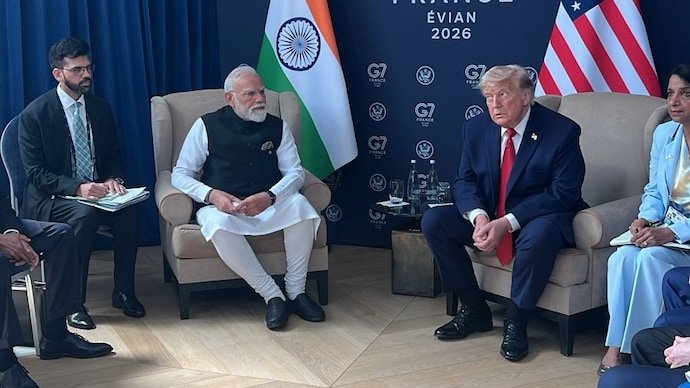
When US President Donald Trump described Prime Minister Narendra Modi as someone who “looks like an angel” but is “a tough trader,” the comment instantly grabbed global headlines. Delivered during their bilateral meeting on the sidelines of the G7 Summit in France, the remark combined Trump’s trademark style with a deeper message about how Washington views India’s leader and New Delhi’s growing influence on the world stage.
The meeting was significant not merely because of the personal warmth displayed between the two leaders, but because it came at a time when India-US relations were navigating several sensitive issues, including trade negotiations, Immigration concerns, maritime security, geopolitical tensions in West Asia, and evolving strategic alignments in the Indo-Pacific.
While Trump’s words generated laughter and social media discussion, they also reflected an underlying reality: India has emerged as one of the most important partners for the United States in an increasingly uncertain global order.
Why the Modi-Trump Meeting Drew Global Attention
The bilateral interaction marked the first in-person meeting between Narendra Modi and Donald Trump in more than 16 months. During that period, both countries experienced significant political and strategic developments.
India continued strengthening its position as one of the world’s fastest-growing major economies, while the United States under Trump’s second administration recalibrated its foreign policy priorities around trade, manufacturing, Energy Security, and strategic competition.
The meeting therefore carried importance beyond symbolism. It offered both leaders an opportunity to address several pending issues while publicly reaffirming the strength of bilateral ties.
Observers closely watched the interaction because recent months had witnessed disagreements over:
- Trade tariffs and market access
- Immigration and visa policies
- Energy purchases and sanctions-related concerns
- Regional security issues involving South Asia
- Maritime security in the Gulf region
- Supply chain diversification and technology partnerships
Against this backdrop, the friendly tone adopted by both leaders signaled a desire to prevent temporary disagreements from overshadowing the broader strategic relationship.
Decoding Trump’s ‘Angel’ and ‘Tough Trader’ Description
Trump’s characterization of Modi was classic Trump dramatic, unconventional, and designed to attract attention.
However, beneath the headline-grabbing language lies a consistent theme that has defined Trump’s assessment of Modi for years: respect for his negotiating style.
When Trump called Modi a “tough trader” and “tough negotiator,” he was referring primarily to India’s approach in trade discussions. Successive Indian governments have historically protected domestic interests aggressively during negotiations involving agriculture, manufacturing, digital services, and market access.
India’s trade policy often prioritizes long-term national interests over short-term concessions, a strategy that has frequently resulted in difficult negotiations with major economic powers.
Trump’s comments effectively acknowledged that while Modi projects a calm and diplomatic public image, he remains firm when defending India’s economic priorities.
This perception is not unique to Washington. Leaders across Europe, Asia, and the Middle East often describe India’s negotiating approach as pragmatic, calculated, and highly focused on national interests.
How India’s Global Position Has Changed Since Trump’s First Presidency
One of the most striking aspects of the 2026 meeting is how dramatically India’s global standing has evolved since Trump first entered the White House.
During Trump’s first term, India was already an important strategic partner. Today, however, its influence extends far beyond traditional diplomatic Relationships.
| Area | India’s Position in 2026 |
|---|---|
| Economic Growth | Among the fastest-growing major economies |
| Technology | Major global digital innovation hub |
| Manufacturing | Increasingly important alternative supply-chain destination |
| Defence | Key Indo-Pacific security partner |
| Energy | Major consumer influencing global demand patterns |
| Diplomacy | Increasing role in Global South leadership |
This transformation has elevated India’s strategic value for the United States, regardless of which party controls the White House.
The Bigger Story: Strategic Partnership Beyond Personal Chemistry
Much of the media attention often focuses on the personal rapport between leaders. While personal relationships matter in diplomacy, the India-US partnership has increasingly become institutional and strategic.
Several factors ensure that cooperation remains strong regardless of political personalities:
- Shared concerns about Indo-Pacific stability
- Growing defence collaboration
- Expanding technology partnerships
- Supply-chain resilience initiatives
- Counterterrorism cooperation
- Increasing bilateral trade
These structural drivers make the relationship resilient even when disagreements emerge.
The meeting reinforced that reality by emphasizing cooperation despite ongoing policy differences.
Trump’s Security Assurance: Symbolism or Strategic Signal?
Perhaps the most consequential remark during the meeting was Trump’s statement that the United States would help India if it were attacked while Modi remained Prime Minister.
Although the statement does not constitute a formal security guarantee, it carries diplomatic significance.
Unlike treaty allies such as Japan or South Korea, India and the United States do not share a mutual Defense pact. Therefore, any public commitment from an American president naturally attracts attention.
The statement can be interpreted in several ways:
- Reassurance to India regarding strategic cooperation
- A signal to regional adversaries about growing partnership
- A reflection of personal trust between the leaders
- An attempt to strengthen bilateral relations amid geopolitical uncertainty
While experts caution against reading the remark as a legally binding commitment, it nonetheless reflects the growing strategic convergence between Washington and New Delhi.
Trade Remains the Most Important Unfinished Agenda
Despite the positive atmosphere, trade remains one of the most challenging aspects of the bilateral relationship.
Both countries recognize the enormous economic opportunities available through deeper commercial engagement.
India’s expanding consumer market, digital economy, and manufacturing ambitions make it highly attractive for American businesses. At the same time, Indian firms continue to seek greater access to US markets.
However, several issues remain under negotiation:
- Agricultural market access
- Digital trade regulations
- Tariff structures
- Technology transfers
- Investment frameworks
- Intellectual property concerns
Trump’s description of Modi as a tough trader reflects precisely why these negotiations often take time. Neither side is willing to compromise easily on issues viewed as strategically important.
The Maritime Security Issue Modi Raised
An important but less-publicized aspect of the meeting was PM Modi’s emphasis on maritime security and the safety of Indian seafarers.
India has one of the world’s largest seafaring communities, with hundreds of thousands of Indian sailors working aboard international commercial vessels.
Recent attacks on shipping routes in the Gulf highlighted the vulnerability of maritime workers caught in geopolitical conflicts.
By raising the issue directly with Trump, Modi underscored a broader strategic concern: freedom of navigation is essential not only for India but also for global trade.
Nearly every major economy depends on uninterrupted maritime commerce. Any disruption in critical sea lanes affects energy supplies, supply chains, shipping costs, and Inflation.
This discussion reflects India’s growing role as a stakeholder in global maritime security rather than merely a regional power.
How the Modi-Trump Dynamic Influences Global Politics
The relationship between Modi and Trump extends beyond bilateral matters.
Both leaders have cultivated strong political brands centered on nationalism, economic development, and projecting strength internationally. While their governing styles differ, they often communicate messages that resonate with domestic audiences seeking strong leadership.
Their interactions also influence broader geopolitical calculations involving:
- The Indo-Pacific region
- China’s growing influence
- Global supply chains
- Energy security
- Technology competition
- International trade frameworks
As a result, every public exchange between them is scrutinized not just by India and the United States but by governments around the world.
What Competitors Are Missing About This Story
Most coverage focused on Trump’s colorful language and personal praise. However, the more important story is what the interaction reveals about India’s evolving global leverage.
A decade ago, discussions involving India and major powers often centered on potential. Today, conversations increasingly revolve around influence.
India’s economic scale, demographic advantage, technological capabilities, and geopolitical importance mean that global leaders cannot ignore New Delhi when addressing major international challenges.
Trump’s comments unintentionally highlighted this shift.
By emphasizing Modi’s negotiating toughness, strategic importance, and leadership role, the US President acknowledged India’s growing ability to shape outcomes rather than merely respond to them.
Future Outlook: What Comes Next for India-US Relations?
The immediate future of India-US relations will likely be defined by three priorities.
First, both sides will seek progress on trade negotiations, which remain the most visible unresolved issue.
Second, strategic cooperation in the Indo-Pacific is expected to deepen as regional security dynamics continue evolving.
Third, technology partnerships involving semiconductors, artificial intelligence, digital infrastructure, and advanced manufacturing are likely to become increasingly important.
While disagreements will inevitably emerge, the broader trajectory of the relationship appears positive.
The fundamental drivers behind the partnership economic opportunity, strategic alignment, and shared interests remain stronger than any individual dispute.
Conclusion
Donald Trump’s description of Narendra Modi as an “angel” who is also a “tough trader” may have generated headlines because of its unusual phrasing, but it revealed something deeper about India’s place in global affairs.
The remarks reflected growing international recognition of India’s negotiating strength, strategic relevance, and economic influence. More importantly, they came during a meeting that reaffirmed the importance of India-US ties at a time of significant global uncertainty.
Behind the jokes, compliments, and viral soundbites lies a larger reality: India is no longer viewed merely as a rising power. It is increasingly seen as a central player in shaping the economic, strategic, and geopolitical landscape of the 21st century.
As trade talks continue, security cooperation expands, and global challenges become more complex, the partnership between Washington and New Delhi is likely to remain one of the most closely watched relationships in international Politics.
For breaking news and live news updates, like us on Facebook or follow us on Twitter and Instagram. Read more on Latest World on thefoxdaily.com.




COMMENTS 0