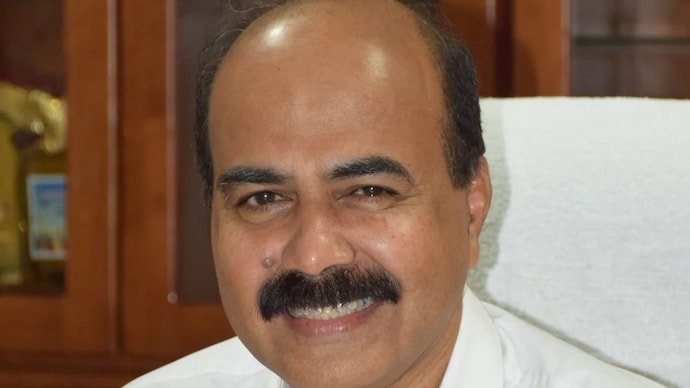
Kerala University Vice-Chancellor Mohanan Kunnummal has triggered a fresh controversy after saying that people WHO oppose saying “Vande Mataram” do not know who their mother is. Kunnummal made the remarks while addressing an RSS youth gathering in Thiruvananthapuram, linking the national song’s reference to the motherland with his broader message about family responsibility and building a developed India.
The comments were made at Sankalp 2026 Yuva Sangamam, an RSS youth meet held at Manivila in Thiruvananthapuram. Kunnummal spoke about the idea of Bharat Mata and the responsibility of families to raise children as capable citizens, before connecting that responsibility with the symbolism of India as a mother.
His remarks have taken on a wider political significance because Kunnummal’s role as Vice-Chancellor has already been questioned by political parties and student organisations in Kerala. The latest controversy comes amid an ongoing debate over university appointments, the perceived proximity of some university officials to the RSS and allegations of ideological influence in the state’s higher Education system.
What Kerala University VC Mohanan Kunnummal said
While speaking at the RSS youth meeting, Kunnummal discussed the responsibility of parents and households in preparing children for a developed India.
He said children placed in families for the purpose of building a developed India should be raised into “brilliant children and exemplary citizens”. According to him, both men and women heading households have a responsibility in this process.
He then placed particular emphasis on women and connected the idea of motherhood with the way India is symbolically described.
“That is why when we pray, we say ‘Vande Mataram’. It is our mother. That is why we say and sing ‘Vande Mataram’,” he said.
Kunnummal then went further, saying that people who opposed saying “Vande Mataram” were those who “do not know who their mother is”. He contrasted them with people who understood the meaning of a mother and therefore, according to his argument, would say and sing the national song.
The remarks have become the focus of criticism because they frame disagreement over the use of Vande Mataram as a question of one’s relationship with the idea of the motherland rather than simply a matter of personal, political or religious choice.
Why the remarks have become politically sensitive
The controversy surrounding Kunnummal’s comments cannot be separated from the political debate already surrounding his position as Kerala University Vice-Chancellor.
Student organisations including the Students’ Federation of India (SFI) and Kerala Students Union (KSU) have accused Kunnummal of attempting to promote an RSS agenda at the university. His participation in an RSS-linked youth event is therefore likely to intensify existing criticism from these groups.
The Left Democratic Front (LDF) and United Democratic Front (UDF) have also questioned his appointment as Vice-Chancellor by the Kerala Governor. The political criticism has included allegations that there are attempts to “saffronise” Kerala’s education system.
These allegations are political claims and should be distinguished from established facts about the Vice-Chancellor’s appointment or his participation in the event. What is clear from the episode is that Kunnummal’s appearance at an RSS youth gathering has provided fresh ground for opponents to question the relationship between university officials and political or ideological organisations.
Vande Mataram becomes part of a wider Kerala debate
Kunnummal’s remarks also come at a time when the use of “Vande Mataram” has become part of a wider political debate in Kerala.
The state government did not recite Vande Mataram at its official Independence Day celebrations, despite a directive from the Union government concerning its observance. Against that backdrop, the Vice-Chancellor’s comments have acquired additional political significance.
The issue is no longer limited to the words used by one university official. It has become connected to larger questions about how national symbols should be treated at public institutions, whether participation in their recitation should be expected, and how political and ideological differences should be handled within educational spaces.
Kunnummal’s argument is rooted in the symbolism of Bharat Mata, or Mother India. His comments suggest that he views the expression “Vande Mataram” as an affirmation of the country as a mother and therefore considers opposition to the phrase inconsistent with that symbolism.
Critics, however, can interpret the matter differently, particularly when the statement comes from the head of a major public university. That is because a Vice-Chancellor occupies an institutional position that carries responsibilities beyond personal political or ideological expression.
Why a Vice-Chancellor’s public statements attract scrutiny
University Vice-Chancellors are responsible for leading academic institutions and representing them in public life. Their statements can therefore be viewed through both a personal and institutional lens.
When a Vice-Chancellor speaks at an event organised by a political or ideological organisation, questions can arise about the distinction between the individual’s views and the institution’s position.
That distinction is particularly sensitive in higher education because universities are spaces where students are expected to encounter different political, social and intellectual perspectives. The ability to disagree with prevailing views without institutional pressure is an important part of academic life.
Kunnummal’s remarks have therefore been placed by critics within the larger debate over whether university leadership should maintain greater distance from political organisations and ideological platforms.
At the same time, participation by a university official in an external event does not by itself establish that the institution has adopted the ideology associated with the event. Any claim about institutional ideological influence would require evidence beyond the appearance itself.
The controversy over Kunnummal’s appointment
Kunnummal’s appointment as Vice-Chancellor by the Kerala Governor has already been politically contested. Both the LDF and UDF have raised objections to appointments to senior university positions and have alleged attempts to influence the state’s education system ideologically.
In Kerala’s university system, the Governor serves as Chancellor and plays a role in the appointment of Vice-Chancellors. This institutional arrangement has been a recurring source of political tension, particularly when the state government and Raj Bhavan disagree over university administration and appointments.
The dispute involving Kunnummal therefore forms part of a longer-running conflict over who should have greater influence over higher education Governance in the state.
The issue is not confined to one political party. The supplied material notes that both the previous LDF government and the current UDF dispensation have raised objections over appointments to senior university posts. This suggests that disagreements over university appointments are embedded in the broader contest between the state government and the Governor’s office.
SFI and KSU criticism adds to the pressure
Student organisations have also entered the debate. SFI and KSU have accused Kunnummal of attempting to push the RSS agenda at Kerala University.
His appearance at Sankalp 2026 Yuva Sangamam is likely to reinforce those allegations in the eyes of his critics because the event was explicitly organised as an RSS youth gathering.
However, the distinction between attending an event and changing university policy remains important. Participation at a political or ideological gathering may prompt questions about judgment and institutional neutrality, but claims that an entire university has been subjected to ideological influence require evidence of decisions, policies or actions within the institution.
That distinction will remain central as political parties and student groups respond to the controversy.
The symbolism behind ‘Vande Mataram’
The phrase “Vande Mataram” carries a long history in India’s national movement and has become closely associated with patriotic expression. Kunnummal’s comments draw on the phrase’s literal and symbolic association with the motherland.
His speech connected the concept of the nation as a mother with the role of parents in raising children. In that framework, saying Vande Mataram becomes an expression of respect for the country.
The political controversy arises because national symbols can carry different meanings for different groups. While many Indians regard Vande Mataram as an important expression of patriotism, debates have periodically emerged over its use, especially in contexts involving public institutions and diverse communities.
That makes the language used by public officials especially important. A statement that frames disagreement as evidence that someone does not know who their mother is can be perceived as moving beyond advocacy for a national symbol and into criticism of those who do not share the same position.
National symbols and freedom of expression
The debate also raises a broader question about how national symbols should coexist with freedom of expression.
In a constitutional democracy, support for a national symbol and the right to question or disagree about how it should be used can exist simultaneously. Public debate does not necessarily require everyone to express patriotism in exactly the same way.
For universities, this balance is particularly significant. Students and academics may hold strongly different views about Politics, nationalism, religion and public policy. The role of an educational institution is not necessarily to eliminate those disagreements, but to provide an environment in which they can be discussed responsibly.
Kunnummal’s remarks have consequently opened a debate that goes beyond the specific phrase used in his speech. They have raised questions about how university leaders should speak about contested political and cultural issues, particularly when addressing audiences connected to ideological organisations.
What could happen next in Kerala
The latest controversy is likely to add another layer to the political dispute over Kerala’s universities. Opposition from student organisations and political parties could intensify, particularly because the comments were made at an RSS youth event rather than at a university function.
The episode may also renew discussion about the relationship between the Governor, state government and university administrations. With both major political fronts having previously objected to aspects of senior university appointments, disagreements over institutional autonomy and political influence are unlikely to disappear quickly.
For Kerala University, the more important question will be whether the controversy remains limited to public statements or develops into a dispute over university administration, student protests or institutional policy.
Any such developments would need to be assessed separately from the political claims already being made about the Vice-Chancellor’s ideological affiliations or intentions.
A controversy at the intersection of politics, education and nationalism
Mohanan Kunnummal’s remarks have placed three sensitive issues together: the meaning of Vande Mataram, the political debate over university appointments and concerns about ideological influence in higher education.
His argument was that India is regarded as a mother and that Vande Mataram expresses respect for that motherland. But his subsequent statement about people who oppose the phrase not knowing who their mother is has transformed what could have been a patriotic message into a point of political controversy.
The timing has added to the attention. Kerala is already witnessing disagreements over the role of the Governor in university appointments, accusations concerning the alleged “saffronisation” of education and debate over the government’s approach to Vande Mataram at official Independence Day celebrations.
For supporters, Kunnummal’s remarks may be viewed as an emphatic defence of national symbolism. For critics, they raise questions about whether a Vice-Chancellor should use such language when discussing those who disagree with him.
The broader issue is likely to remain focused on institutional neutrality and the space for disagreement in higher education. Universities bring together students and academics with different political and ideological beliefs. How their leaders navigate that diversity can have consequences well beyond any single speech.
As the political debate continues, the most consequential question may therefore be less about one phrase and more about the principles governing Kerala’s universities: who appoints their leaders, how independent those institutions are from political influence, and whether students and academics remain free to disagree without their views being treated as a test of patriotism.
For breaking news and live news updates, like us on Facebook or follow us on Twitter and Instagram. Read more on Latest India on thefoxdaily.com.






COMMENTS 0