Keeping oil and gas prices low has become the United States’ “goal No. 1” in its war with Iran, Vice President JD Vance said, as the Trump administration threatened to maintain a naval blockade indefinitely and promised a new wave of economic pressure against Tehran.
Vance’s remarks represent another shift in how the Trump administration has publicly described its objectives in the conflict. The vice president placed energy prices ahead of Iran’s nuclear ambitions, which he described as the administration’s second priority.
The comments came as oil prices moved higher again Friday following warnings from Washington that the economic campaign against Iran could intensify. Treasury Secretary Scott Bessant also signalled that the administration was preparing measures intended to impose unprecedented economic isolation on Tehran.
The developments come after weeks of disruption surrounding the Strait of Hormuz, a crucial international energy route. Traffic through the waterway has fallen sharply from normal peacetime levels, while attacks on vessels and competing claims over control of the strait have increased pressure on global Energy Markets.
Vance puts oil prices at the centre of U.S. strategy
Vance said the administration’s immediate priority was preventing energy prices from rising further for American consumers.
“That’s goal No. 1 keep oil and gas cheap for Americans all over our country,” Vance told Fox News on Thursday.
He acknowledged that oil prices had fallen substantially from their initial highs after the conflict began, but said keeping them low remained the administration’s primary objective. Vance identified ensuring that Iran does not acquire a nuclear weapon as “goal No. 2”.
The change in emphasis is significant because the Trump administration has offered several explanations for its military campaign against Iran. Earlier arguments included support for anti-government protests, while the administration subsequently focused heavily on Iran’s nuclear programme and other strategic objectives.
The latest comments place the cost of energy for American households much more directly at the centre of the administration’s public rationale.
Oil prices rise again as Hormuz tensions intensify
global oil markets initially surged after the United States and Israel attacked Iran on February 28. Prices subsequently eased from those early peaks, but they remained substantially above pre-conflict levels and moved higher again after the latest statements from U.S. officials.
Brent crude, the international oil benchmark, was trading just above $87 a barrel, according to the figures cited in the report. That was about 45% higher than its January level.
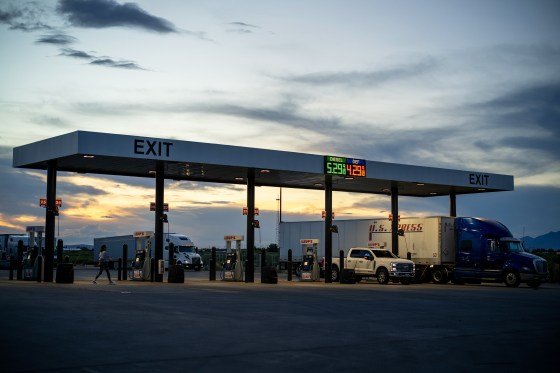
The increase has also reached American consumers. The average U.S. gasoline price had climbed above $4 a gallon, compared with less than $3 before the conflict.
That difference helps explain why fuel prices have become an increasingly important political and economic concern for Washington. Higher crude prices can feed into gasoline costs, transportation expenses and the broader cost of goods.
Why the Strait of Hormuz matters so much
The conflict has increasingly become centred on the Strait of Hormuz, a narrow but strategically vital waterway connecting the Persian Gulf with the wider global shipping system.
Before the war, roughly 20% of the world’s energy supplies travelled through the strait, according to the information provided. Any prolonged disruption therefore has consequences far beyond Iran and its immediate neighbours.
Oil is not the only commodity affected. The disruption has also affected the movement of other important products, including fertilizer, adding another layer to the economic consequences of the conflict.
Under normal conditions, around 130 to 140 vessels would typically pass through the waterway during a comparable period. The current level of traffic has fallen to only a trickle, reflecting the risks faced by commercial shipping.
The disruption has turned the strait into one of the central pressure points in the conflict. The United States says it has imposed a blockade on Iranian ports, while Iran has warned that ships cannot safely cross the waterway without its approval and supervision.
Trump claims U.S. control, but shipping remains severely disrupted
President Donald Trump said Wednesday that the United States had “total control” over the Strait of Hormuz and described the American blockade of Iranian ports as a “wall of steel”.
Despite that assertion, commercial traffic remains far below normal levels. Iran continues to fire on ships attempting to transit the waterway, while Tehran has said the strait will not fully reopen until its demands are met.
The competing claims highlight the gap between military control and normal commercial operation. Even if one side maintains a strong naval presence, shipping companies and vessel operators must still consider the risks of attacks, insurance costs and the possibility of becoming caught in a military confrontation.
Two tankers attacked while attempting to cross Hormuz
The risks became clearer Thursday when two tankers affiliated with the Abu Dhabi National Oil Co. were attacked while attempting to cross the Strait of Hormuz.
The United Arab Emirates Foreign Ministry blamed Iran for the attack. The vessels suffered minor damage and there were no reported injuries, according to the UAE and the United Kingdom Maritime Trade Operations Center.
The UKMTO said the vessels were hit by aerial drones.
The incident adds to the uncertainty facing commercial shipping in the region. Even limited damage can have wider consequences when operators begin to reassess whether a major trade route is safe enough to use.
For energy markets, the concern is not simply whether oil can physically move through the strait on a given day. The larger question is whether producers, traders and shipping companies can rely on the route continuing to operate normally.
Iran says ships need its authorization to cross
Iranian officials have taken a sharply different position from Washington.
Iranian military spokesman Ebrahim Zolfaghari said Thursday that no vessel could safely transit the Strait of Hormuz without Iran’s authorization and supervision, according to Iran’s state-controlled IRIB news agency.
Iranian Foreign Minister Abbas Araghchi also accused the United States of intelligence failures and described Washington’s approach to Hormuz as a miscalculation.
Tehran’s position indicates that the dispute over the waterway is not merely a temporary shipping problem. Control over access to the strait has become part of the broader confrontation between Iran and the United States.
U.S. says blockade could continue indefinitely
Washington has indicated that it is prepared for a prolonged confrontation.
Defense Secretary Pete Hegseth said Thursday that the United States could maintain its naval blockade of Iran “indefinitely”. He said American forces would rotate ships in and out to sustain the operation.
The statement signals that the administration is not necessarily working toward a rapid end to the maritime confrontation. Maintaining a long-term blockade, however, requires continued deployment of naval forces and creates additional demands on personnel and military equipment.
The U.S. Navy is already adjusting its forces in the region. The USS George Washington is sailing toward the Middle East and is expected to replace the USS Abraham Lincoln aircraft carrier.
The Lincoln has been at sea for around 250 days and has not made a port call for more than 200 days, according to the information provided. Families of some of the approximately 5,000 sailors and Marines aboard the carrier have described low morale and deteriorating conditions.
Washington prepares a new economic offensive
Alongside the military pressure, the Trump administration appears to be placing greater emphasis on economic measures against Tehran.
Treasury Secretary Scott Bessant said Thursday that further announcements were expected the following week. He described the coming measures as potentially unprecedented in the history of economic isolation against a country.
“Watch this space for more announcements coming next week,” Bessant told Newsmax.
He did not provide specific details about the measures being considered. That leaves uncertainty over whether the next phase would focus on additional sanctions, financial restrictions, trade measures or other forms of economic pressure.
The lack of detail is significant because the administration has previously issued strong warnings toward Tehran before subsequently shifting its approach. Trump has also suggested moving away from direct military force and toward what he called “low-keying it” through economic pressure.
Why the strategy is changing
The administration’s apparent shift comes after a costly cycle of military exchanges that produced no clear resolution while placing additional pressure on American forces.
The conflict has also depleted U.S. reserves of missile interceptors, according to the information provided. That creates a strategic incentive to reduce reliance on sustained high-intensity military operations if economic pressure can achieve some of Washington’s objectives.
At the same time, domestic political pressure is increasing ahead of the U.S. midterm elections. Higher gasoline prices can become especially sensitive for an administration because consumers encounter them directly when filling their vehicles.
Vance’s focus on keeping oil and gas affordable therefore connects foreign policy with a domestic economic concern. A prolonged conflict that pushes fuel prices significantly higher could affect households at the same time that the administration is trying to maintain political support.
Iran’s nuclear programme remains a U.S. priority
Although Vance ranked low energy prices first, he still identified Iran’s nuclear ambitions as a central objective of the conflict.
He said the second goal was to ensure that Iran never obtains a nuclear weapon. Tehran, however, insists that it does not seek to develop one.
The disagreement over Iran’s nuclear programme remains one of the fundamental issues underlying the confrontation. The latest shift in emphasis does not eliminate that dispute; instead, it places the immediate economic consequences of the war alongside the nuclear question.
The administration’s various explanations for the conflict have included supporting anti-government protests, limiting Iran’s nuclear capabilities and, at times, discussing regime change. The changing emphasis has made it more difficult to identify a single public rationale for the war.
Higher oil prices could spread beyond fuel pumps
The economic consequences of the Hormuz disruption are not confined to gasoline.
Oil is a basic input for transportation and many industrial processes, meaning sustained higher crude prices can increase costs throughout an economy. Shipping disruptions can compound those pressures by raising the cost and risk of moving goods.
The conflict has already affected products beyond oil and gas, including fertilizer. That matters because fertilizer is closely connected to agricultural production, meaning prolonged disruption could eventually create pressure elsewhere in the supply chain.
The scale of the risk depends heavily on how long the Strait of Hormuz remains disrupted. A short-lived interruption would have a different economic impact from a prolonged reduction in shipping traffic.
What happens next could determine the economic cost
The next phase of the conflict will depend heavily on whether Washington and Tehran can reduce tensions around the Strait of Hormuz while addressing their wider disagreements.
If shipping traffic remains close to its current depressed levels, oil markets could continue to face a significant risk premium. Further attacks on commercial vessels could increase that pressure, particularly if major energy companies and shipping operators become more reluctant to use the route.
On the other hand, a meaningful diplomatic breakthrough or a restoration of reliable commercial traffic could ease some of the pressure on crude prices.
Washington’s promised economic measures will also matter. If the administration imposes substantially tougher restrictions on Tehran, Iran could face additional economic pressure, but the response from Iranian authorities could influence shipping and energy markets as well.
Oil prices have become a central measure of the war’s impact
The latest comments from Vance make clear that the cost of energy has become a central concern for the Trump administration as the Iran war continues.
Brent crude above $87 a barrel and U.S. gasoline above $4 a gallon show how the conflict has moved from a geopolitical confrontation into a direct economic issue for consumers and businesses.
At the same time, the situation in the Strait of Hormuz remains unresolved. Traffic is dramatically below normal, commercial vessels face security risks and Iran and the United States continue to make competing claims over the waterway.
The administration is now attempting to combine military pressure with an expanded economic campaign against Tehran while limiting the domestic cost of higher energy prices.
Whether that strategy succeeds will depend on several factors: the duration of the conflict, the stability of shipping through Hormuz, Iran’s response to new economic pressure and the ability of the United States to sustain its military presence without further exhausting its forces.
For American consumers, however, the most immediate measure may remain the price displayed at the fuel pump. For Washington, keeping that price under control is now, in Vance’s words, “goal No. 1”.
For breaking news and live news updates, like us on Facebook or follow us on Twitter and Instagram. Read more on Latest World on thefoxdaily.com.






COMMENTS 0