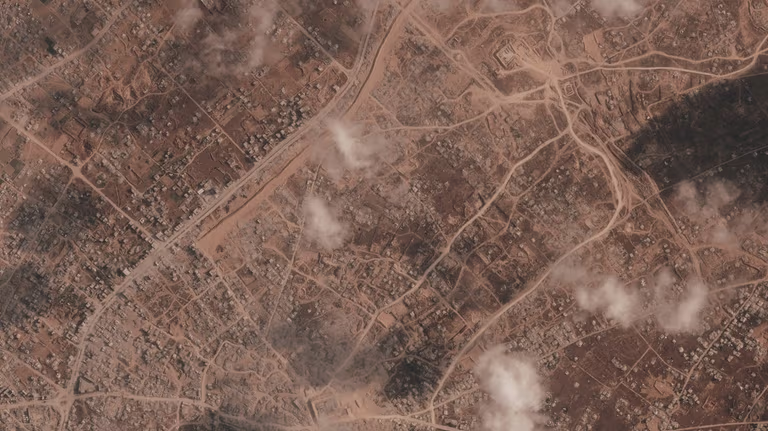
Satellite images show that large parts of Gaza, including the southern city of Rafah, have been reduced to rubble as Israeli military demolitions continue even after the Israel-Hamas ceasefire agreement. The destruction has deepened displacement, complicated humanitarian recovery and left large areas of the territory with little prospect of near-term reconstruction.
Rafah, once home to around a quarter of a million people, has been among the areas most extensively destroyed. Imagery reviewed from Planet Labs PBC shows that demolition has continued in areas under Israeli military control, with buildings bulldozed or destroyed and new military positions appearing among the ruins.
The developments have added another layer to the humanitarian crisis facing Gaza’s roughly two million Palestinians after years of conflict, displacement and Infrastructure damage.
Satellite Images Reveal Continuing Destruction in Gaza
The satellite imagery provides a view of the scale of physical destruction across parts of Gaza that is difficult to capture from individual ground-level scenes.
In areas held by Israeli forces, many buildings have been demolished or reduced to rubble. Dirt tracks now run through places where residential streets once connected neighbourhoods, while military outposts have appeared on land that previously contained homes and civilian infrastructure.
According to the imagery, at least 50 Israeli military outposts can be identified across the Israeli-held portion of Gaza. At least 18 of those positions were built after the ceasefire began.
Many of the outposts appear to stand in or near areas where residential buildings have been cleared away. The imagery also shows continued demolition in parts of Rafah where only a limited number of structures remained standing after the earlier military campaign.
The Israeli military says buildings are demolished to prevent Hamas militants from using them or to destroy tunnel networks and other military infrastructure.
The scale and nature of the destruction, however, have generated intense scrutiny from international observers and rights experts, particularly where civilian neighbourhoods and essential infrastructure have been affected.
Rafah Has Been Almost Entirely Destroyed
Rafah became one of the most important population centres in Gaza during the war after large numbers of Palestinians fled there from other parts of the territory.
The city had been home to around 250,000 people before the conflict, but its population grew dramatically during periods of mass displacement.
Much of Rafah was already destroyed before the ceasefire. New satellite imagery indicates that demolition has continued, with remaining structures being cleared and military positions appearing across parts of the devastated city.
Several abandoned United Nations buildings remain visible in the area, while a municipal sports field appears to have been converted into a military position.
The destruction of Rafah has particularly serious consequences because the city had served as a destination for Palestinians displaced from other parts of Gaza. The loss of housing and public infrastructure leaves many families with few options beyond temporary shelters.
Gaza’s Population Is Concentrated Into a Smaller Area
The destruction has also changed the geography of civilian life across Gaza.
According to the supplied satellite analysis, Gaza’s population is now concentrated in roughly 40% of the territory, while Israel controls the remainder.
For civilians, this concentration means that enormous numbers of people are living in increasingly limited areas while much of the surrounding territory remains inaccessible or heavily damaged.
With almost the entire population displaced at some point during the conflict, sprawling tent settlements have replaced homes for many families.
The destruction of housing has created a problem that extends well beyond the immediate need for shelter. Rebuilding homes requires construction materials, functioning utilities, roads, medical facilities, schools and other infrastructure that have also been damaged or destroyed.
Demolitions Continue After the Ceasefire
The ceasefire halted the most intense phases of the fighting and heavy bombardment, but it has not ended all military activity.
Israeli strikes on tents, vehicles and buildings have continued, according to the supplied report. Israel says such strikes are directed at Hamas members and military targets.
Palestinian civilians, including women, children and relatives of suspected militants, have also been reported among those killed in attacks.
The continuing violence means that many families cannot treat the ceasefire as the beginning of a normal recovery period.
Instead, residents remain exposed to insecurity while attempting to survive in damaged neighbourhoods or temporary camps.
Reconstruction Has Barely Begun
The physical destruction has been accompanied by a severe reconstruction challenge.
Most people in Gaza remain displaced, while the availability of jobs and basic economic opportunities has collapsed. Construction materials are also heavily restricted, making it difficult to rebuild homes and public facilities at the scale required.
A broader reconstruction plan has stalled amid disagreements between Israel and Hamas over the future of the territory and the disarmament of Hamas.
As a result, the gap between the end of major fighting and the beginning of large-scale rebuilding remains substantial.
For families living beside destroyed homes, that delay is not an abstract political issue. It determines whether they can return to permanent housing, restore livelihoods and rebuild communities that have been repeatedly displaced.
Jabaliya Faces Extensive Destruction in Northern Gaza
The destruction is not limited to Rafah.
Recent satellite images from northern Gaza show extensive damage in Jabaliya, an area that was once home to Gaza’s largest refugee camp.
The camp had around 120,000 refugees as well as tens of thousands of other residents. Large sections have now been heavily destroyed.
The al-Awda Hospital Complex has been largely reduced to rubble, according to the satellite imagery, while several United Nations-run school buildings have also been destroyed.
One of the few major structures still standing is the octagonal Indonesian Hospital. The hospital has been empty since Israeli troops shut it down in June 2025.
A new Israeli military base has also been built nearby, further changing the physical landscape of the area.
The destruction of hospitals and schools has consequences beyond the loss of buildings. These facilities are part of the infrastructure required for communities to recover, provide education and deliver Healthcare after the fighting ends.
Beit Hanoun and Shijaiya Also Reduced to Rubble
Other parts of Gaza have suffered similar levels of destruction.
Beit Hanoun, which was once home to approximately 70,000 people, has been left with long stretches of flattened residential areas.
In Gaza City, the historic neighbourhood of Shijaiya has also suffered extensive destruction.
The neighbourhood was founded around 800 years ago and had developed into one of Gaza City’s established residential areas. Large sections now consist of destroyed homes and apartment buildings.
For residents WHO survived the fighting, the destruction creates a difficult question: even if they are permitted to return, what remains of the neighbourhoods they once knew?
Families Continue Living Beside the Ruins
The humanitarian consequences of the destruction can be seen in the lives of individual families.
Najwa Abu Eita lost her seven-year-old daughter when Israeli forces struck her home in the Nuseirat refugee camp in September 2024. Her three other children were injured, while Abu Eita lost an eye and suffered severe facial injuries and breathing difficulties.
Before the war, Abu Eita worked as a hairdresser. She now lives in a tent beside the ruins of her home without regular employment.
Her four-year-old son has told her that he would give her one of his eyes, an expression of the trauma and emotional distress affecting families that have experienced devastating losses.
Her situation illustrates how the consequences of the war extend beyond destroyed buildings. Families have lost relatives, homes, jobs, medical access and the basic conditions needed to rebuild ordinary lives.
Gaza’s Economy Has Been Shattered
The destruction of homes and infrastructure has been accompanied by a collapse in economic activity.
A greater flow of humanitarian aid and commercial goods has helped pull Gaza back from famine conditions that emerged in some areas during a prolonged period when Israel restricted food and other supplies.
Even with improved flows of assistance, most people remain dependent on international relief.
Employment opportunities are scarce, leaving many people dependent on informal economic activity, including selling whatever goods can be obtained in local markets.
The loss of businesses, workshops, farms and other economic infrastructure means that rebuilding the economy will require more than repairing physical structures. It will also require restoring employment and the ability of people to earn stable incomes.
Amputees Struggle to Rebuild Their Lives
The war has also left thousands of people with life-changing injuries.
Shadi Barawi lost his father early in the conflict. Soon afterward, shrapnel from a strike near his home in Gaza City struck him and resulted in the amputation of his leg.
Barawi is among an estimated 6,000 amputees left by the war, according to the supplied report.
Before the conflict, he worked as a barber. Now he has returned to cutting hair from the tent where he lives, balancing on crutches because he does not have a prosthetic limb.
He remains responsible for supporting his family of six as well as five sisters.
His experience reflects the wider difficulty faced by injured Palestinians who must try to work and support their families while living without adequate medical equipment, mobility aids or stable workplaces.
Thousands of Bodies Remain Under the Rubble
Even after the ceasefire, another painful task has continued: recovering the remains of people believed to be buried beneath collapsed buildings.
Gaza authorities have been moving from one destroyed site to another in an effort to locate bodies and return them to their families.
In one recent search, a team reached the former home of Haneen al-Khodari in Gaza City.
When the building was struck in December 2023, al-Khodari was thrown into a nearby tree. She later spent weeks in hospital and was told that her parents, siblings and many cousins had been killed.
The remains of 17 relatives had reportedly remained trapped beneath the wreckage for years.
After eight hours of digging, the search team recovered the remains of a small child and two bones before abandoning the effort.
The discovery provided only a fragment of what the family had been waiting to recover.
For families like al-Khodari’s, the destruction of Gaza is therefore not only visible in ruined buildings. The rubble also contains the remains of people whose relatives are still waiting for the chance to bury them.
International Scrutiny Over the Scale of Destruction
The scale of the destruction has prompted severe criticism from international experts.
A UN-appointed expert said in a February report that the destruction of civilian housing and infrastructure in Gaza was unprecedented even by the standards of modern warfare since the 20th century.
The report raised the possibility that the destruction could amount to crimes against humanity or genocide under international law, including through the deliberate imposition of conditions of life calculated to bring about physical destruction.
Israel rejects accusations of genocide and maintains that its military operations target Hamas militants and military infrastructure embedded in civilian areas.
The competing positions have made the extent and legality of the destruction a major subject of international scrutiny.
The satellite imagery adds an important visual dimension to that debate by showing how entire neighbourhoods have changed over time and how demolition has continued in some areas even after the most intense fighting subsided.
Military Outposts Change the Landscape
The emergence of Israeli military outposts across parts of Gaza has become another significant feature visible in the satellite imagery.
At least 50 outposts were identified in the Israeli-held area, including positions constructed after the ceasefire began.
Some appear to have been established in locations where neighbourhoods once stood. In Beni Suhaila, a new base has been built around what was previously a major intersection.
The surrounding area has been levelled, while dirt tracks now cross the landscape where established roads once existed.
For Palestinians, the presence of military infrastructure alongside destroyed homes raises questions about the future control and accessibility of these areas.
For Israel, the military says such positions and demolitions are connected to Security objectives, including preventing Hamas from operating from buildings and destroying tunnel networks.
Gaza Faces a Long Road to Reconstruction
The satellite images offer a stark picture of what reconstruction would require if large-scale rebuilding is eventually able to begin.
Entire residential districts have been destroyed. Hospitals and schools have been damaged or demolished, roads have disappeared beneath rubble and military positions have altered the landscape.
At the same time, a large proportion of Gaza’s population remains displaced and dependent on humanitarian assistance.
Reconstruction would therefore involve far more than replacing individual homes. It would require the restoration of water systems, electricity, healthcare, education, transportation, sanitation, housing and economic activity.
The continued restrictions on construction materials and the unresolved political dispute over Hamas’s disarmament have further delayed that process.
Ceasefire Has Not Ended Gaza’s Humanitarian Crisis
The ceasefire has reduced the scale of major fighting, but the satellite imagery and conditions on the ground show that the consequences of the war remain deeply embedded in Gaza’s landscape.
Rafah has been almost entirely transformed. Jabaliya, Beit Hanoun and Shijaiya have suffered extensive destruction. Military outposts now occupy parts of territory that once contained homes and public facilities.
Meanwhile, families continue to live in tents, injured survivors struggle without adequate equipment, workers attempt to rebuild livelihoods under extraordinary conditions and relatives search for the remains of loved ones beneath collapsed buildings.
The destruction has therefore not ended with the reduction in major combat. It has become a continuing humanitarian and reconstruction crisis.
For Gaza’s population, the central challenge is no longer simply surviving bombardment. It is finding a path from displacement and devastation toward permanent housing, functioning communities and economic recovery while the political and security disputes surrounding the territory remain unresolved.
For breaking news and live news updates, like us on Facebook or follow us on Twitter and Instagram. Read more on Latest World on thefoxdaily.com.





COMMENTS 0