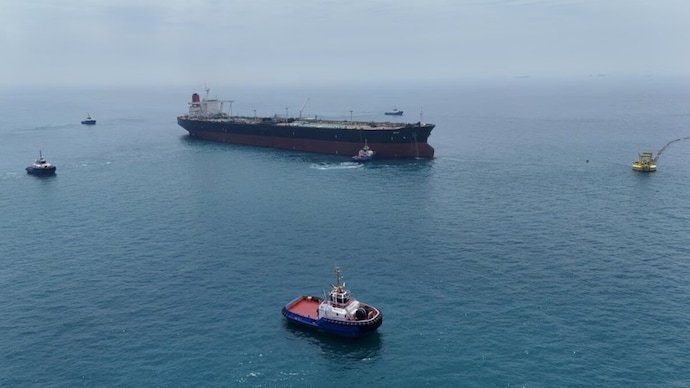
The United States military says it struck three Iranian Oil Tankers on Saturday, September 5, hours after Iran‘s Islamic Revolutionary Guard Corps launched ballistic missiles toward two US Navy warships. The latest exchange marks another sharp escalation in the confrontation between Washington and Tehran, with the battle now stretching beyond military bases into Iran’s oil-shipping network.
US Central Command said the American vessels successfully evaded the Iranian missile attacks and that no US personnel were injured. In response, American forces targeted three crude oil carriers associated with Iran, disabling two and completely destroying another, according to the US military.
The operation adds a significant economic dimension to the military conflict. Rather than limiting retaliation to missile sites, air-defence systems or radar installations, the United States has now directly targeted maritime assets tied to Iranian oil exports.
The move comes as the Strait of Hormuz remains at the centre of the confrontation. The narrow waterway is one of the world’s most important energy corridors, and growing military activity around it has already reduced commercial shipping while increasing fears of higher oil prices and wider disruption to global trade.
What the US says happened
According to US Central Command, the immediate trigger for the latest operation was an Iranian missile attack on two US Navy ships operating in regional waters.
CENTCOM said Iran’s Revolutionary Guard launched ballistic missiles toward the vessels, but the attacks failed to inflict damage. The US military said an American aircraft carrier and a guided-missile destroyer were able to evade the incoming missiles.
No US personnel were reported injured.
Hours later, American forces carried out strikes against three Iranian oil carriers. CENTCOM presented the action as a deliberate response intended to impose a greater economic cost on Iran following the attack on US forces.
The sequence is important because it signals a potentially broader US strategy: attacks on American military assets could trigger retaliation against the economic infrastructure that helps finance Iran’s military activities.
Three tankers were targeted
CENTCOM identified the three vessels as M/T Downy, M/T Stark 1 and M/T Kylo, with the latter also referred to as the “Noxen.”
The Downy was reported targeted off the coast of Kharg Island, while the Stark 1 was struck near Jask. The US military said both vessels were permanently disabled.
The third ship, M/T Kylo, was an unladen crude oil carrier operating in the Gulf of Oman. CENTCOM said the crew was directed to abandon the vessel before American forces struck it in multiple critical locations, rendering it completely inoperable.
The Pentagon’s public description is significant because it portrays the operation as a coordinated effort against Iran’s maritime oil network rather than an isolated attack on a single ship.
CENTCOM also said the vessels were part of what it described as a multibillion-dollar shadow network that funds the IRGC and its regional proxies. That claim comes from the US military and has not independently established every detail of the alleged network.
Brad Cooper sends warning to Iran
CENTCOM commander Admiral Brad Cooper issued a direct warning after the strikes.
He said Iran would face a higher economic cost if it attacked US ships and indicated that American forces were prepared to continue targeting Iran’s exposed oil fleet if necessary.
The language reflects a strategy built around deterrence. Washington is seeking to convince Tehran that missile attacks on US forces will not produce only defensive interception or limited retaliation. Instead, such attacks could lead to pressure on one of Iran’s most important sources of revenue.
That approach carries its own risks, however. If Tehran responds to tanker strikes with attacks on additional US vessels or commercial shipping, the confrontation could quickly move into an escalating cycle of retaliation.
Why targeting oil tankers is different
Striking an oil tanker is fundamentally different from hitting a radar installation or a missile battery.
Oil carriers are tied directly to international trade and energy markets. Even when a vessel is operating for a state involved in a conflict, an attack on commercial-style shipping can have consequences that extend beyond the two governments involved.
For Iran, oil exports are a critical component of the economy. Disrupting ships involved in crude transportation can therefore reduce revenue and raise the logistical costs of moving oil.
For the international market, repeated attacks create another problem: uncertainty. Shipowners, insurers and energy companies must consider not only whether ports remain open, but whether individual ships can safely travel near Iranian waters.
That uncertainty alone can reduce traffic, increase freight rates and push up the price of moving energy around the world.
Kharg Island is a key Iranian oil hub
The location of one of the strikes is particularly important. Kharg Island is a major Iranian oil-export hub and a strategically sensitive part of the country’s energy infrastructure.
Any military activity near the island is therefore closely watched by oil traders and shipping companies. Even limited attacks can raise concerns about whether broader operations could eventually affect loading facilities, storage systems or export routes.
The reported strike on a tanker off Kharg does not by itself mean that Iran’s oil-export infrastructure has been disabled. But it demonstrates that maritime assets operating around one of the country’s main oil centres are now exposed to direct military action.
That raises the stakes for any vessel seeking to move Iranian crude through the Gulf.
The Strait of Hormuz is at the heart of the crisis
The latest attack comes against the backdrop of growing tension around the Strait of Hormuz, the narrow passage connecting the Persian Gulf with the Gulf of Oman.
Under normal conditions, roughly one-fifth of the world’s oil supply moves through the waterway, making it essential to global Energy Security.
That dependence gives both Iran and the United States enormous strategic reasons to control developments around the strait.
For Tehran, the waterway offers geographical leverage. For Washington, keeping the passage open is closely tied to the security of global shipping and the interests of major energy-importing countries.
The result is a high-risk environment in which even a relatively small maritime incident can have economic consequences far beyond the immediate battlefield.
Commercial traffic has already fallen
The security situation has already affected the movement of commercial vessels. Ship operators have become more cautious as attacks, threats and naval activity have increased the risks associated with entering or leaving the Gulf.
A shipping route does not need to be formally closed to become economically dysfunctional. If insurance premiums rise sharply, crews face greater danger and vessels require naval escorts or lengthy detours, operators may decide to postpone voyages altogether.
That has already contributed to a significant reduction in traffic through the strait compared with normal conditions.
The consequences can spread quickly because oil tankers operate on tightly connected schedules. Delays at one point in the supply chain can affect refining plans, storage levels and deliveries in distant markets.
US operations around Hormuz have expanded
The tanker strikes are the latest part of a much broader series of US military operations against Iranian capabilities along the southern coast.
American forces have previously targeted Iranian air-defence systems, radar installations, maritime assets, communications facilities and mine-laying capabilities, according to CENTCOM.
US forces also struck Iranian military positions on Larak Island, with Washington saying the targets were linked to preparations to deploy sea mines and interfere with maritime traffic.
The mine-laying issue is particularly significant because sea mines can threaten commercial vessels for an extended period. Even after active combat stops, naval authorities may need substantial time and resources to locate and remove mines before shipping can safely return.
That creates a risk that maritime disruption could last longer than the immediate military exchanges.
Iran’s missile and drone attacks have widened the conflict
Iran has responded to US operations with missile and drone attacks against American and US-linked targets around the region.
The latest ballistic missile launches toward US Navy ships suggest that Tehran is willing to challenge American naval operations directly rather than relying solely on attacks against fixed bases.
That development increases the pressure on US naval forces operating in and around the Gulf. It also creates the possibility that future attacks could involve commercial ships caught near military operations.
Every additional incident increases the chance of miscalculation. A missile intended for a military target could strike a commercial vessel, while an armed response to a suspected threat could accidentally hit a civilian ship.
The closer military and commercial traffic operate to one another, the more difficult it becomes to contain such incidents.
Iran has threatened restrictions on Hormuz
Tehran has repeatedly warned that it could use the Strait of Hormuz as leverage if its oil exports are obstructed.
The threat does not necessarily mean Iran intends to impose a complete blockade. Even partial restrictions, heightened inspections, attacks on selected vessels or the threat of mining shipping lanes could be enough to discourage commercial traffic.
From Iran’s perspective, the strait is one of the few places where its geographic position gives it significant leverage over international energy flows.
But exercising that leverage would also carry serious costs for Iran because the country itself relies heavily on the same maritime network for trade and energy-related activity.
Reports of tanker attacks add to shipping fears
The latest US strikes came after reports of other incidents involving commercial vessels in and around the Strait of Hormuz.
Two large tankers were reportedly attacked while leaving the waterway, while another oil tanker was reported struck near Kharg Island. Iranian authorities had not immediately confirmed every reported incident.
For shipping companies, the accumulation of incidents matters as much as any individual attack. A single event can be treated as an isolated risk. Several incidents within a short period can indicate a pattern that changes how insurers and shipowners assess the route.
That is why the shipping industry is closely watching the confrontation even when individual attacks do not immediately interrupt global oil supplies.
Oil prices are becoming another battlefield
The conflict has already affected global energy markets. Brent crude has risen as traders assess the risk that fighting could reduce the volume of oil reaching international customers.
The market impact can occur in stages.
First comes the immediate loss or delay of specific cargoes. Then shipping costs rise as insurers and vessel operators demand compensation for increased risk. Finally, traders begin pricing in the possibility of a longer disruption, pushing benchmark crude prices higher.
A sustained disruption through Hormuz would be especially significant because so much Middle Eastern oil moves through the corridor under normal conditions.
Higher crude prices would affect not only fuel at petrol stations but also transportation, aviation, manufacturing, chemicals and other energy-intensive industries.
Asia faces particular exposure
The economic consequences would be especially important for major Asian importers because many depend heavily on Gulf crude and natural gas.
Countries such as India, china, Japan and South Korea have extensive energy relationships with Middle Eastern producers. Even when alternative crude supplies are available, replacing Gulf shipments can take time and often costs more.
A prolonged reduction in Hormuz traffic could therefore increase competition for supplies from producers outside the region.
India would have to monitor the situation closely because higher international crude prices can increase the cost of imports and place pressure on inflation, trade balances and fuel markets.
The tanker strikes could change Iran’s calculations
Washington’s decision to target oil carriers creates a new strategic dilemma for Tehran.
If Iran responds by attacking additional US naval assets, it risks inviting more strikes against its oil infrastructure or maritime fleet. But avoiding a response after losing economically valuable vessels could also be perceived domestically as weakness.
This is one reason the current situation is so difficult to de-escalate. Each side has incentives to demonstrate resolve while trying to avoid a conflict that becomes impossible to control.
The United States wants to protect its forces and maintain freedom of navigation. Iran wants to preserve its military capacity and prevent its economic lifelines from being severed.
Those objectives are increasingly colliding on the same stretch of water.
What happens if the US keeps targeting Iranian oil shipping?
Continued attacks on Iranian tankers could place significant pressure on Tehran’s ability to move crude and generate foreign revenue.
But the consequences would not necessarily be limited to Iran.
Insurance costs could rise across the Gulf, even for ships not carrying Iranian oil. Some operators could avoid the region altogether. Other vessels might demand naval escorts or wait offshore until the security situation improves.
That would make an already strained global energy supply chain more expensive and less predictable.
The United States could also face pressure from allies concerned about the effect of maritime escalation on global oil prices.
For that reason, the success of the strategy will depend not only on whether the US can disable Iranian ships but also on whether it can prevent the conflict from triggering a much larger commercial shipping crisis.
The legal and humanitarian questions around tanker attacks
As attacks expand into maritime territory, another set of questions becomes increasingly important: which vessels are considered legitimate military targets, what evidence is used to link them to military financing and what protections apply to civilian crews?
CENTCOM has described the targeted ships as part of an Iranian oil network connected to the IRGC. The US military also said the crew of the Kylo was directed to abandon the vessel before it was struck.
Nevertheless, attacks involving commercial-style vessels can create difficult issues under the laws governing armed conflict and freedom of navigation.
The longer the conflict continues, the more closely international governments and maritime organisations are likely to scrutinise the circumstances of each strike.
Trump warns of a stronger response
US President Donald Trump has repeatedly warned Iran that attacks against American forces or retaliation against US operations would bring a stronger response.
Tehran, meanwhile, has continued to describe the US campaign as aggression and has vowed to respond.
The opposing public positions leave little room for either side to back down without appearing to surrender its strategic objectives.
That increases the importance of the next few maritime incidents. A direct hit on a US warship, a major commercial tanker casualty or a serious attempt to block Hormuz could trigger a far larger round of attacks.
Why the next battle may be over shipping lanes
The immediate military focus is likely to remain around the Strait of Hormuz, where US naval forces are attempting to protect maritime activity while Iran seeks to retain leverage over the waterway.
The conflict has now moved beyond traditional battlefield targets. Oil tankers, maritime infrastructure and commercial shipping have become part of the strategic equation.
That is dangerous because the consequences of an attack are no longer limited to soldiers and military facilities. A damaged tanker can affect civilian crews, environmental safety, insurance markets and energy prices simultaneously.
A major disruption to navigation could therefore create a chain reaction that reaches international markets within hours.
US-Iran conflict reaches a new maritime phase
The reported destruction of three Iranian oil tankers after missile attacks on two US Navy ships represents a major escalation in the confrontation between Washington and Tehran.
The United States says the attacks on its vessels failed and that no American personnel were harmed. Washington then responded by striking three Iranian crude carriers, framing the operation as both a military response and an economic warning to Iran.
For Tehran, the loss of oil-shipping capacity could become a direct threat to an important source of national revenue. For the United States, the operation demonstrates that Iranian attacks on American forces can be met with pressure on Iran’s wider economic infrastructure.
But the greatest concern extends beyond the two countries.
The Strait of Hormuz remains the critical pressure point, and any further deterioration there could affect oil prices, shipping costs and global energy security. If more vessels are attacked or navigation becomes increasingly restricted, the economic consequences could rapidly outgrow the original military confrontation.
The latest strikes therefore mark more than another exchange between US and Iranian forces. They show that the conflict is increasingly being fought across the maritime and economic fronts, with the safety of one of the world’s most important energy corridors now tied directly to the next moves made by Washington and Tehran.
For breaking news and live news updates, like us on Facebook or follow us on Twitter and Instagram. Read more on Latest World on thefoxdaily.com.





COMMENTS 0